Discovery & architecture
Feature taxonomy (feed, Radar, chat, economy), privacy data-flow mapping, GDPR + CCPA posture, platform-capability audit (CoreLocation vs Android ForegroundService), API schema design.

Case study · Social Media · Consumer Tech
How we shipped a production social platform — App Store and Google Play, live across the US, the EU, and beyond — combining an interest-curated content feed, a geo-proximity Radar for people discovery, encrypted messaging, and a full virtual economy of coins, gifts, and premium subscriptions.
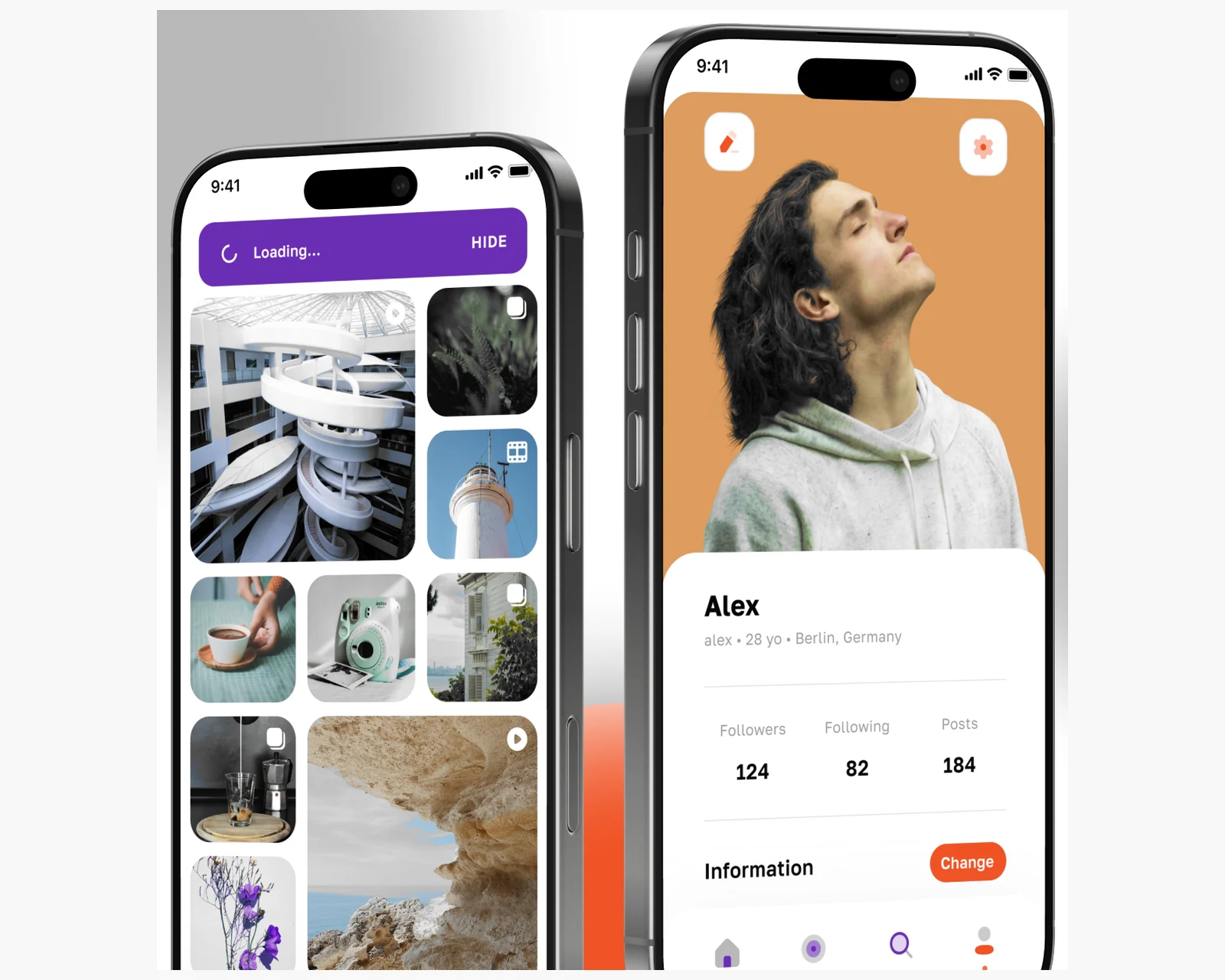
The JoyJet product team wanted a social platform that went further than a photo-video feed. The core insight was that discovery — finding interesting people, not just content — was underserved by existing social apps. Off-the-shelf social SDKs and white-label community platforms offered feeds and messaging but had no framework for real-time geo-proximity matching, and none of them supported a layered virtual economy that could reward both creators and engaged community members. We built JoyJet from first principles as a native iOS and Android application: a content platform with an interest-curated feed, a Radar that surfaces nearby people matching your interests, fast encrypted messaging, Stories, and a JJPremium subscription tier backed by a coin-and-gifts marketplace. The result is a social product that ships to App Store and Google Play, available in English, Russian, Spanish, and Traditional Chinese for audiences across the United States, the European Union, and beyond.
A snapshot of what the JoyJet build delivered across iOS and Android in its first production cycle.
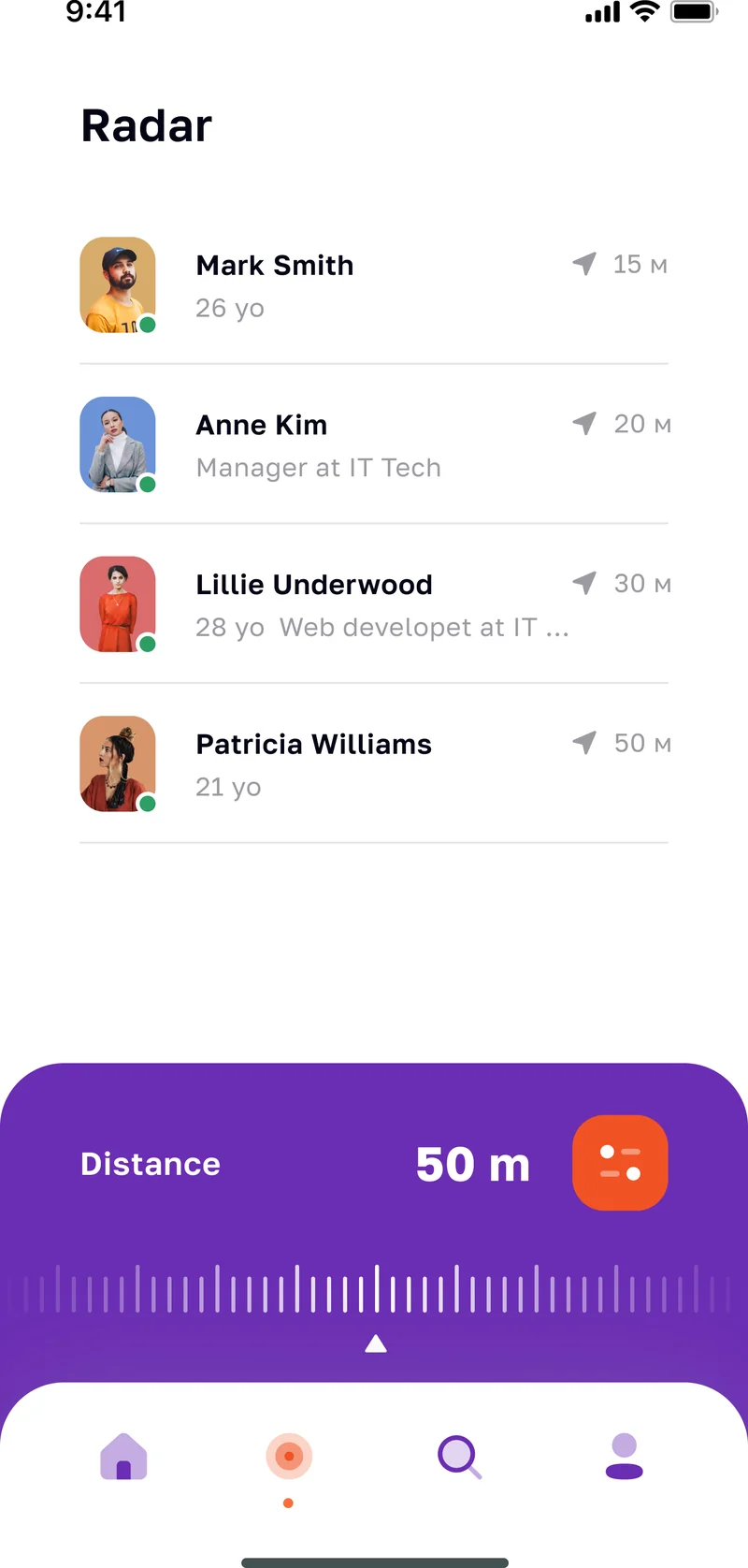
No off-the-shelf social platform — Sharetribe, Circle, Mighty Networks, or community-white-labels — combines an interest-based content feed, real-time geo-proximity radar, WebSocket messaging, and a virtual coin economy in a single native mobile package. Existing SDKs lock teams into fixed schemas and UI templates, which makes the Radar's continuous background location matching technically impossible within their permission and lifecycle models. Building on top of a social SDK for JoyJet would have meant forking it substantially — at which point the SDK provides no leverage and all its assumptions become liabilities. We chose a greenfield native build on Swift / SwiftUI for iOS and Kotlin / Jetpack Compose for Android so that every feature — Radar, feed ranking, coins, push — is owned end-to-end with no vendor constraints.
The feed algorithm in particular required a custom scoring model: content is ranked by a combination of interest-tag overlap, account affinity, recency decay, and JJLike signal weight. That scoring logic runs server-side in a Node.js service backed by Redis sorted sets for hot-content caching, with PostgreSQL as the source of truth for interest tags and engagement history. A white-label solution's fixed algorithm would have made interest customization — the product's core differentiator against Instagram and TikTok — impossible without rewriting the vendor's inference engine.
| Dimension | Custom native (JoyJet) | React Native / Flutter | White-label social SDK |
|---|---|---|---|
| Geo-proximity Radar precision | Native CoreLocation + Foreground Service — full precision | JS bridge adds latency; background scan limited | Not available |
| Feed ranking algorithm | Fully custom — interest tags, affinity, recency, JJLike signal | Custom backend possible; UI layer is cross-platform | Fixed vendor algorithm — not configurable |
| Real-time messaging | Native WebSocket + BGAppRefresh — <100ms delivery | Acceptable; depends on native module quality | SDK-bundled, limited customization |
| Virtual economy (coins, gifts) | Fully custom state machine + StoreKit / Play Billing | Custom backend required regardless | Not supported |
| App Store compliance control | Direct — own every permission prompt and label | Partial — wrapper may trigger additional scrutiny | Vendor-controlled — review delays propagate |
| Background processing | Native BGAppRefreshTask / ForegroundService — reliable | Limited by JS runtime suspension | Varies by SDK |
| Long-term ownership cost | Higher initial build; zero SDK licensing or lock-in | Lower initial; shared-codebase maintenance | Low initial; high ongoing licensing and constraint cost |
Platform references: Apple CoreLocation, Android Foreground Services, Apple BackgroundTasks framework.
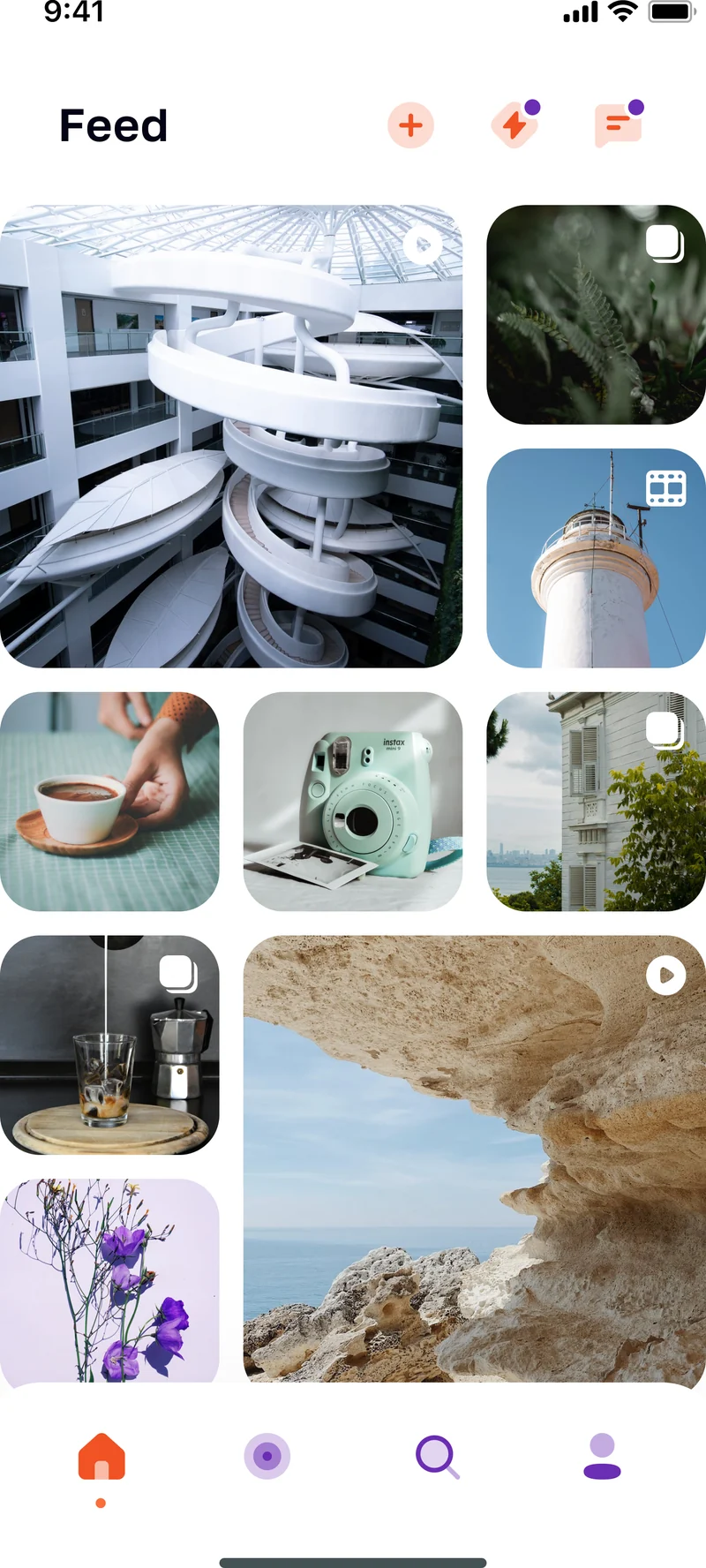
The iOS client is built entirely in Swift with SwiftUI for the UI layer and UIKit for performance-critical surfaces — specifically the infinite-scroll video feed, where AVPlayer pre-roll and cell reuse timing require direct control that SwiftUI's lazy stacks do not yet provide reliably at scale. The content feed fetches paginated ranked batches server-side, caches the active viewport in memory, and prefetches the next batch when the user is within three cells of the bottom. Interest tags chosen in onboarding seed the initial ranking model; JJLike and share signals refine it continuously without requiring an explicit re-setup flow.
The Radar feature runs on CoreLocation with a Significant Location Change monitor for background updates — a power-efficient alternative to continuous GPS polling that still keeps the nearby-user list fresh as the device moves. User coordinates are quantized to a coarse grid on the device before transmission, so the server never receives raw GPS positions: it receives cell identifiers. Matching runs server-side against other active cell identifiers, with interest overlap as the secondary sort. Profiles returned by Radar show name, interests, and distance band ("within 500 m / 1 km / 5 km") — never exact coordinates. The same iOS client handles mobile app development across the full feature surface: feed, Radar, chat thread list, profile editing, onboarding, and JJPremium subscription flow.
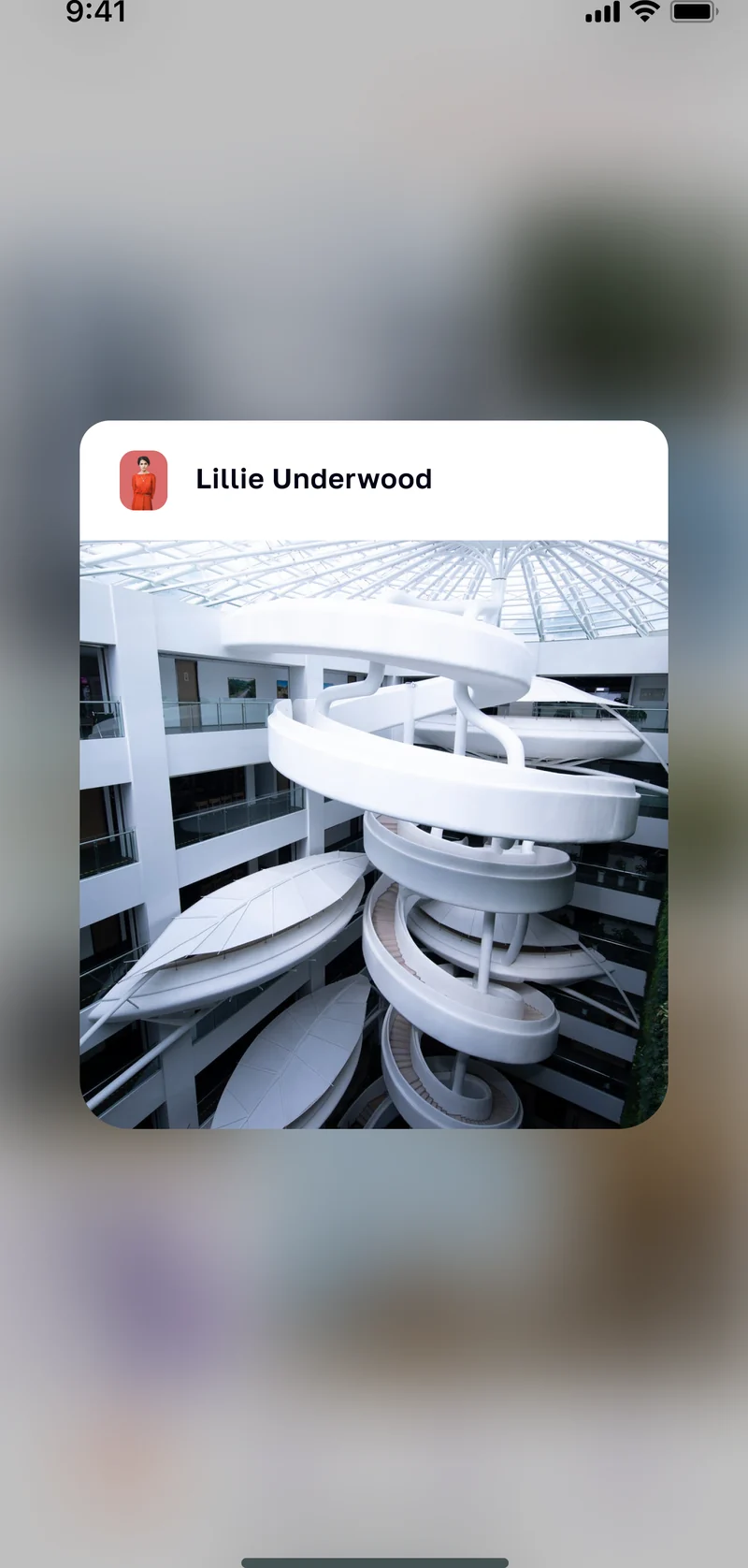
The Android client is written in Kotlin with Jetpack Compose for the UI and a foreground service for persistent messaging and Radar background sync. The foreground service is mandatory: on Samsung, Xiaomi, OnePlus, and Pixel device families, aggressive battery optimizers kill background-only services within minutes. The foreground service displays a minimal notification that keeps the process alive across Doze mode cycles, and the Radar sync piggybacks on the same process window to avoid waking the device twice. WorkManager handles non-urgent operations — cache cleanup, telemetry flush, push token refresh — with backoff semantics that respect battery saver states across Android 10 through Android 14.
Messaging is built on WebSocket with automatic reconnect. On Android, reconnect logic runs inside the foreground service, so a brief loss of connectivity (carrier handoff between Wi-Fi and LTE, common across urban US and EU deployments) recovers in under two seconds without user action. Message ordering uses server-assigned monotonic sequence IDs rather than client timestamps — a common source of ordering bugs in distributed chat that we eliminated at the architecture stage. The same Android codebase serves all iOS and Android engineering feature parity: feed, Radar, Stories, JJPremium, market, JJFans statistics, and the multi-screen onboarding flow.

JoyJet's stated privacy posture — no persistent user data collection — informed the architecture from the first sprint. Location data is quantized on-device before leaving the phone (coarse grid cells, not GPS coordinates), so the server never sees a user's precise position. Session tokens are short-lived and rotated on every app foreground; the Radar matching service works only with the coarse-grid cells present in the current session and does not build a location history. Chat messages are stored server-side for history sync but are identified by session-scoped message IDs; the schema was designed from day one to allow ephemeral-mode conversations where history is discarded at session end, without a retroactive migration.
Push notifications for messages use APNs (iOS) and FCM (Android) with notification-only payloads: the notification body is constructed on the client after decrypting the payload from the messaging service, so the notification vendor never sees message content. The developer's App Store privacy declaration of zero data collection reflects this architecture: no analytics SDK, no crash reporter with PII, no ad network, and no third-party data broker integrations were included in the build. This posture is compatible with both GDPR requirements in the European Union and CCPA / CPRA requirements in California and other US states.
Compliance posture: GDPR-aligned · ISO 27001 ready · SOC 2 Type II in progress · HIPAA-capable · CCPA-acknowledged.
A five-phase build that took JoyJet from product specification to production across iOS, Android, and a real-time backend.
Feature taxonomy (feed, Radar, chat, economy), privacy data-flow mapping, GDPR + CCPA posture, platform-capability audit (CoreLocation vs Android ForegroundService), API schema design.
Swift / SwiftUI iOS client and Kotlin / Jetpack Compose Android client: onboarding, interest selection, content feed with ranking, user profiles, basic messaging over WebSocket.
CoreLocation + Foreground Service geo-proximity engine, coarse-grid quantization, interest-overlap matching service, always-on foreground messaging, Stories, push notifications via APNs + FCM.
JJPremium subscription via Apple StoreKit + Google Play Billing, virtual coins purchase flows, gifts marketplace, JJFans creator payouts, content moderation tooling, admin dashboard.
App Store + Google Play submission across US and EU storefronts, multi-language QA (EN / RU / ES / ZH-TW), crash-free-session monitoring, on-call rotation, feed-ranking A/B framework.
JoyJet's monetization model goes beyond a simple subscription. JJPremium unlocks advanced feed filters, Radar extended-range discovery, higher-resolution media uploads, and priority ranking in the Radar results of others. In-app billing routes through Apple StoreKit on iOS and Google Play Billing on Android, with server-side receipt validation against both stores' verification endpoints and a single entitlement record per user that resolves the subscription state across devices and reinstalls. Beyond the subscription, a virtual coin economy lets users purchase coins via in-app purchase and spend them on virtual gifts sent in chat — a social signal layer that drives engagement without relying on advertising. The gifts marketplace is implemented as a catalog backed by PostgreSQL with Redis cache for the hot-item list, and the gift-send flow is a two-phase commit: coin deduction and gift delivery are atomic, so a dropped WebSocket connection cannot result in a double-charge or a lost gift. JJFans — a creator-economy layer — lets users earn coins from engaged followers, with a payout system designed to support future fiat withdrawal via payment processor integration. The entire economy was built from scratch with extensibility in mind: adding new coin SKUs, gift types, or premium tiers requires a configuration change, not a code release.
JoyJet launched on Apple App Store and Google Play with storefronts active across the United States, the European Union, and the United Kingdom. The multi-language build — English, Russian, Spanish, and Traditional Chinese — means the app serves users in California, New York, Texas, and Florida in the US, and users in Germany, France, the Netherlands, Ireland, and Sweden in the EU, without a separate codebase per region. Privacy consent flows are region-aware: users in the EU and EEA receive a GDPR-style granular consent screen with separate toggles for analytics and personalization; users in California receive a CCPA-style "Do Not Sell or Share My Personal Information" disclosure. Data-handling practices are aligned with GDPR for European users and with the US state-privacy patchwork — CCPA/CPRA (California), VCDPA (Virginia), CPA (Colorado), CTDPA (Connecticut), UCPA (Utah), TDPSA (Texas), and Oregon CPA.
The backend separates EU and US user data into distinct database partitions with separate encryption key hierarchies, enabling a future data-residency commitment without a schema migration. The Radar matching service runs stateless workers that can be pinned to EU or US regions independently. Both the App Store age rating (4+) and the Google Play content rating were calibrated for the social feature set, and in-app reporting and blocking flows — required by both platforms for user-generated-content apps — were built and reviewed as first-class features rather than afterthoughts. EU data-protection compliance and California CCPA obligations are documented in the in-app privacy policy and the server-side data-processing agreement template provided to the client for their DPA with EU sub-processors.
The active custom software development roadmap for JoyJet includes a video-call layer for chat threads (WebRTC), a dislikes and content-sentiment signal for feed ranking refinement, geo-tag support for posts, a business-post format for commercial accounts, and a live-broadcast feature (JJBroadcast). The premium tier is planned to expand with a post-promotion tool and a richer creator analytics dashboard that surfaces follower-growth, engagement rates, and gift revenue by cohort. Infrastructure plans include moving the Radar matching service to a dedicated microservice with sub-50ms SLO and migrating media storage to a multi-region CDN topology for EU data-residency compliance.
If you are planning a social app, a community platform with geo-proximity features, or a creator economy product for audiences in the US and EU, we have shipped this stack end-to-end and can compress the build timeline meaningfully. The live product is available at joy-jet.com on iOS and Android, and the engineering team behind it sits inside YuSMP Group. We work fixed-price for well-scoped MVPs and on dedicated development teams for ongoing delivery, with a CET workday and a guaranteed East-Coast US overlap (9 AM–1 PM ET) window for stand-ups, demos, and incident response.
Related services
iOS, Android and cross-platform apps from concept to App Store with App Store-grade quality bar.
Explore mobile app development →
AWS, Azure and GCP migrations, Kubernetes platforms, CI/CD and observability for US & EU teams.
Explore cloud & DevOps →
End-to-end product engineering for ambitious US & EU companies, built by senior teams under GDPR-aligned and SOC 2-minded practices.
Explore custom software development →Related cases
Native iOS + Android VPN with WireGuard, no-logs backend, split tunnel, and App Store + Google Play launch for US & EU.
View case →
PropTech marketplace + admin for residential developers — apartment-level inventory grids, multi-role workflows, US + EU data residency.
View case →
Dealer web platform with Bitrix24 CRM sync, Dadata pre-fill and real-time voice alerts — single intake channel for every auto-financing enquiry.
View case →Native iOS, Android, and cross-platform apps with store-ready release pipelines.
Learn more →
End-to-end engineering pods owning product KPIs from discovery through operate.
Learn more →
A long-running senior squad embedded in your roadmap with CET + US East Coast overlap.
Learn more →Share a few details and a senior consultant will reply within one business day.