Card scope creep
PCI DSS audit scope quietly grows with every new microservice. We tokenize early and isolate cardholder data to keep the audit boundary small.
YuSMP Group builds production fintech software for payments, lending, wallets, neobanks and capital-markets desks across the US and EU. Eighty senior engineers ship inside PCI DSS software development scope, partner with QSAs on assessments, and deliver KYC/AML, open banking and real-time payment flows that satisfy regulator-grade scrutiny. xRouten payment routing improved auth rates by 4.1 points and cut latency 38%.
We deliver custom fintech engineering for four buyer profiles: payment processors and PSPs moving card, ACH, SEPA and FedNow volume; consumer and SMB lenders running KYC/AML, underwriting and servicing; wallet, BNPL and neobank teams building on banking-as-a-service rails; and capital-markets desks integrating market data, execution and post-trade workflows. Our delivery teams operate inside PCI DSS scope, coordinate assessments with partner QSAs, and design to PSD2, open banking, FedNow, SEPA and US state money-transmitter expectations. GDPR alignment, SOC 2 Type II progress and ISO 27001 readiness sit underneath every engagement. Explore how we deliver this through our Custom Software Development service.
Software development for financial services is different from general product work: every release has to survive a compliance review, an audit trail has to exist for every money movement, and a failed integration means real customers cannot pay or get paid. That is why our financial software development starts from the regulatory map and the payment rails, not from the UI. For the broader background — types of financial software, architecture and build steps — see our guide to financial software development; this page is about how we deliver it for fintechs, banks, lenders and payment companies.
PCI DSS audit scope quietly grows with every new microservice. We tokenize early and isolate cardholder data to keep the audit boundary small.
Strong customer authentication kills conversion when applied bluntly. We tune risk-based exemptions and 3DS2 flows for measurable uplift.
Mainframe and aging core banking systems block product velocity. We wrap them with event-driven facades and progressive strangler patterns.
Rule-only monitoring drowns analysts in false positives. We add ML scoring and feedback loops to lift true-positive rate without breaking auditability.
ICT risk register, third-party concentration and resilience testing are now non-negotiable. We engineer them in, not bolt them on.
Multi-jurisdiction deployments need careful data residency and SCC handling. EU data residency by default, US options on request, with clear lawful basis.
Acquiring, issuing and orchestration with token vaults, 3DS2, refunds and reconciliation across US & EU schemes.
Origination, decisioning, servicing and collections with explainable scoring models and regulatory reporting.
Core ledger, accounts, cards, FX and onboarding stacks for licensed EMIs and challenger banks.
Order management, market data, execution and post-trade for retail and pro investors under MiFID II.
Identity verification, sanctions and PEP screening, transaction monitoring, SAR/STR case management.
Banking-as-a-Service APIs, partner onboarding, white-label wallets and revenue-share reporting.
The solutions above are what we build; these are the ways fintech and banking teams typically hire us — from a short discovery to a long-running platform team. Most clients combine two or three of them over the life of a product.
Two to four weeks of product, technical and compliance discovery: we map the regimes in scope, the rails and providers you need, and the build-vs-buy line for each module, and finish with a scoped delivery plan and a quote for the first release. A discovery sprint can begin within a week of signing the NDA.
A focused first release — a wallet, a lending flow, a pay-by-bank checkout — built through our MVP development practice, with KYC, audit logging and PCI scope decisions made in the first sprint rather than retrofitted before launch.
Full-cycle builds of payment, lending, neobanking, trading and embedded-finance platforms: back end, web and admin consoles, with ledgers, reconciliation and regulatory reporting designed in from day one.
Native and cross-platform apps for iOS and Android with biometric login, SCA, card controls and push-based transaction alerts, delivered by our mobile development team. For a deeper look at the build, see our mobile banking software development guide.
Aging core banking, card or lending systems usually still work but cannot expose an API or keep up with product demand. We wrap them with event-driven facades and move functionality out step by step — the strangler pattern described above — through our legacy software modernization service, so customers never see a big-bang cut-over.
Integration layers for card networks, ACH, FedNow, SEPA, open banking aggregators, KYC vendors and Banking-as-a-Service partners, abstracted so a provider can be replaced without re-architecting the product.
Data pipelines, reporting and production machine learning for fraud, credit and AML use cases, delivered with our AI, ML & data engineering team on top of the event streams your platform already produces.
Threat modelling, penetration-test remediation, load testing for peak payment volume, then SLA-backed support and monitoring after launch, with every release shipping traceable change records and SBOMs.
Banks, credit unions and licensed EMIs need the same regulation-first engineering as fintechs, but on top of a core that already runs millions of accounts. Our banking software development services focus on the systems that decide how fast a bank can launch products — without putting the existing book at risk.
API layers and event streams around the existing core, a double-entry ledger of record for new products, and phased migration of accounts and products so old and new run in parallel until reconciliation proves the switch.
Customer-facing web and mobile banking with onboarding, accounts, cards, transfers and statements, strong customer authentication and a design system that lets the bank ship features without waiting for a full release train.
Application, decisioning, document collection, e-signature, servicing and collections, with explainable scoring and credit-bureau integration — the same building blocks behind our Loan Conveyor case. Our lending software development guide covers the architecture in depth.
ACH, wires, FedNow and SEPA Instant processing, ISO 20022 message handling, limits, holds and exception queues, plus reconciliation that finance teams can audit line by line. See our payment software development guide.
PSD2 access-to-account interfaces, consent management and developer portals for third-party providers in the EU, and FDX-style data sharing for US institutions preparing for CFPB Section 1033. More in our open banking API integration guide.
Relationship-manager workstations, case management for KYC refresh and disputes, and regulatory and management reporting fed from the same data platform instead of month-end spreadsheets.
Choosing a vendor for a bank programme is its own decision; our article on how to choose a banking software development company walks through types, cost drivers and selection criteria.
GDPR-aligned · ISO 27001 ready · SOC 2 Type II in progress · HIPAA-capable · CCPA-acknowledged
Shared: PCI DSS v4.0 — tokenization, scope reduction, audit-ready logging.
On this page each regime is framed as a fintech delivery challenge. For the step-by-step control implementation and audit path, see our dedicated PCI DSS software development, GDPR compliance consulting and SOC 2 readiness services.
Fintech products live or die on their connections. Our engineers build against the rails, schemes and data providers that US and EU financial products depend on — cleanly abstracted so a provider can be swapped without re-architecting.
Visa, Mastercard, American Express and Discover flows with EMV 3DS2, network tokenization and acquirer/processor connectivity for both issuing and acquiring.
ACH under NACHA, FedNow and TCH RTP in the US; SEPA Credit Transfer, SEPA Instant and SEPA Direct Debit plus SWIFT and Fedwire for cross-border payments and wires.
PSD2 account-information and payment-initiation flows through licensed AISP/PISP providers and aggregators such as Plaid, MX and Mastercard Open Banking for account verification and pay-by-bank.
Document and biometric identity verification, sanctions and PEP screening against OFAC, EU consolidated and UN lists, and transaction-monitoring feeds wired into SAR/STR workflows.
Core-banking and card-issuing processors, Banking-as-a-Service partner rails and a double-entry ledger of record for accounts, balances and reconciliation.
Market-data feeds, order-management and execution over FIX, plus custody, settlement and post-trade reconciliation for trading and brokerage desks under MiFID II.
Need a specific integration scoped? Our custom software development and cloud & DevOps teams own the build and the runtime.
Every engagement is compliance-enforced from the first architecture decision, not audited into shape at the end.
We map the regimes in scope — PSD2, DORA and MiCA in the EU, or GLBA, SEC, FFIEC and BSA/AML under FinCEN in the US — and define PCI DSS boundaries before a line of code is written.
Token vaults and cardholder-data isolation keep the PCI audit boundary small; data residency is EU-default with US options, and lawful basis is decided up front.
Engineers ship inside PCI scope with KYC/AML controls, PSD2 SCA and 3DS2 flows, sanctions screening and threat models built into each increment.
We coordinate assessments with partner QSAs, run DORA-aligned resilience testing and certify integrations against scheme and rail requirements before launch.
Each release ships with traceable change records, SBOMs and threat-model deltas, plus incident classification and third-party monitoring to keep resilience evidence audit-ready.
We stay on as a long-term engineering partner — tracking regulatory change, tuning AML rules and evolving the platform as your licences and markets expand.
AI earns its place in financial software where decisions repeat thousands of times a day and every decision has to be explained to an auditor. We add machine learning where it measurably beats rules, and keep rules, thresholds and a human reviewer where a regulator expects them.
Device, behavioural and velocity signals scored in real time alongside rule engines, so high-risk payments get a challenge and legitimate customers do not — with false-positive rate tracked as closely as catch rate.
ML scoring and analyst feedback loops on top of rule-based monitoring to cut alert noise, with every model decision logged so SAR/STR cases remain defensible.
Explainable scoring models that combine bureau data with open banking transaction history for thin-file applicants, with reason codes for adverse-action notices.
Extraction and validation of IDs, bank statements, payslips and invoices into structured data, with exceptions routed to an operator instead of re-keyed by hand.
Agents that answer balance and payment-status questions, triage disputes or prepare KYC refresh cases against your APIs, with approval steps for anything that moves money — built by our AI agent development team.
Liquidity, collections and portfolio-risk forecasts built on the same governed data platform as regulatory reporting, so the numbers in a board pack and a regulator return match.
Cost depends on regulatory scope, the number of rails and providers, and whether you hold your own licence or build on a partner’s. As a market ballpark from our 2026 fintech guides:
What moves a project between tiers: card data in scope or tokenized away, the number of payment rails and KYC/BaaS providers, real-time versus batch processing, mobile platforms, and how many jurisdictions you report to. We don’t publish fixed hourly rates or packages — every engagement is scoped and quoted against your requirements after discovery. See how our pricing works and our fintech app development guide for the cost, stack and compliance detail.
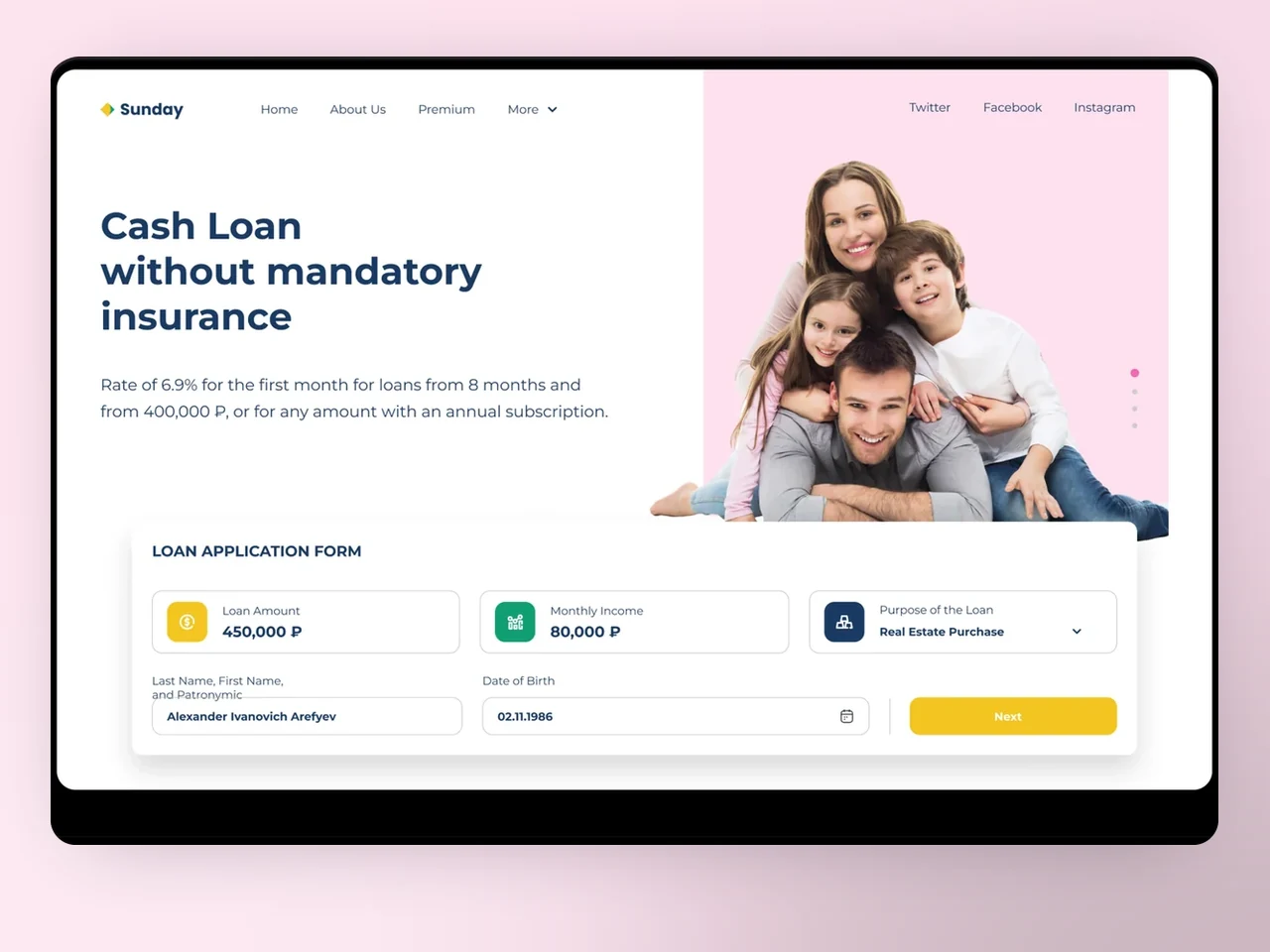
A high-throughput loan decision engine on Laravel — automated scoring, credit-bureau integration, and 10x faster decisions for US & EU lenders.
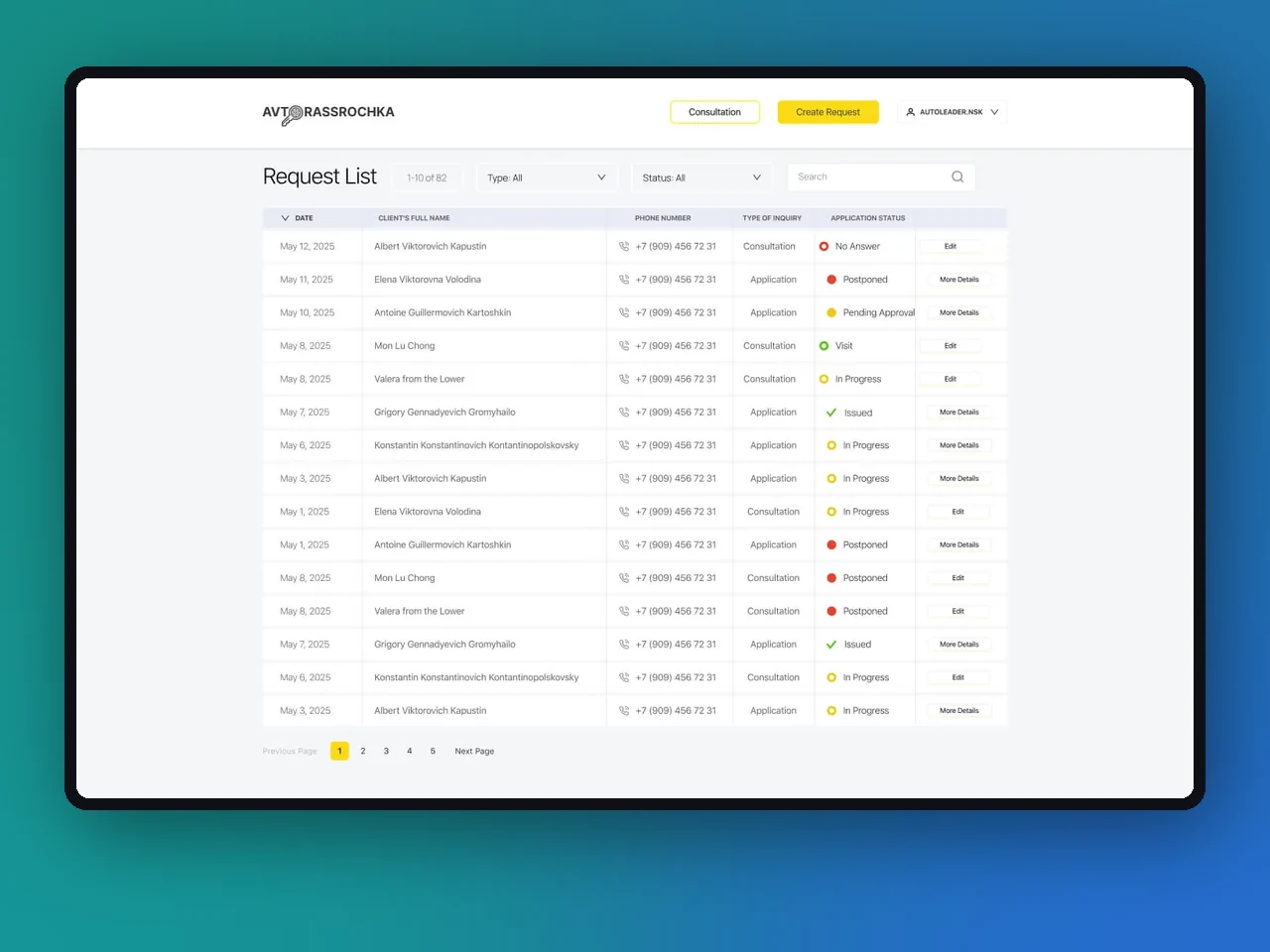
Dealer-facing web platform funneling every auto-financing enquiry into a single tracked queue with Bitrix24 CRM sync.
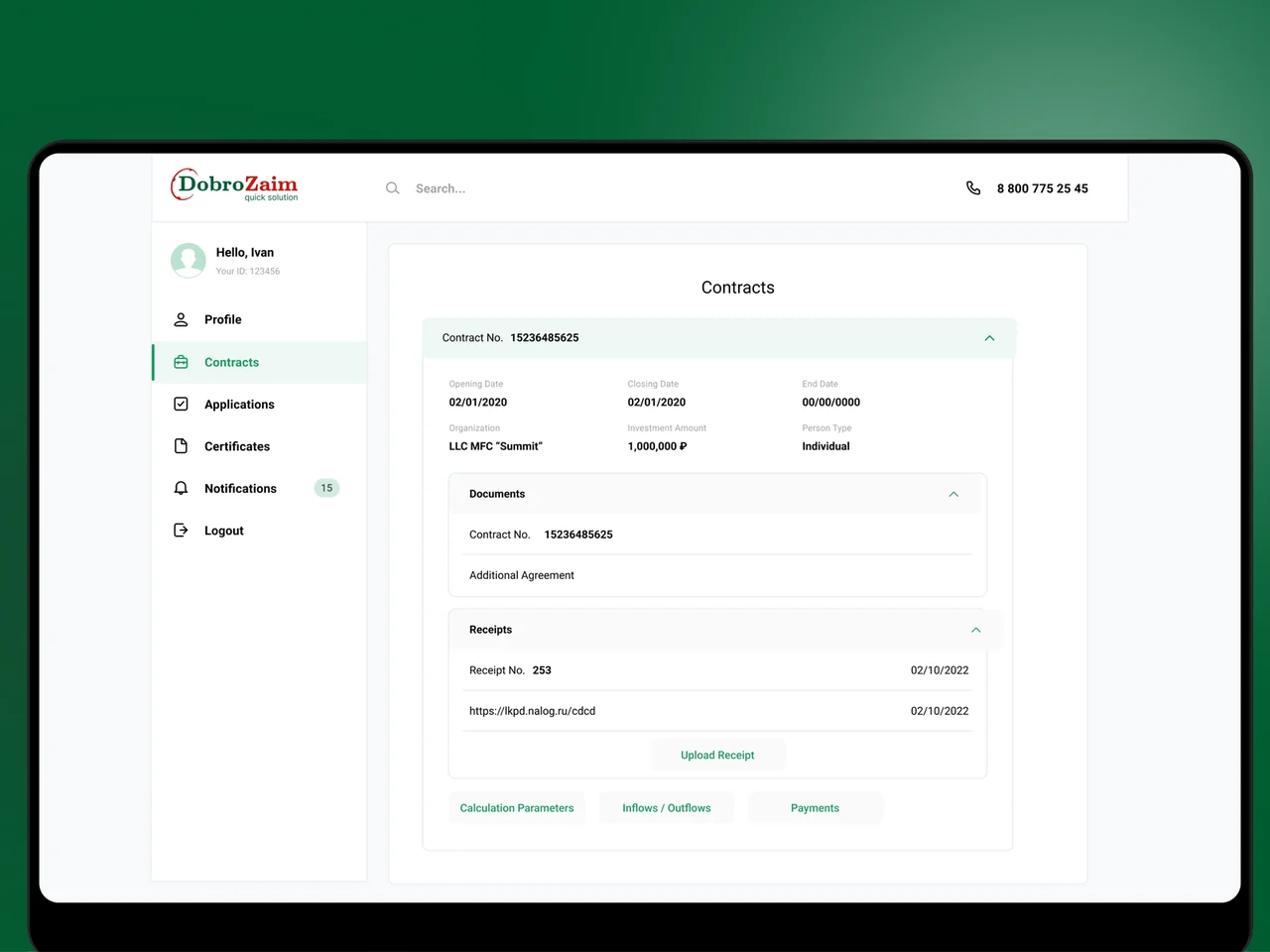
Laravel + React microloans platform — borrower dashboard with e-signature, underwriter workstation, collections, accounting, admin.
Senior engineers fluent in PSD2, DORA, MiCA (EU) and GLBA, SEC, FFIEC (US) — not learning on your audit.
EU data residency by default (Frankfurt, Dublin, Stockholm) · US options on request (us-east-1, us-west-2). SCCs only when truly needed.
Every release ships with traceable change records, SBOMs and threat-model deltas.
Aggregating live prices across multiple exchanges while keeping latency under 500 ms is genuinely hard engineering. YuSMP built the multi-exchange feed, real-time token charts, and listing workflow into a coherent platform. We have not had an outage since launch.
A loan decision engine that takes ten times less time to approve does not happen by accident. YuSMP built the scoring pipeline, integration with credit bureaus, and a back-office that our underwriters actually enjoy using. Approval turnaround went from two days to under four hours.
1 / 2
How you hire matters as much as who you hire. We work in three models, and many fintech clients move between them as the product and its licences mature. Commercial terms are on our pricing and engagement models page.
Best for a well-defined first release or a single integration, where the deliverable and budget are clear up front. Discovery produces the scope; the quote is fixed for that release.
A cross-functional team of PM, designer, engineers and QA working on your roadmap sprint by sprint — the right fit for an evolving payments, lending or banking platform. See our dedicated development team model.
Senior engineers with payments, ledger, KYC/AML or trading experience added to your in-house team under your own process, through our IT staff augmentation service.
Lists of the “top fintech software development companies” rank vendors by size and marketing. A fintech, bank or lender choosing a financial software development company needs different evidence. These are the questions we would ask in your place — of us and of anyone else on your shortlist.
YuSMP brings 9+ years in business and 80+ senior engineers to that checklist; our fintech case studies and client reviews are the place to verify it.
FAQ
Yes. We design card-handling architectures with tokenization, scope reduction and audit trails aligned with PCI DSS v4.0, and partner with QSAs for formal certification.
We implement PSD2 SCA with risk-based exemptions, 3DS2 flows and account information service connectivity through licensed AISP/PISP providers. For US flows we align with Reg E, NACHA WEB debit authentication and FFIEC multi-factor guidance.
We map ICT risk, set up incident classification, third-party register and resilience testing in line with DORA articles 5-15 from day one of architecture. For US clients we mirror the program against FFIEC IT examination guidance and SEC Reg S-P safeguards.
We implement GLBA Safeguards Rule controls, SEC Rule 10b-5 anti-fraud surveillance for trading, FFIEC-aligned IT exam readiness and BSA/AML programs under FinCEN — including CIP, SAR/CTR filings and OFAC sanctions screening.
Yes. We deliver custody, exchange and tokenization platforms with MiCA-aligned governance, market abuse controls and travel rule integration.
We integrate identity providers, sanctions and PEP screening, transaction monitoring with adjustable rule engines and ML scoring, and SAR/STR workflows.
PCI DSS Level 1 certification (required for merchants or processors handling more than 6 million card transactions annually) requires an onsite QSA assessment and typically takes 6–18 months from initial scoping to Attestation of Compliance (AOC), depending on your existing control posture. Cost ranges from $40,000–$200,000+ for the QSA assessment, plus internal remediation costs. Organizations starting with a strong security baseline and limited CDE scope typically achieve certification in 6–9 months; those with broad scope and legacy systems often take 12–18 months.
PSD2 (EU) mandates open banking via the Berlin Group NextGenPSD2 framework, requiring ASPSPs (banks) to provide free API access to licensed TPPs for account information (AISP) and payment initiation (PISP) services. FDX (Financial Data Exchange) is the US voluntary standard backed by major banks and fintechs, providing a common API schema for financial data sharing under CFPB's Section 1033 rulemaking. CDR (Consumer Data Right) is Australia's government-mandated open banking regime, now extending to energy and telecommunications. Multi-market open banking products need adapters for each standard's OAuth2 authentication scheme and data model variations.
A FinTech MVP timeline depends heavily on regulatory complexity and integration scope. A non-regulated FinTech tool (budgeting app using open banking data) can ship in 8–12 weeks. A licensed payment initiation service (PISP) requires regulatory approval first (2–6 months depending on jurisdiction), then 12–20 weeks of development. A neobank MVP with issuing and acquiring capabilities, compliant KYC, and SEPA payment connectivity realistically takes 6–12 months including licensing. The constraint is usually compliance readiness rather than engineering speed.
Effective real-time fraud prevention requires a multi-layer approach: device fingerprinting and behavioral biometrics at the client layer, velocity rule engines for pattern detection at the gateway layer, and ML-based anomaly scoring for the long-tail cases that rules miss. For account takeover, behavioral biometrics detect credential stuffing attacks that bypass password-based controls. For e-commerce, 3DS2 with risk-based authentication challenges only high-risk transactions. False positive rate is as important as detection rate — most fraud teams target less than 0.5% false positives to avoid degrading the customer experience for legitimate transactions.
For a neobank MVP with under 50,000 customers, a well-structured modular monolith with clear domain boundaries (accounts, payments, cards, compliance) is significantly faster to build and operate than microservices. The operational complexity of microservices — service discovery, distributed tracing, inter-service authentication, eventual consistency — consumes engineering capacity that early-stage neobanks need for product development and regulatory compliance. We typically recommend starting with a monolith that has clean internal module boundaries, then extracting the highest-traffic components into separate services as traffic validates the separation.
Payment systems require RPO of near-zero (seconds) and RTO under 60 seconds for transaction processing, requiring active-active multi-region deployments where transactions are processed simultaneously in two or more regions with synchronous replication of the authoritative ledger state. PostgreSQL with streaming replication and Patroni failover automation, or cloud-managed databases like Aurora Global or Spanner, provide the synchronous replication guarantees required. Payment gateway integrations need circuit breakers, retry logic with idempotency keys, and fallback routing to secondary providers when primary processors are degraded.
Fintech software development services cover consulting and discovery, MVP and full-cycle development, mobile banking and fintech apps, legacy core modernization, payment, open banking and BaaS integration, AI and data engineering, and security, QA and support. Each is delivered with PCI DSS, KYC/AML and regional regulation built into the architecture.
Yes. For banks, credit unions and licensed EMIs we build core banking modernization layers, online and mobile banking, loan origination and servicing, payments and money movement, open banking APIs and back-office reporting, phased so the existing core keeps running until reconciliation proves each switch.
Financial software has to pass compliance review on every release, keep an audit trail for every money movement, reconcile to the cent and stay available when payment rails or providers fail. That is why we start from the regulatory map and the rails, and design ledgers, idempotency and audit logging before the user interface.
As a 2026 market ballpark, a compliant fintech MVP typically costs $90,000–$250,000 over 4–7 months, a payments or wallet app $150,000–$300,000, and a neobank or lending platform with KYC/AML and a banking-as-a-service integration $250,000–$500,000+. Every engagement is scoped and quoted after discovery.
The most valuable uses are real-time fraud scoring, AML alert reduction with analyst feedback loops, explainable credit scoring with open banking data, document and KYC automation, AI agents for support and operations with approval steps, and liquidity and portfolio-risk forecasting.
Look for shipped financial cases with measurable results, fluency in the regulations of your market, ledger and reconciliation competence, real integration experience with card, ACH, SEPA, open banking and BaaS providers, audit-ready security evidence, a discovery phase before a fixed quote, time-zone overlap and full ownership of code and data.
Tell us where you want to be in twelve months. We’ll come back with a plan to get you there.
Response within 1 business day. NDA on request.
From regulated banking infrastructure to embedded finance APIs, we cover the full spectrum of financial technology development.
We build cloud-native core banking platforms with microservice-based account management, transaction processing, and product configurability that lets you launch new financial products in weeks instead of months.
Our PSD2/Open Banking integrations implement OAuth2 TPP authorization flows, consent management UIs, and AISP/PISP API adapters that comply with EBA Regulatory Technical Standards.
Core banking API layers use event-sourced ledger systems with double-entry accounting, CQRS pattern for read/write separation, and idempotency controls for payment processing. We use Apache Kafka for event streaming, PostgreSQL with financial-grade ACID transactions, and Redis for real-time balance caching at banking scale.
ISO 20022 migration is mandatory for SWIFT cross-border and SEPA payments, requiring end-to-end message transformation and enriched data handling. We implement message translation layers, co-existence period strategies, and SEPA Instant Credit Transfer (SCT Inst) processing pipelines capable of sub-10-second settlement with 24/7/365 availability.
Payment processing pipelines handle millions of events per second through Kafka's distributed log architecture, enabling real-time fraud detection, payment routing, and audit trail generation without performance degradation under peak load. We build ISO 8583 adapters for card network connectivity and 3DS2 authentication flows for SCA compliance.
MiFID II requires suitability and appropriateness assessments for investment recommendations, transaction reporting (RTS 22/24), and best execution analysis.
We build robo-advisory engines with risk profile questionnaires, goal-based portfolio optimization using Modern Portfolio Theory, and automated rebalancing workflows that satisfy MiFID II suitability documentation requirements.
Investment platforms need real-time market data ingestion, order management systems (OMS) with DMA capabilities, and portfolio performance attribution that satisfies GIPS standards. We integrate with market data providers (Bloomberg, Refinitiv, Quandl) and prime brokers via FIX protocol.
Financial crime compliance teams need ML-based behavioral analytics engines that reduce false positives in AML transaction monitoring while meeting FATF and 6AMLD requirements.
We build automated KYC/KYB document verification integrations (Onfido, Jumio, Sumsub) and sanctions screening APIs that process customer records against OFAC, UN, and EU lists in real time.
Regulatory reporting automation reduces manual reconciliation work by 80%+ through structured data pipelines that aggregate transactional data into FCA/EBA/BaFin-format regulatory reports. We build audit trail systems with immutable append-only logging satisfying 7-year retention requirements for transaction monitoring evidence.
Parametric insurance products pay out automatically when predefined triggers are met (weather station data, flight delay APIs), eliminating manual loss adjustment.
We build IoT telematics data pipelines for usage-based insurance (UBI), AI-powered first notice of loss (FNOL) processing, and automated claims adjudication workflows that reduce claims cycle time by 60–80%.
Insurance platforms require actuarial data models integrated with pricing engines, reinsurance treaty management, and regulatory reporting for Solvency II. We build insurance product configurators that let underwriting teams define new coverage products without engineering involvement.
Embedded finance allows non-bank businesses to offer financial services through APIs, creating new revenue streams and improving customer retention. We integrate Banking-as-a-Service platforms (Railsr, Solaris, Treasury Prime), implement BNPL lending decisioning models with credit bureau integrations, and build merchant-facing financial product widgets deployable in days.
BNPL decisioning models use alternative credit data sources (open banking transaction history, behavioral signals) to assess creditworthiness for thin-file customers, expanding addressable market while managing credit risk through ML-based approval thresholds and portfolio monitoring dashboards.
In-depth guides on building compliant fintech apps — cost, stack and security.
Share a few details and a senior consultant will reply within one business day.
Email: sales@yusmpgroup.com
Phone: +374 44 871 811
Offices: KAMAR Business Center, Vazgen Sargsyan St. 2, Yerevan, Armenia · Remote — East-Coast US overlap (9 AM–1 PM ET)