

Fast route building
An optimized algorithm calculates the path across dozens of tour stops without freezing.
Logistics · Mobile app
xRouten is a navigation and route-planning service for delivery businesses. We carried out a large-scale refactor of an unstable Android app: stabilized it, fixed the logic of core routing and driver-tracking functions, and stopped user churn.
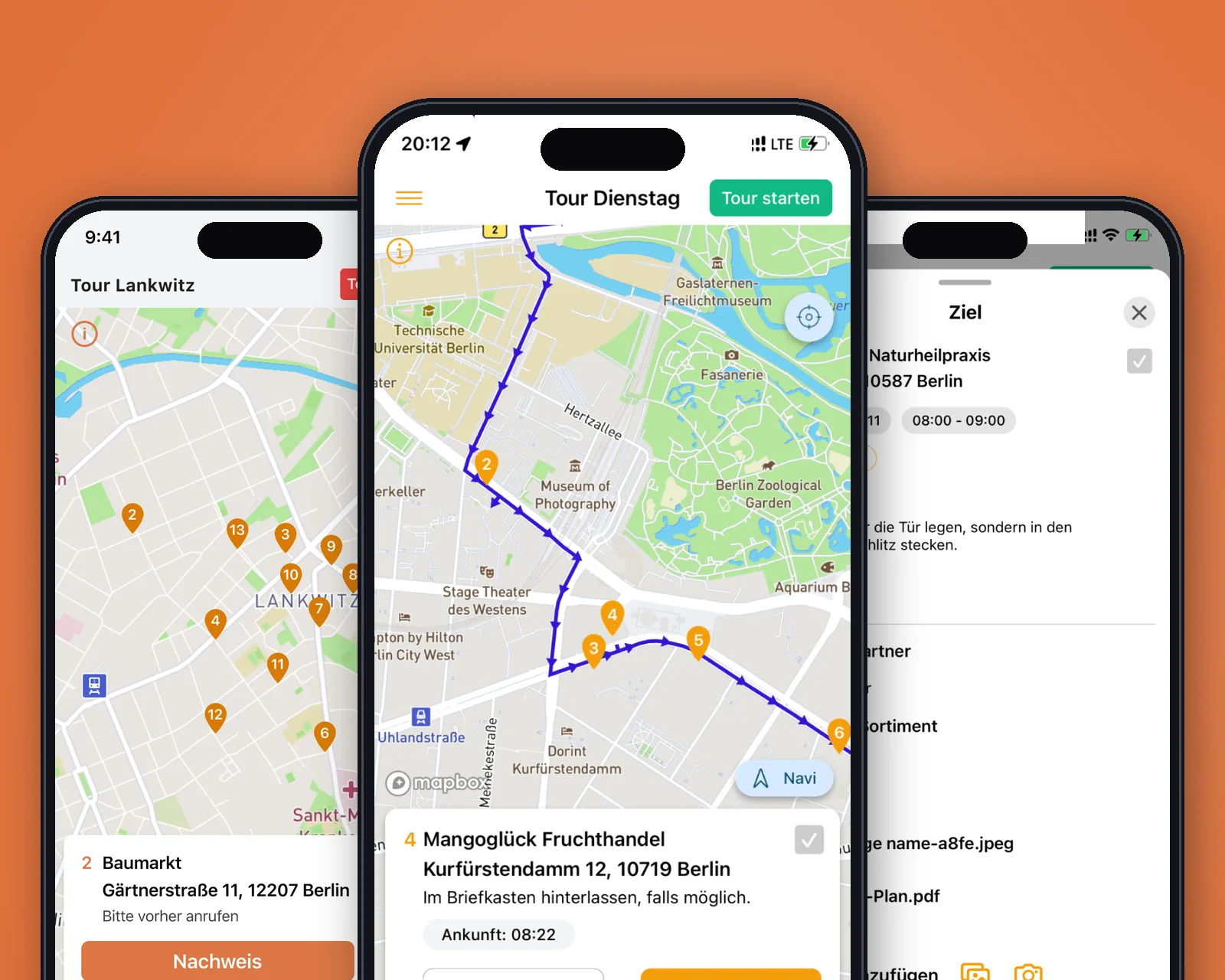
In short: what the product is and who we built it for.
xRouten is an app for drivers and delivery services that builds a route across dozens of stops, guides the driver on the map and records proof of delivery at every address. A dispatcher assembles a tour from orders, and the driver follows it along the optimal path, marking stops as complete and attaching supporting documents directly in the app.
The client didn't come to us for a build from scratch, but with an already working, yet unstable, product: the app suffered from poor performance, errors and critical bugs that directly hit the business — up to disrupted deliveries. The task was to stabilize the app, rewrite the problem areas and win back user trust.
The app ran on legacy code and had accumulated critical problems: poor performance, freezes when building routes across dozens of stops, errors in core functions and bugs that made drivers lose tour data. Every such error cost the business dearly — disrupted deliveries and financial losses — and users started leaving.
The project was further complicated by a language and geographic barrier: the interface was in German, and route testing ran on maps of Germany. The team had to understand someone else's codebase without breaking what already worked, and systematically fix the most painful spots.
How we built the product, from architecture to process.
We started with an audit of the most unstable areas: route building, driver tracking and delivery confirmation caused the most failures. We rewrote the problem modules in clean Kotlin, optimized the route-calculation algorithm across dozens of points and removed the freezes.
In parallel, we cleaned up the core functions: smooth real-time display of drivers on the map, digital documentation with invoice generation and sending to customers, and a working payment system. The redesign improved the user experience, and the updated code base made the app ready for release on the App Store and Google Play.
Tools chosen to fit the product’s goals.
Rewriting from scratch means losing accumulated business logic, adding extra risk and delaying delivery to users. A refactor keeps the parts that already work, removes the causes of instability and gives the product a second life without a full service stoppage.
The client side was moved to Kotlin — Android's official language — giving full access to maps APIs, background services and GPS without restrictions. We considered alternatives: React Native (faster start, but weaker map UX and limited GPS API access) and Flutter (close in capability, but a separate build chain). Native Kotlin was chosen because of the UX requirements for navigation and real-time tracking.
Key capabilities that solved the business problem.
An optimized algorithm calculates the path across dozens of tour stops without freezing.
Smooth, real-time display of staff locations for the dispatcher.
Generating and sending invoices and delivery confirmations to customers right from the app.
At every stop the driver marks completion and attaches supporting documents.
Address, arrival window, notes, contact person and attachments for each order on the tour.
A working payment module replaced the unstable legacy solution.
Key product screens, step by step.
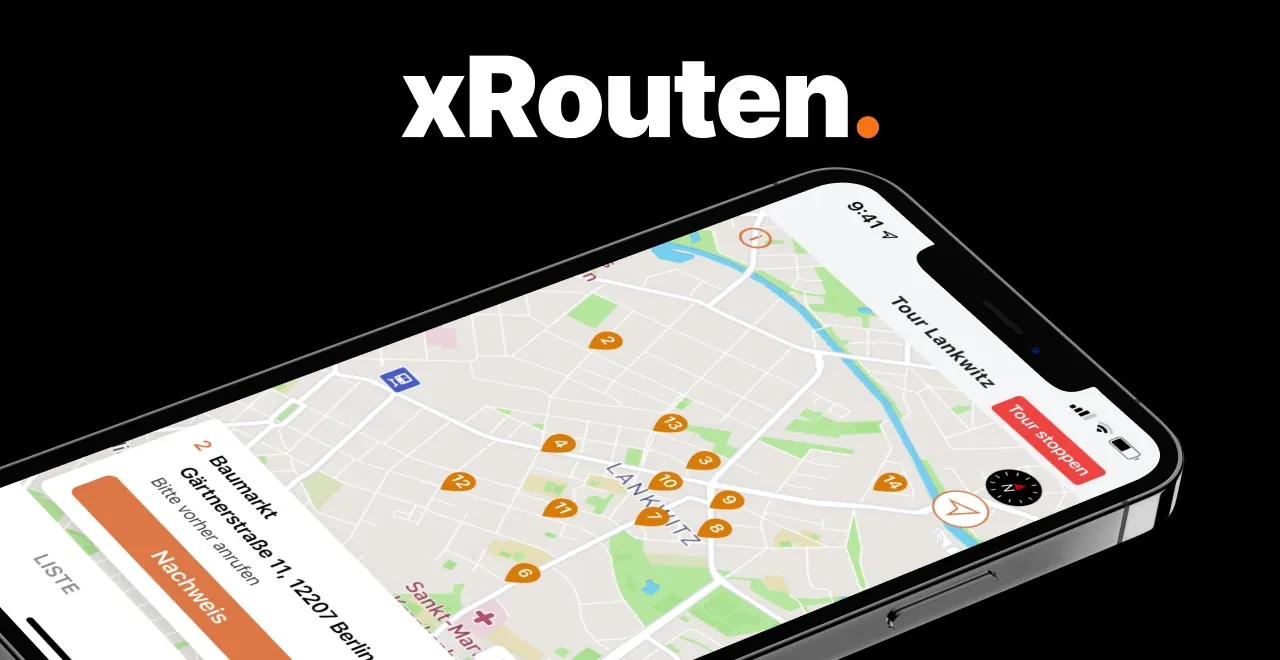
The driver's main screen is a map of the active tour with numbered delivery stops. Each point on the map shows its sequence number, and a card for the nearest address opens below it — for example, "Baumarkt, Gärtnerstraße 11, 12207 Berlin" with the note "Bitte vorher anrufen" (please call ahead).
From here the driver runs the tour: the "Nachweis" button records proof of delivery, "Tour stoppen" ends the route, and a compass and arrow help with orientation on the ground.
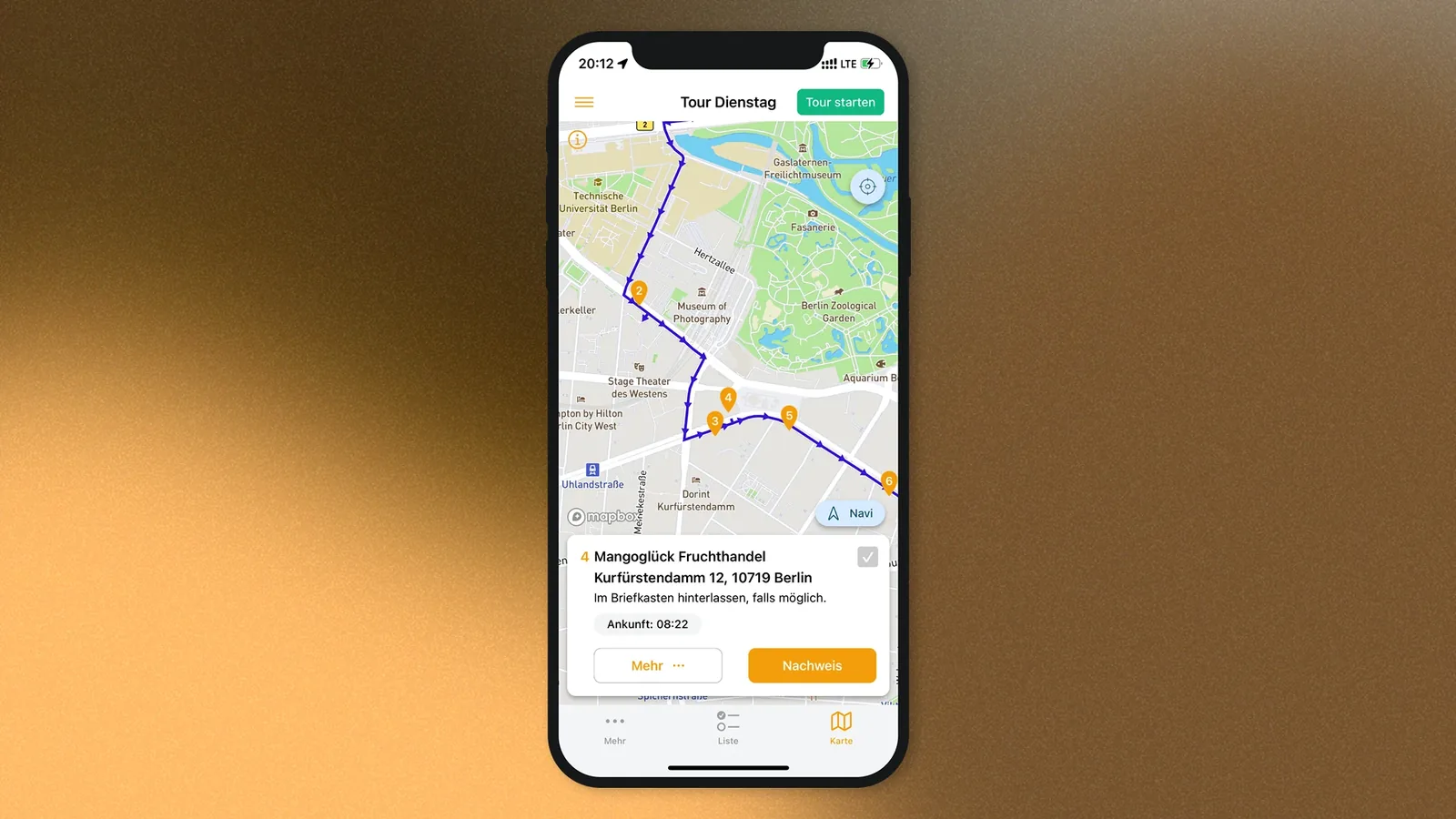
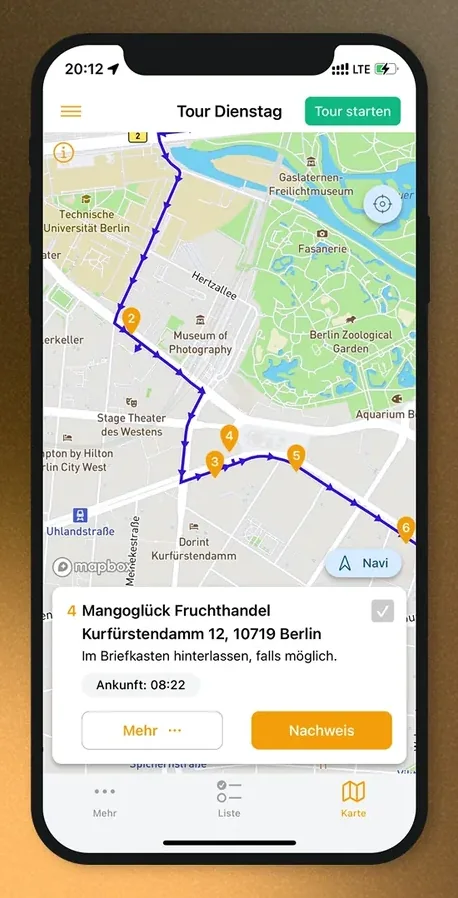
In the "Tour Dienstag" (Tuesday tour) mode, the app draws the route on the map as a blue line, connecting stops in the optimal order and guiding the driver from address to address.
The next stop's card shows the recipient "MangoGlück Fruchthandel, Kurfürstendamm 12, 10719 Berlin", the estimated arrival time "Ankunft: 08:22" and "Mehr" and "Nachweis" buttons — to open order details or confirm delivery.
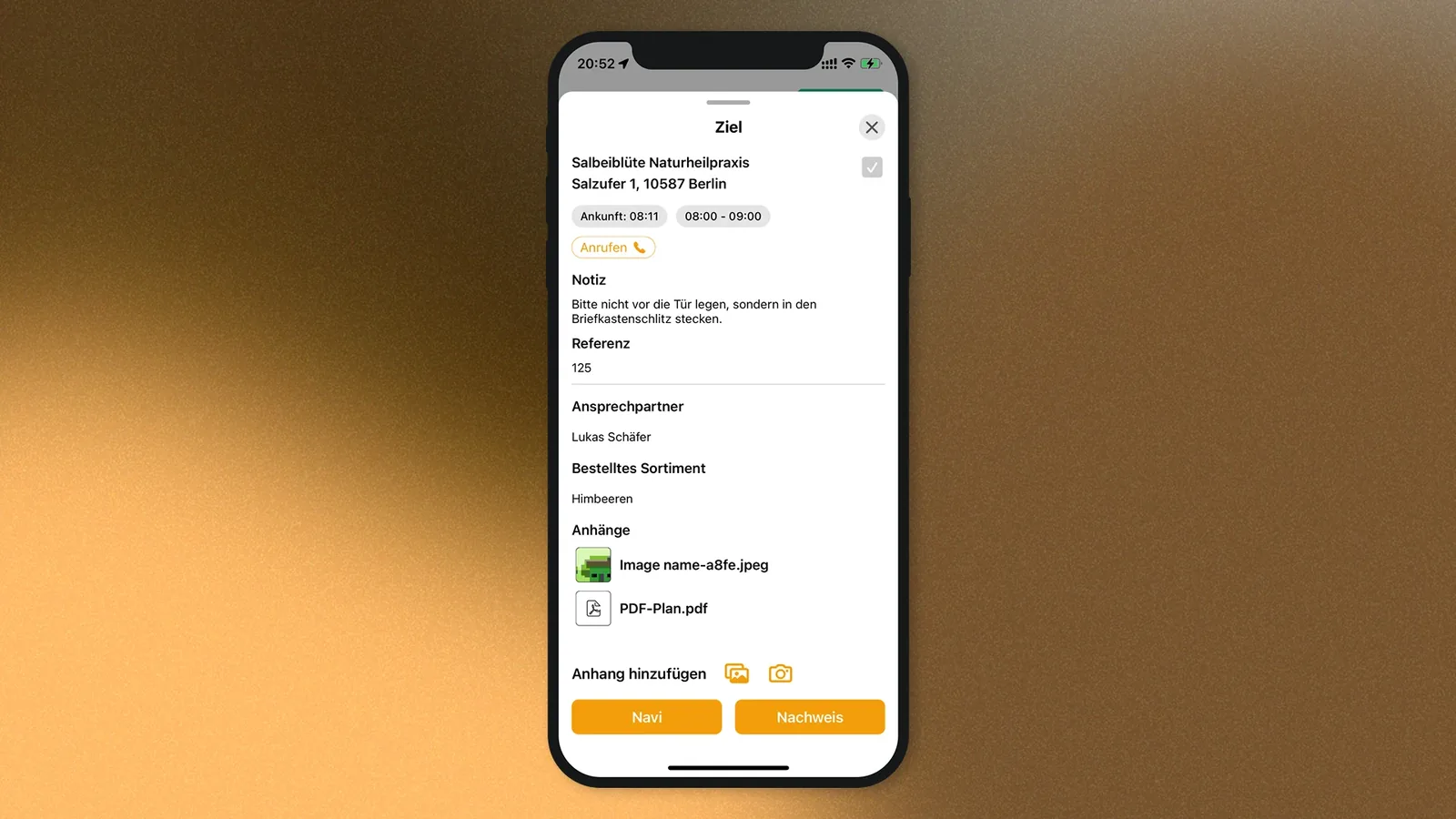
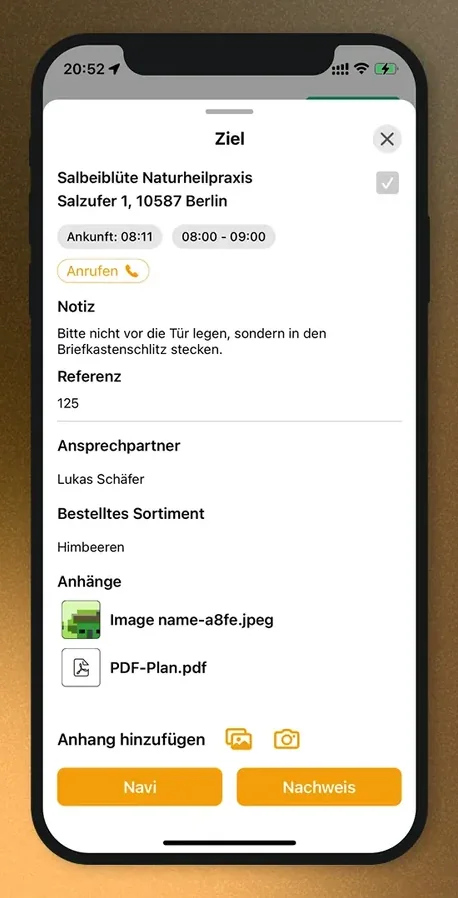
Tapping a stop opens a detailed "Ziel" (destination) card: recipient address, arrival window, a note for the courier, order reference, contact person (Ansprechpartner) and the ordered assortment.
The same screen runs the digital documentation module — order attachments (image-adfe.jpeg, PDF-Plan.pdf) and an "Anhang hinzufügen" (add attachment) button, so the driver can attach a photo or PDF proof of delivery right at the stop.
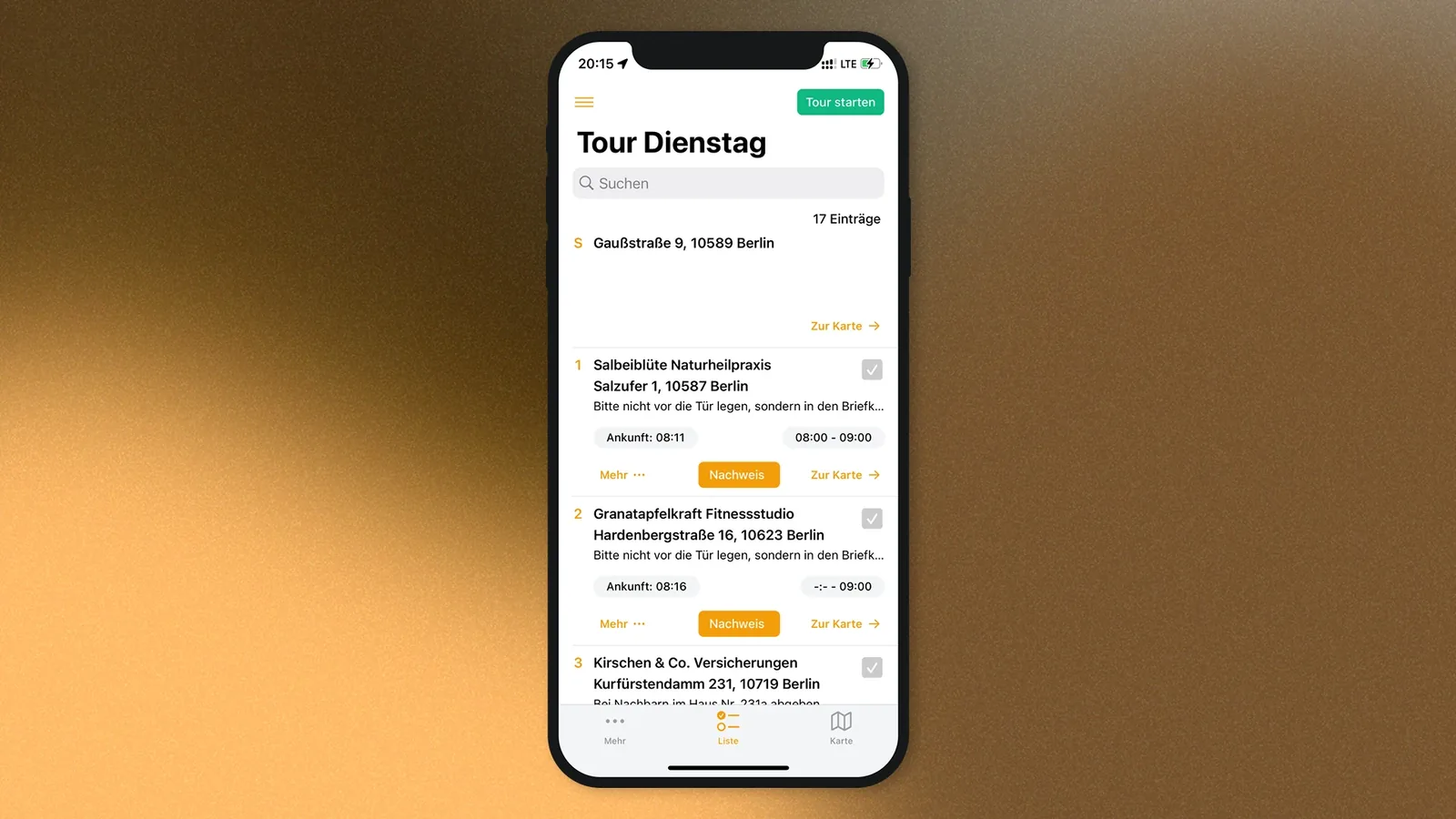
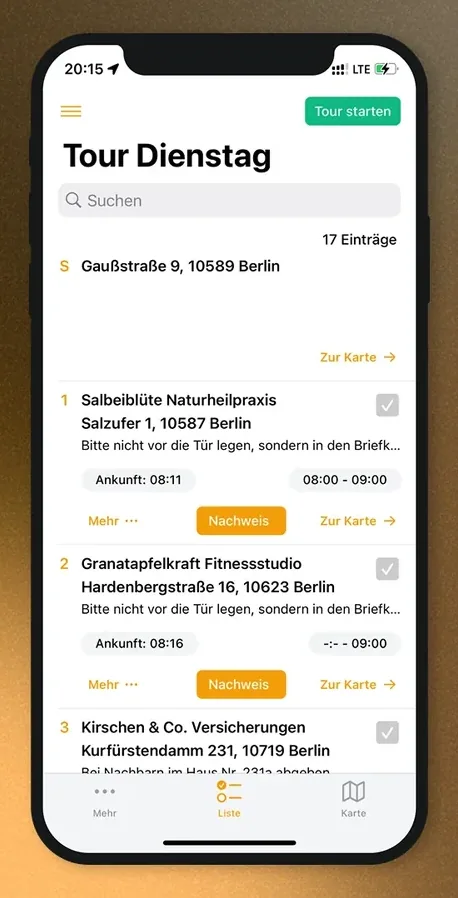
Besides the map, the tour is also available as a list: the "Tour Dienstag" screen with a search field and a "17 Einträge" (17 entries) counter shows every address on the route in order.
Each row shows the recipient, address, arrival window and a "Nachweis" button: the driver sees the whole tour at a glance, finds the right stop quickly and confirms deliveries without switching back to the map.
The app processes personal data of drivers and customers: geolocation, routes and contacts. Driver location data is transmitted only to calculate the route and isn't stored beyond what's necessary. Access to data is minimized by role.
Data is processed under the requirements of the client's jurisdiction, with role-restricted access and protection of operations and payment data used when generating invoices and delivery confirmations.
Deep refactor of legacy Kotlin code: stabilization without a full rebuild.
Critical errors and the instability that caused disrupted deliveries and customer loss were eliminated.
High-speed route building across dozens of stops without freezing.
Real-time driver tracking on the map.
Digital documentation module: invoices generated right from the app.
iOS and Android are both ready for release on the App Store and Google Play.
Cost depends on how deep the legacy-code problems run, how much test coverage is needed and the set of required features. We give an exact estimate after analyzing the codebase.
Refactoring keeps the product's working parts and accumulated business logic. Building from scratch usually takes longer and means re-agreeing every feature with the client from zero. Refactoring is significantly faster and cheaper when the product's core already works.
The optimized algorithm processes the route graph in memory and minimizes calls to external APIs when recalculating. The result is a fast response even across dozens of stops, with no interface freezing.
Drivers' personal data (geolocation, routes, contacts) is stored on the client's servers within the client's jurisdiction. We hand over document templates covering the data-processing policy, regulator notification and a designated-responsible-person order as part of the delivery.
Timelines depend on the scope of problems, the test coverage needed and the set of new features. A typical range for refactoring a mid-complexity Android app is 10–16 weeks (an industry range, not a guarantee). We lock in exact timelines after a codebase audit.
Companies from retail, medtech, logistics and e-commerce that we helped build digital products.












The full spectrum of development — from native mobile apps to web platforms, AI and cloud. Pick a direction or order a turnkey project.
Native iOS & Android plus cross-platform Flutter and React Native — from MVPs to apps with millions of installs.
Learn moreNative Swift / SwiftUI iOS apps — with Apple Pay, Sign in with Apple, App Store Connect deployment pipelines.
Learn moreNative Kotlin / Jetpack Compose Android apps — Material 3, Google Play release pipelines, Firebase integration.
Learn moreSingle Dart codebase across iOS, Android, web and desktop — with native modules where needed.
Learn moreProduction web apps on React, Next.js, Vue and Node — SaaS dashboards, B2B portals, marketing-conversion stacks.
Learn moreREST, GraphQL and gRPC APIs — designed for partners, mobile clients and internal microservices.
Learn moreBespoke platforms for mid-market and enterprise teams — internal tools, vertical SaaS, mission-critical backends. Discovery to launch in 12–36 weeks.
Learn moreFocused MVPs in 12–20 weeks — one or two integrations, real users on day one, telemetry built-in.
Learn moreEnd-to-end ownership of a digital product — design, build, ship and continuous evolution.
Learn moreTool-using agents that plan, retrieve, act and self-evaluate — in customer service, ops automation, internal copilots.
Learn moreAWS, Azure and GCP architecture, Kubernetes, Terraform/Pulumi, CI/CD and observability — SRE-grade operations for product teams.
Learn moreTechnical SEO, Core Web Vitals, structured data, internal-link architecture — built into your engineering process.
Learn moreRelated cases
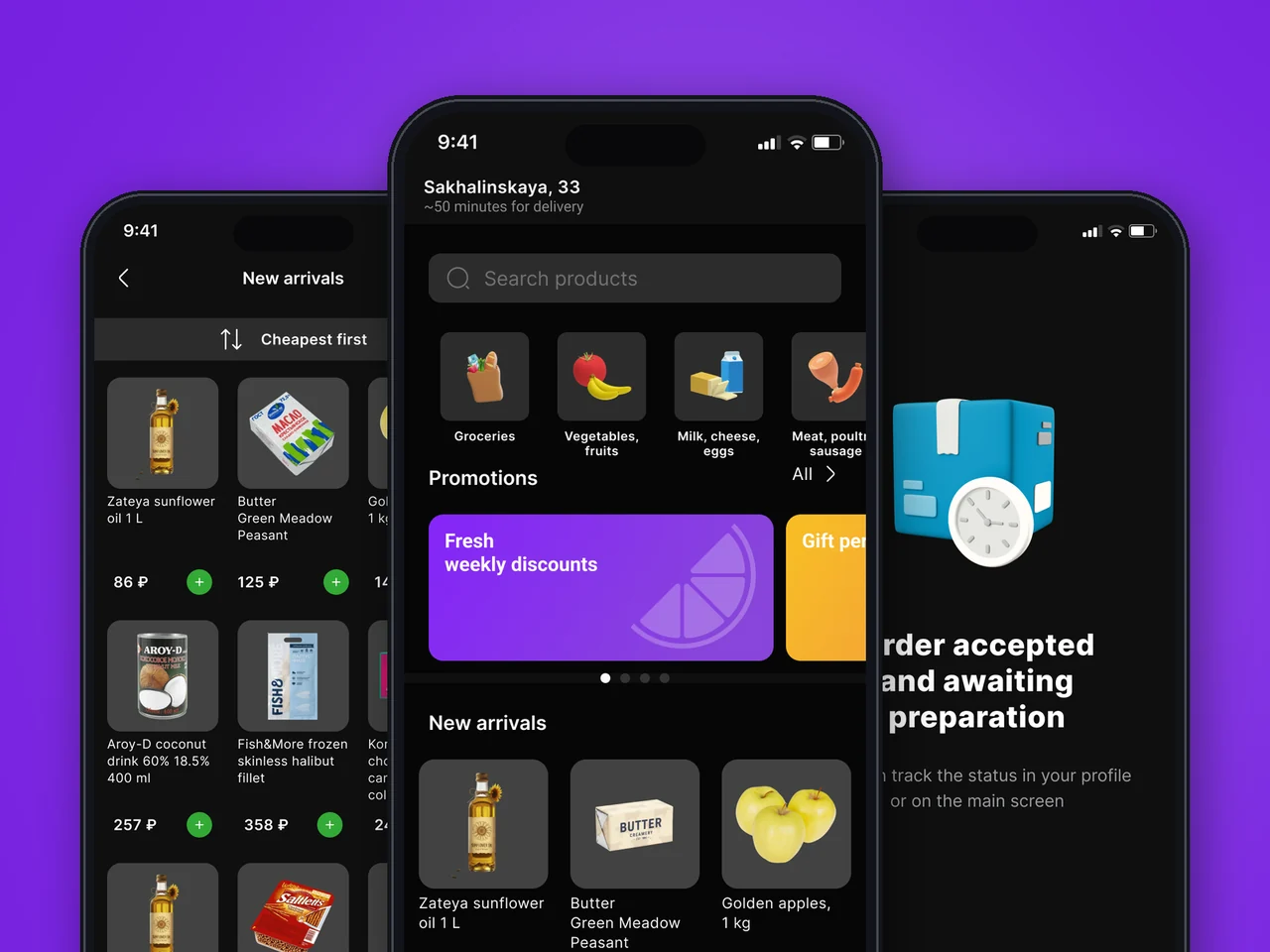
Four coordinated products on one Laravel backend — customer app, picker app, admin panel — with designed-from-scratch logistics.
View case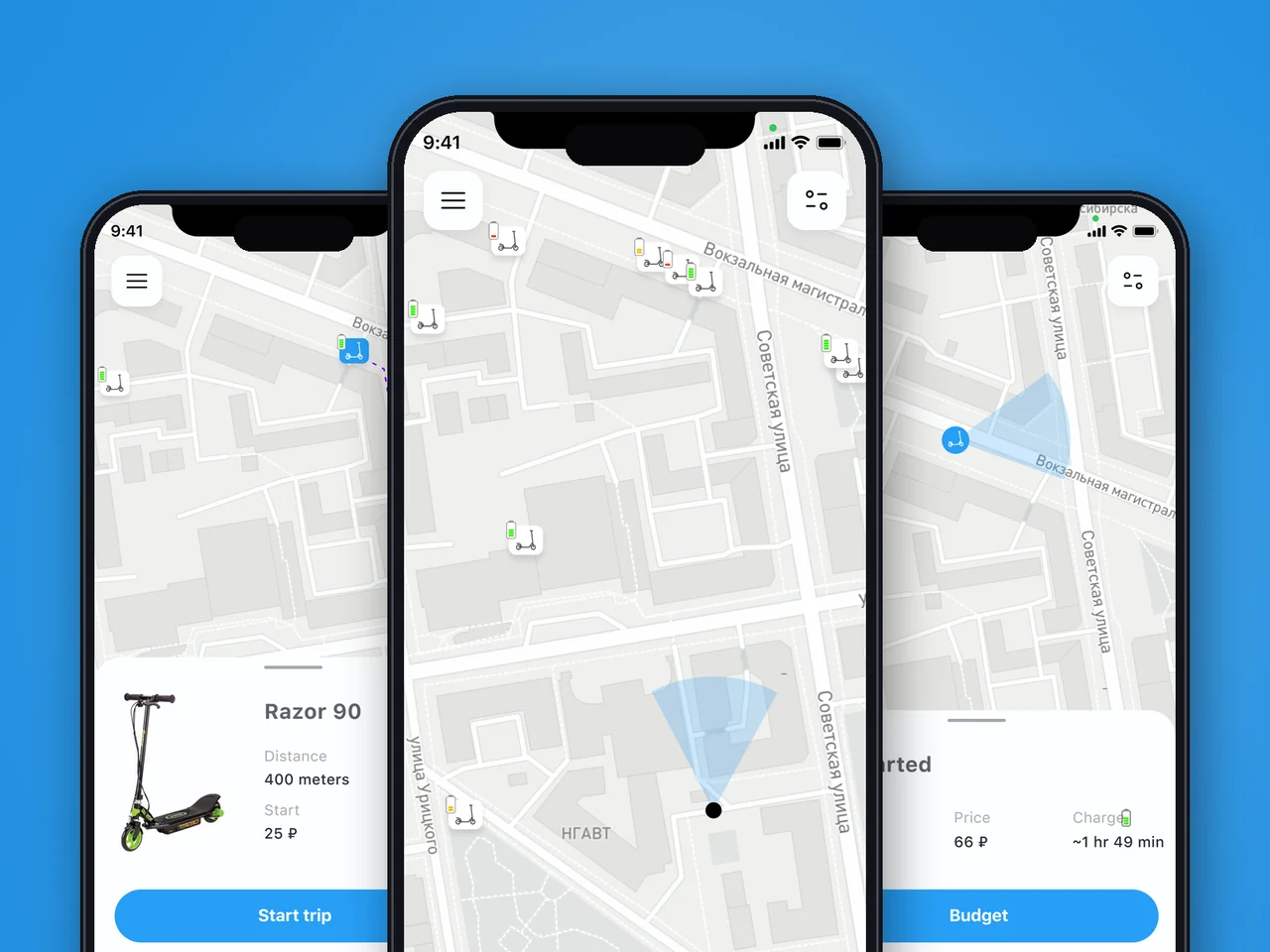
E-scooter sharing app with live map, QR unlock, and ride wallet for iOS and Android — 5,000+ riders, built for US & EU rollouts.
View case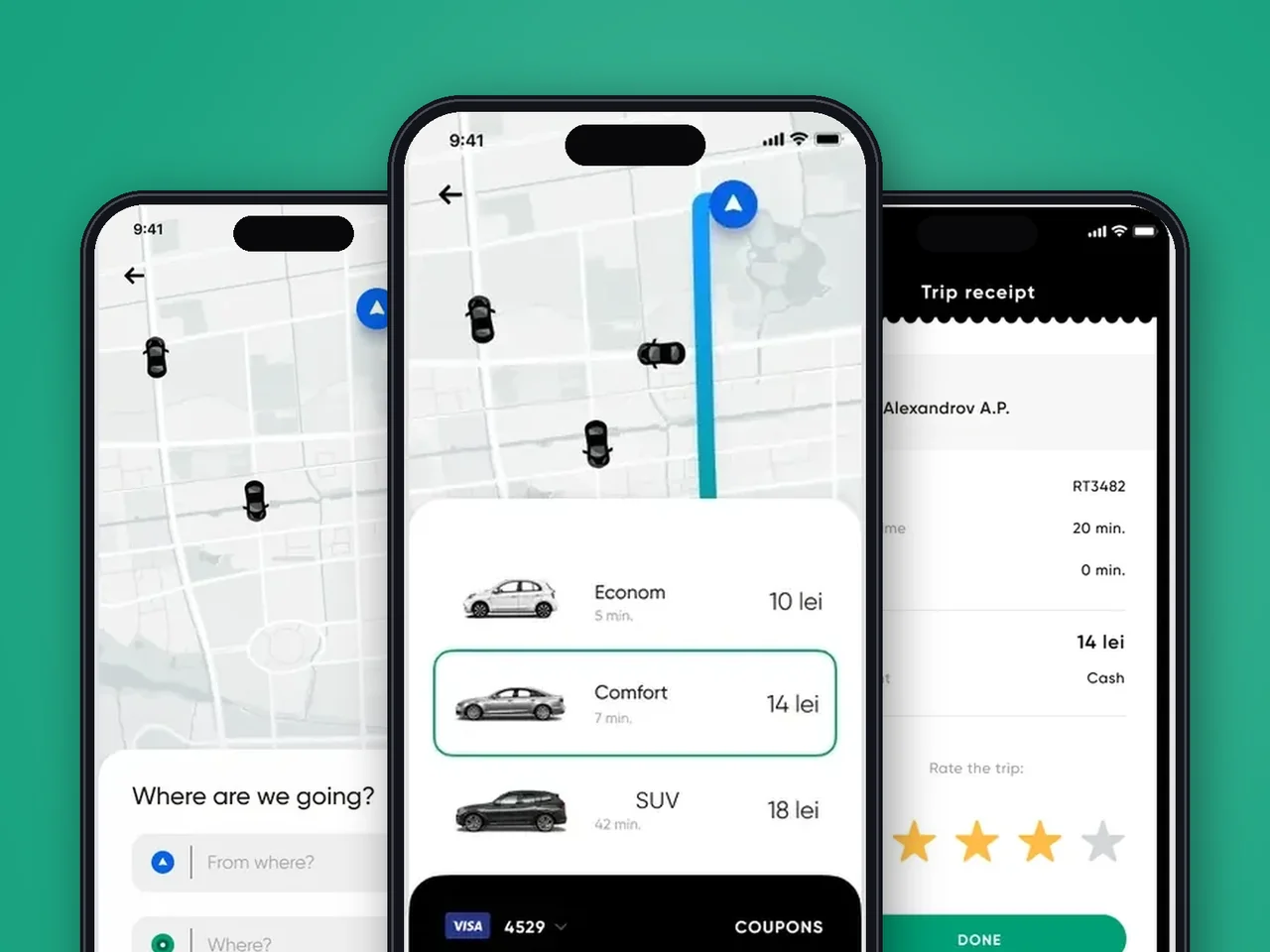
Three-app ride-hailing platform — driver, passenger, dispatcher — with real-time GPS, document verification, dual cash/card payments.
View case20 articles across 5 categories — engineering-led guides on AI, SaaS, MVP, compliance and mobile for US and EU product teams.

Performance-tested comparison of RN (New Architecture) and Flutter (Impeller) across hiring, time-to-market and EU/US compliance.
Read article
Real cost ranges by region (US onshore, Western EU, EU nearshore), team and feature scope. With a worked fintech example.
Read article
Data-driven framework for choosing iOS-first or Android-first in 2026 — US & EU market share, ARPU, review timelines, EU DMA.
Read articleTell us about the app you already have and what's not working, and we'll help you scope a refactor that stabilizes it without a costly rebuild. Let's discuss how a similar process could work for your product.
Share a few details and a senior consultant will reply within one business day.
Email: sales@yusmpgroup.com
Phone: +374 44 871 811
Offices: KAMAR Business Center, Vazgen Sargsyan St. 2, Yerevan, Armenia · Remote — East-Coast US overlap (9 AM–1 PM ET)