Cross-platform Flutter apps
iOS 14+, Android API 24+, web (canvaskit and html renderers), Windows, macOS and Linux desktop from one Dart codebase. Material 3 and Cupertino widgets adapted per platform.
Services
Senior Flutter and Dart engineering for funded mobile teams: Flutter 3.27 with Dart 3.6, Riverpod 2 or Bloc 8 state, GoRouter 14, Drift or Isar local persistence, FFI for native iOS / Android plugins, melos-managed monorepos, and CI on Codemagic, GitHub Actions or Bitrise that ships TestFlight and Play internal tracks every commit. One codebase to iOS, Android, web and desktop — without compromising on the native feel users actually notice. Fixed-scope, all-in USD delivery tiered by product maturity: an MVP from $3,500, a production app from $5,800, a full product from $9,200 and a complex app from $11,500. Dedicated-team and staff options are available on request. Evaluating the stack first? See our Flutter capabilities and when to choose it over native or React Native.

GDPR-aligned · ISO 27001 ready · SOC 2 Type II in progress · HIPAA-capable · CCPA-acknowledged · CET workday with 9 AM–1 PM ET overlap
Flutter wins when your product needs identical UX across iOS and Android (and increasingly web and desktop), when you cannot afford two separate native teams with different release cadences, and when your designers want pixel-precise custom UI rather than the platform-default look. We use it where it earns its place: B2C consumer apps with strong brand-driven UI, B2B field-service and logistics apps where iOS + Android parity is a contractual requirement, and white-label products where one codebase powers fifty branded apps. Our Flutter engineers average 6+ years on Dart, have shipped apps with 5M+ MAU on the Play Store and App Store, and know which Flutter packages to never use in production. We are GDPR-aligned · ISO 27001 ready · SOC 2 Type II in progress. See it in practice in our Crypto Wallet case study.
iOS 14+, Android API 24+, web (canvaskit and html renderers), Windows, macOS and Linux desktop from one Dart codebase. Material 3 and Cupertino widgets adapted per platform.
Riverpod 2 with code generation, or Bloc 8 with hydrated_bloc, GoRouter 14 with type-safe routes, freezed for sealed unions, dio or http for networking with retry interceptors.
Custom platform channels in Swift / Kotlin, Dart FFI for direct C/C++ interop (encryption libraries, ML runtimes, hardware SDKs), pigeon for type-safe codegen of native bridges.
Firebase Auth, Auth0, Supabase, Cognito, custom OIDC. flutter_secure_storage backed by Keychain and Keystore, biometric prompts via local_auth, certificate pinning for high-trust contexts.
Drift (SQLite) or Isar for local persistence, PowerSync or custom CRDT sync, background sync via WorkManager (Android) and BGTaskScheduler (iOS), conflict resolution patterns that survive 30-day offline gaps.
Migrating Flutter 2.x / 3.0–3.10 onto Flutter 3.27, null-safety completion, Provider / setState onto Riverpod 2, Navigator 1 onto GoRouter, single repo onto melos workspace with shared design system.
1–2 weeks: audit existing repo (or Figma file), decide Riverpod vs Bloc, decide GoRouter vs auto_route, decide REST vs GraphQL, decide Firebase vs custom backend, and write the ADR before code lands.
Sprint 1–2: melos monorepo with app + design_system + api_client + shared packages, very_good_analysis lints, golden tests via alchemist, CI on Codemagic or GitHub Actions, Fastlane for App Store / Play release.
Two-week sprints, trunk-based, Firebase Remote Config or ConfigCat for feature flags, widget tests + integration_test driver + golden tests, Sentry for crash reporting from day one.
TestFlight and Play internal track on every merge, weekly external beta, store-listing optimisation, Sentry triage on-call rotation, monthly review of crash-free sessions and ANR rate, quarterly Flutter / Dart SDK upgrade.
Our default. One Flutter codebase delivered to a fixed scope and a fixed all-in USD price, from an MVP through to a complex app. Discovery, build, real-device QA and App Store and Play release, signed off before any code is written.
2–6 senior engineers embedded in your roadmap, daily standup in your channel, your repo, your CI, your on-call. Best for product roadmaps with a 6+ month horizon — scoped and priced on request.
One or two senior engineers slotted into your existing squad, your stand-up, your process. Best for filling a known capability gap without disturbing team structure — available on request.
Fixed-scope projects are all-in and quoted in USD. NDA, DPA, and IP assignment signed before kickoff, with a CET workday and a 9 AM–1 PM ET overlap for US clients.
Most agencies keep the number for a sales call. Below are reference formats for different stages of product maturity — we name the exact quote after a free scope assessment. Flutter projects are fixed-scope and all-in, quoted in USD, with no recruitment markup, no tool surcharges and no hidden fees. You see the line-item budget before any code is written and sign off on it.
MVP
from $3,500
4–8 weeks · one codebase
First working app on one Flutter codebase. Core flow, iOS and Android, minimal design and App Store and Play release — enough to put a real product in front of users.
Normal
from $5,800
production app
A production app users rely on. Several features, backend integration, offline persistence, event analytics and a hardened App Store and Play release.
Optimum
from $9,200
full product
A full product with depth. Multiple modules, roles and permissions, external integrations, CI/CD to TestFlight and Play, and QA on a real-device farm.
Advanced
from $11,500
complex app
A complex app built for scale. Offline-first sync with conflict resolution, native Dart FFI plugins, in-app payments, performance work and A/B experiments.
What moves the number: how many features and surfaces you ship (iOS + Android only vs adding web and desktop — each surface adds design and QA); the depth of any Flutter migration (2.x→3.27, null-safety completion, Provider/setState→Riverpod 2, Navigator 1→GoRouter); offline-first and sync complexity (last-write-wins vs CRDTs, background sync, multi-day offline gaps); how many native platform channels and Dart FFI plugins the app needs; and compliance scope (GDPR EU data residency, App Store Privacy Manifests, Play Data Safety, HIPAA-capable). A single-surface app on clean data sits at the bottom of the range; a multi-surface product under a DPA writing to production systems sits at the top. App Store, Play and third-party API fees are billed on your own accounts, so you keep the cost lever. Prices are indicative and are fixed in a written quote for your specific scope.
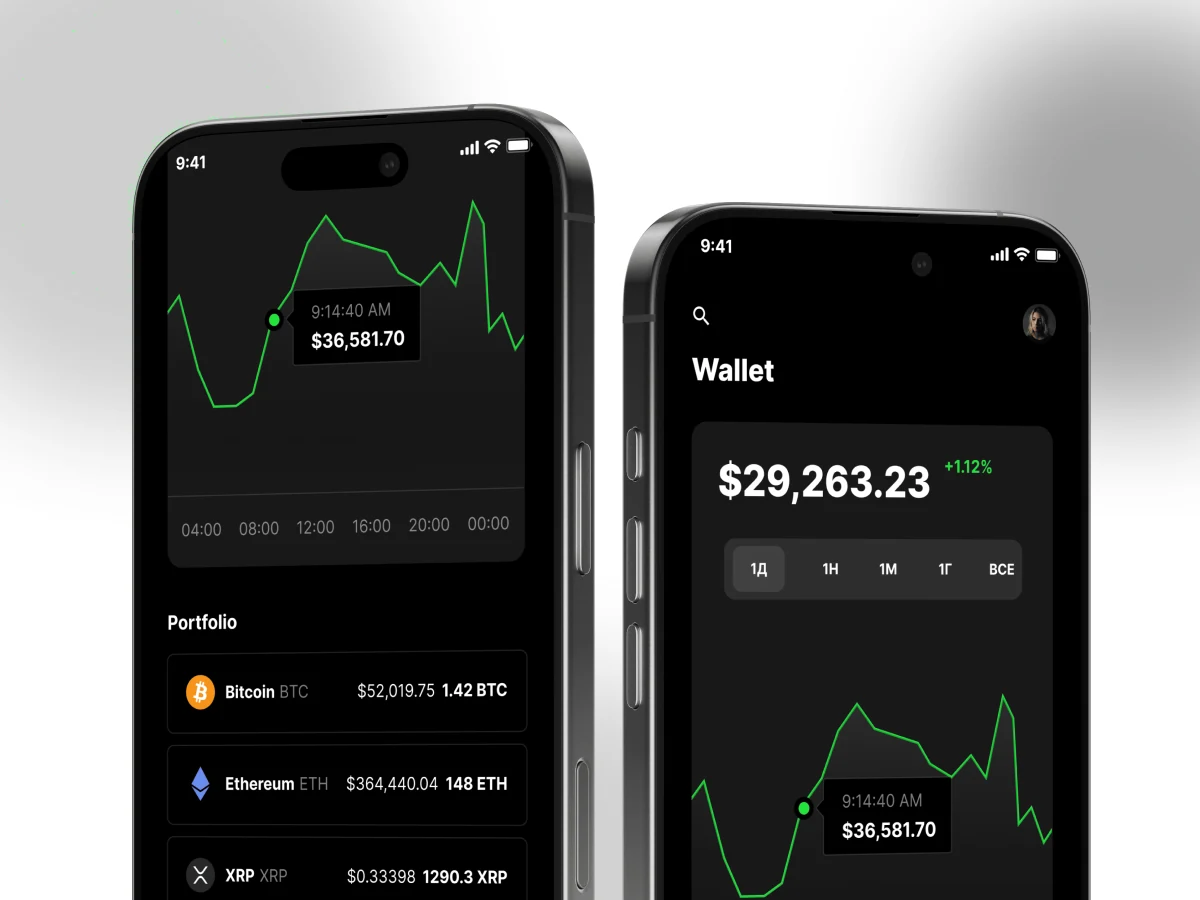
Flutter iOS + Android companion for a custodial platform — biometric unlock, P2P transfers, fiat-crypto bridge, in-app exchanger.
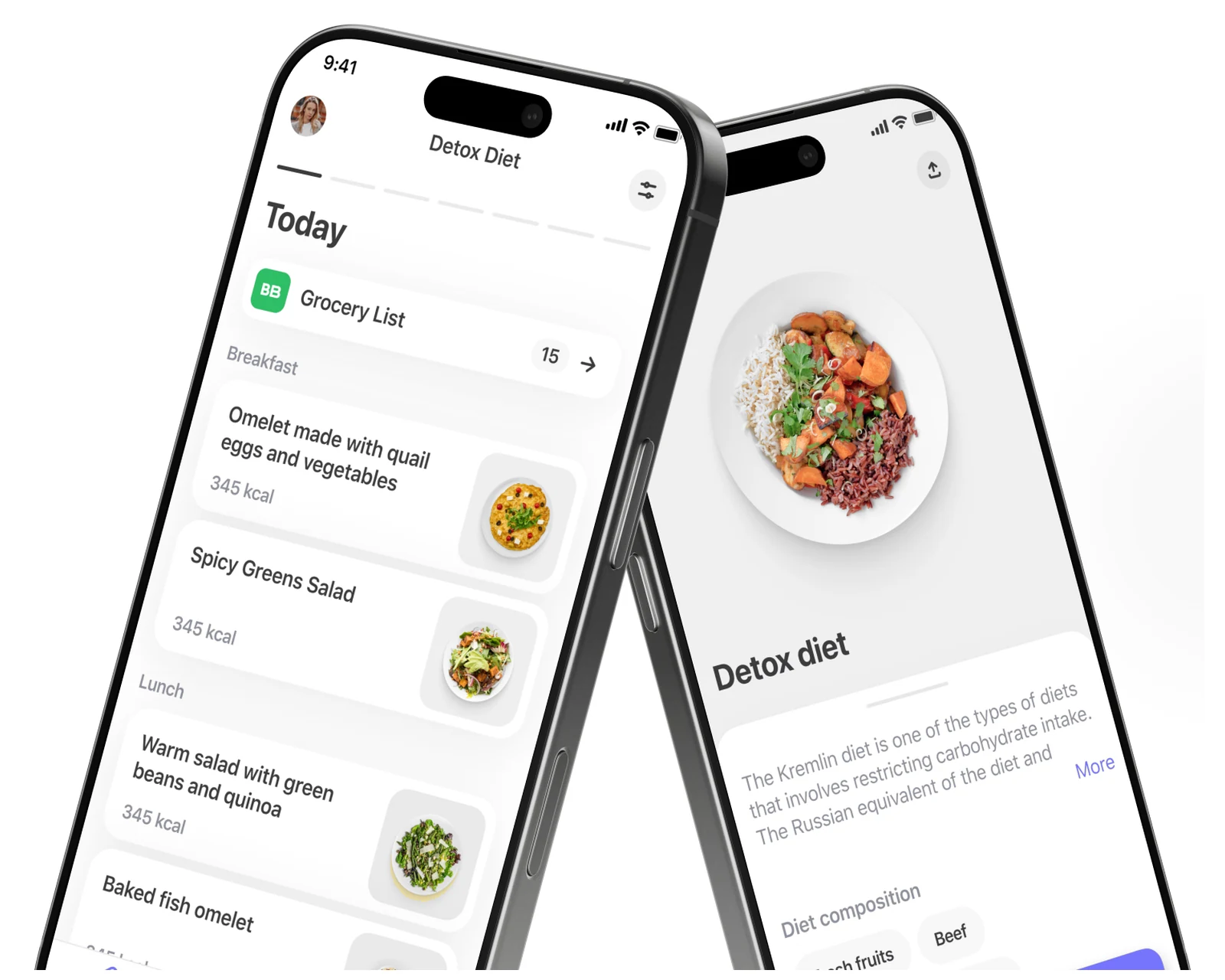
Cross-platform diet and meal-planning app on Flutter — calorie engine, recipe library, weekly meal-plan, grocery ordering.
A cross-platform app is only as good as its fit with your regulatory and operational reality. We pair senior Flutter engineering with industry-specific compliance across US & EU markets, and share a codebase and release process with our cross-platform mobile and React Native teams when a product needs both stacks compared.
Flutter iOS + Android payment and wallet apps built to PCI DSS surface requirements: biometric unlock via local_auth, flutter_secure_storage backed by Keychain (iOS) and Keystore (Android), certificate pinning with Dio interceptors, and custom payment UIs that keep card-holder data off the device entirely by tokenising through Stripe Elements or Adyen Drop-in flows.
One Dart codebase across iOS and Android cuts the compliance surface in half compared to two native codebases — a single code path for encryption, a single set of audit evidence. As on our custodial Crypto Wallet build: biometric unlock, P2P transfers, fiat-crypto bridge, in-app exchanger, GDPR-aligned EU-region backend.
FinTech apps →HIPAA-capable Flutter apps that reach native HealthKit (iOS) and Health Connect (Android) via Platform Channels — Dart cannot call these APIs directly, so we write Swift and Kotlin plugins using Pigeon for type-safe codegen of the native bridge. PHI stays in on-device health stores or encrypted EU-region backends; it never touches third-party analytics SDKs without explicit DPAs.
GDPR-aligned consent management is wired as a separate CMP from ATT and Google UMP so the two consent surfaces do not conflict. As on our BasilDoc build: calorie/meal engine, weekly meal plans, grocery ordering, and App Store auto-renewable subscriptions — shipped to production-ready in four months with 90-day retention exceeding the client benchmark by 30 percent.
HealthTech apps →Flutter’s single codebase across mobile, web, and desktop is a natural fit for omnichannel retail: one team ships the iOS shopper app, the Android app, and the web storefront from one repo, keeping product detail pages, cart logic, and promotion mechanics pixel-consistent across surfaces. Stripe and Adyen Flutter SDKs handle checkout; in-app purchases use the appropriate store IAP flow to avoid Guideline 3.1.1 rejections.
As on our ZipIt buyer apps: two-sided marketplace over a multi-tenant Symfony CRM, Laximo VIN catalog integration for automotive retail, deep links for campaign attribution, and offline product caching with Drift so the catalogue browses without connectivity. Push notifications drive re-engagement without IDFA-dependent cross-app tracking.
E-commerce apps →Flutter’s animation APIs (AnimationController, Tween, CustomPainter) and rich widget system make it well-suited for interactive learning flows: drag-and-drop exercises, progress visualisations, gamification layers, and multimedia content playback via video_player and just_audio — all from one codebase on iOS and Android. Offline-first content delivery with Drift or Isar means lessons load even on spotty school Wi-Fi.
Privacy for under-13 and under-16 audiences is designed to COPPA and GDPR-K standards from the start: no advertising SDKs, no cross-device tracking, anonymous identifiers by default, and parental-consent flows built before the first TestFlight and internal Play track build. ClassKit integration for Schoolwork and Screen Time API compliance are handled via Platform Channels.
EdTech apps →Offline-first field-service and last-mile Flutter apps with Drift or Isar as the local store, background sync via WorkManager (Android) and BGTaskScheduler (iOS), and conflict resolution patterns (last-write-wins or CRDTs) that survive multi-day offline gaps — including the 27-day vessel-at-sea gap we shipped a field-service app through, syncing 14 GB of inspection data on reconnect without a single manual conflict resolution.
Real-time tracking uses the geolocator package with a background location service plugin for continuous driver-position streaming to a WebSocket backend. GDPR location-data retention policies — how long driver coordinates are stored and under what access controls — are designed to the standard a DPA reviewer expects, not guessed at the go-live date.
Logistics apps →Flutter’s ability to target iOS, Android, macOS, Windows, Linux, and web from one Dart codebase is uniquely compelling for SaaS tools that need a mobile companion alongside a web dashboard. One team, one design system, one set of business logic — with platform-adaptive UI that uses NavigationRail on wide screens and a bottom tab bar on mobile, without maintaining a separate React web codebase or an Electron shell.
Custom design systems are built with Flutter’s Theme and ComponentTheme extensions so your brand tokens propagate consistently across every platform surface. White-label deployments use conditional imports and flavors so one codebase powers multiple branded builds with different app icons, color schemes, API endpoints, and feature flags. Riverpod 2 scoped providers isolate tenant context cleanly across a multi-tenant B2B product.
SaaS apps →Flutter’s pub.dev package registry and Platform Channel bridge give Dart access to every iOS and Android SDK. Below are the integration categories we deliver most often in production — each with the packages and native modules we have battle-tested across real client engagements.
Stripe Flutter SDK and Adyen Flutter for card and wallet payments, flutter_inapp_purchase for StoreKit 2 (iOS) and Play Billing Library 7 (Android) with the new base-plan/offer subscription model, Apple Pay and Google Pay via the respective plugin flows, and EU User Choice Billing for DMA-eligible categories. PCI-scoped integration keeps cardholder data off the Dart layer entirely by tokenising through the SDK's drop-in UI elements.
google_maps_flutter for cross-platform map rendering, mapbox_maps_flutter for offline vector tiles and custom styling, and flutter_map (Leaflet-based) for open-source tile layers. Background location via a Platform Channel bridging WorkManager (Android) and BGTaskScheduler (iOS), with the geolocator package for foreground accurate GPS. Custom clustering and real-time driver-position overlays are built in CustomPainter for sub-60 ms render performance on large fleets.
Sign in with Apple (mandatory for iOS apps with social login), Google Sign-In, and firebase_auth for multi-provider federated identity. Biometric unlock via local_auth with BiometricPrompt (Android hardware-backed) and LocalAuthentication (iOS Secure Enclave). OAuth 2.0 / OIDC flows via flutter_appauth for enterprise SSO integrations. On-device credential storage with flutter_secure_storage backed by Keychain (iOS) and EncryptedSharedPreferences (Android). 2FA via TOTP using otp package.
Firebase Analytics, Amplitude, and Mixpanel Flutter SDKs with user ID hashing and IP anonymisation configured on day one. Sentry Flutter for error monitoring with stack trace scrubbing of PII before the event leaves the device. Firebase Performance Monitoring for cold start and network request latency. Custom event taxonomy designed in discovery so the analytics schema is intentional, not a noise-floor of auto-tracked events that require a data team to clean up six months post-launch.
WebSocket via the dart:io WebSocket client or socket_io_client for multiplayer, live chat, and real-time dispatch dashboards. Supabase Flutter for Postgres-backed realtime subscriptions. Firebase Realtime Database and Firestore for document sync with offline persistence. MQTT for IoT device communication in field-service and industrial apps. GraphQL subscriptions via ferry or graphql_flutter for fine-grained data fetching in complex B2B products.
REST and GraphQL integrations with SAP, Salesforce (via REST API and Connected App OAuth), Microsoft 365 and SharePoint via Microsoft Graph, and 1C ERP via JSON-based REST or SOAP adapters. Healthcare interoperability via HL7 FHIR R4 REST endpoints and the fhir Dart package for patient-record exchange. ERP inventory sync, CRM lead-capture flows, and ticketing-system integrations (Jira, ServiceNow) are handled by the same team building the mobile layer, eliminating the API contract negotiation that plagues split mobile-and-backend teams.
GDPR-aligned · ISO 27001 ready · SOC 2 Type II in progress · HIPAA-capable · CCPA-acknowledged
Every engineer on your account has 5+ years of production Flutter / Dart experience and a published app on the App Store and Play Store. No bait-and-switch from the senior who sold the deal.
CET-aligned squads with a guaranteed 9 AM–1 PM ET overlap for US clients — four hours of synchronous work per day, async docs for the rest. No 3 AM standups for anyone.
GDPR DPAs, SOC 2 Type I/II readiness, HIPAA controls for US healthtech, CCPA notices, App Store Privacy Manifests, Play Data Safety. The compliance work is built into the sprint, not bolted on before submission.
For regulated workloads we work directly with your auditor or fund's technical advisor and prepare evidence to the standard the reviewer expects — not the standard a generalist consultant assumes.
We had a concept and tight timelines. YuSMP converted a Flutter skeleton into a production-ready nutrition app with a calorie engine, meal plans, and App Store subscriptions in four months. 90-day retention exceeded our benchmark by 30%.
Two-sided marketplaces are hard to get right. YuSMP built the Flutter buyer apps, the multi-tenant Symfony CRM, Laximo VIN catalog integration, and delivery management — a scope most agencies would have split into three separate contracts.
Flutter wins when pixel-perfect cross-platform UI parity matters more than feeling 100% native, when you want one team shipping iOS and Android (and web/desktop) from one repo, and when your design system is custom rather than platform-default. React Native wins when your team already lives in TypeScript and your app is mostly screens-on-top-of-APIs. Native Swift/Kotlin wins for AR/VR, deep OS integration, and apps with platform-specific UX expectations (e.g. iOS-only premium consumer apps). Kotlin Multiplatform wins when you want to share business logic but keep native UI — great for existing native teams adding code sharing without committing to one UI framework. We have shipped on all four and will tell you honestly during discovery.
Flutter 3.27 stable with Dart 3.6 as of 2026. Material 3 default for Android-leaning brands, Cupertino with adaptive widgets for iOS-leaning. Minimum supported iOS 14, Android API 24 (covers 99%+ of devices in EU and US markets). We pin Flutter SDK per-project via fvm so every contributor and CI runs the same exact build. Quarterly SDK upgrade reviews — we never sit on a Flutter version more than two minor releases behind stable in production.
Yes. Backend defaults to EU regions (AWS eu-central-1, GCP europe-west3, Supabase eu-central-1) with KMS keys held in the customer account. We ship App Store Privacy Manifests (mandatory from May 2024) declaring every required-reason API and SDK data collection. Play Data Safety section completed against the actual SDK inventory. GDPR consent via UMP (Google) or custom CMP integrated with our analytics and crash-reporting stack. Apple ATT prompt where IDFA is needed. Anonymous identifiers default, PII opt-in only.
Drift (SQLite) or Isar as the local store, with our own sync layer or PowerSync when the customer wants managed sync. Conflict resolution defaults to last-write-wins on simple records and operational transforms or CRDTs on collaborative data. Background sync via WorkManager (Android) and BGTaskScheduler (iOS) on a 15-minute cadence with exponential backoff on failure. We have shipped a field-service app that survived a 27-day offline gap (vessel at sea) and synced 14 GB of inspection data on reconnect without a single conflict requiring manual resolution.
Yes, this is a common engagement. Step 1: get the test suite green on the existing version. Step 2: complete null-safety migration (most teams stopped 80% in). Step 3: stepwise SDK upgrade 2.10 → 3.0 → 3.10 → 3.19 → 3.27 with green tests at each step. Step 4: replace deprecated APIs (RaisedButton → ElevatedButton, AccessibilityFeatures, BottomNavigationBar themes). Step 5: introduce Riverpod 2 or Bloc 8 alongside existing Provider/setState, migrate per feature. Typical 80k-LOC app takes 3 to 5 months without a feature freeze.
Flutter projects are fixed-scope and tiered by product maturity, all-in and quoted in USD. An MVP runs from $3,500 (4–8 weeks: one Flutter codebase, core flow, iOS and Android, store release); a production app from $5,800 (several features, backend integration, offline persistence, analytics); a full product from $9,200 (multiple modules, roles, external integrations, CI/CD, real-device QA); and a complex app from $11,500 (offline-first sync, native FFI plugins, payments, scale, A/B). The exact number depends on the number of features and surfaces, migration depth, native FFI plugins and compliance scope. You see the line-item budget after a free scope assessment and sign off before any code is written. NDA, DPA and IP assignment are signed before kickoff, with a CET workday and a 9 AM–1 PM ET overlap for US clients. Dedicated-team and staff options are available on request.
Flutter wins when three conditions are true: (1) you want pixel-perfect UI parity between iOS and Android without platform compromise — Flutter renders with its own Impeller graphics engine so the UI is identical across platforms by construction; (2) you cannot afford two separate native engineering teams with separate release cadences; and (3) your design system is custom-branded rather than relying on iOS Human Interface Guidelines or Material Design defaults. React Native is the better call when your team already lives in TypeScript, your app is mostly thin screens over an API, and the New Architecture has stabilised enough for your target package set. Native Swift/Kotlin wins for AR/VR, deep OS-level integrations (CarPlay, SharePlay, watchOS-primary apps), or products where the platform-specific UX is a product differentiator. We have shipped on all three and will give you an honest recommendation at discovery based on your team, timeline, and product constraints — not based on which stack we prefer to bill.
Platform Channels are Flutter’s mechanism for calling native Swift (iOS) or Kotlin (Android) code from Dart. There are three forms: MethodChannel for one-shot calls (open the camera, read a sensor value), EventChannel for streams of data (live location updates, health sensor readings), and BasicMessageChannel for continuous bidirectional communication. For type-safe codegen of the native API surface we use Pigeon, which generates matching Dart, Swift, and Kotlin code from a schema file — eliminating the runtime type errors and serialisation bugs that appear when the Dart and native sides drift. Dart FFI (Foreign Function Interface) is an alternative for C and C++ libraries (encryption runtimes, ML inference engines, hardware SDKs) where you want zero overhead and no message-passing round trip. We have written Platform Channel plugins for HealthKit, Health Connect, Core NFC, Core Location background mode, ARKit, and several hardware-specific BLE peripherals. The Pigeon-generated native bridges are unit-tested on both the Dart side and the native side so interface drift is caught before it reaches TestFlight.
Yes. Flutter 3.x targets six platforms from one codebase: iOS, Android, web (both CanvasKit and HTML renderers), macOS, Windows, and Linux. The web and desktop targets have reached production maturity for most use cases, though the depth of native OS integration varies — desktop gets menu bars, system tray, multi-window, and file-picker support; web gets SEO limitations (Flutter web renders to canvas, not semantic HTML, so it needs a separate SEO strategy if organic search matters). For SaaS tools and internal B2B products Flutter’s ability to ship a mobile app and a desktop client from one codebase is genuinely compelling: one design system, one set of business logic, one release pipeline. We build platform-adaptive layouts that switch between a bottom tab bar on mobile and a NavigationRail or side drawer on wide screens, so the app feels appropriate on each surface without maintaining separate UI code. We scope web and desktop targets explicitly at discovery — each adds design and QA work that we size honestly.
Our default for new projects is Riverpod 2 with code generation (riverpod_generator and riverpod_annotation). Code-generated providers are typed precisely, testable in isolation, and avoid the boilerplate that made Riverpod 1 verbose. We use AsyncNotifier for server-state (loading, error, data), Notifier for local UI state, and family modifiers for parameterised providers (e.g., per-entity detail state). Bloc 8 (with hydrated_bloc for persistence) is our preference when a team has existing Bloc expertise or when the audit trail of explicit event-to-state transitions matters for compliance — the event log is a testable specification of business rules. Provider and setState are kept for leaf-widget local state where Riverpod would be over-engineering. GetX is not used in new projects — its implicit global state is incompatible with the modular architecture we build for testability. For migrations we introduce Riverpod 2 or Bloc 8 alongside existing Provider/setState, migrate per feature rather than in a big-bang rewrite, and keep the test suite green at every step.
Flutter’s Impeller rendering engine (the default since Flutter 3.16 on iOS and Flutter 3.19 on Android) eliminated the shader compilation jank that made Flutter 2.x scrolling feel uneven on first run. On ProMotion (120 Hz) iOS devices and high-refresh Android devices, Flutter apps built with Impeller hit a consistent 60 or 120 fps on standard list and animation workloads — confirmed with Frames charts in Flutter DevTools and Instruments on-device. Cold startup is the area where Flutter still lags native by 200–400 ms on mid-range Android devices because the Dart VM initialises at startup; we address this with a native splash screen, background isolate warm-up, and deferred component loading to push that cost past the first meaningful paint. Memory overhead is higher than a lean native app — the Flutter engine adds roughly 4 MB on iOS and 8–12 MB on Android — but for most product categories this is well within acceptable bounds. Where raw native performance is a hard requirement (real-time AR, signal processing, high-frequency sensor polling), we call native code via Platform Channels or Dart FFI rather than trying to do it in Dart.
Flutter cannot call platform-specific APIs directly from Dart — that is the honest answer. Platform Channels (MethodChannel, EventChannel) let a Dart function call a Swift method (iOS) or a Kotlin function (Android) synchronously or as a stream. For type-safe code generation we use Pigeon, Google’s Flutter-team tool, which generates the Dart, Swift/Obj-C, and Kotlin/Java interfaces from a single schema file, eliminating manual codec errors. On pub.dev, well-maintained packages (health for HealthKit/Health Connect, geolocator for location, local_auth for biometrics) abstract common Platform Channel bridges so you do not write them from scratch. For niche SDKs (medical device BLE protocols, custom hardware) we write a first-party plugin and publish it internally.
Flutter web is production-ready for dashboards, internal tools, and data-heavy B2B interfaces where the user base is defined and controllable. The canvaskit renderer gives pixel-perfect UI parity with mobile but adds a ~2 MB WASM download on first visit, which we mitigate with split-point lazy loading and a skeleton screen. SEO is still a limitation — Flutter web renders to Canvas, not DOM, so it is not appropriate for content sites or pages where organic search matters. Flutter desktop (macOS, Windows, Linux) is used in production for companion desktop clients, internal tooling, and enterprise licence-management GUIs where deployment is controlled. We recommend Flutter desktop only when the alternative is building and maintaining a separate Electron or Tauri app from a different codebase.
Flutter flavours map to Xcode schemes (iOS) and Gradle build variants (Android), letting one codebase produce dev, staging, and production builds with different bundle IDs, app icons, display names, API endpoints, and feature flags. We use flutter_dotenv or a build-time --dart-define-from-file flag to inject environment values without hardcoding them in the Dart source. For white-label deployments, each client gets its own flavour with its own asset bundle, colour token overrides, and Firebase project. CI (GitHub Actions or GitLab CI) builds all flavours on every merge to main so a feature-flag change in dev never accidentally ships to production without passing the same test suite.
Code sharing between Flutter and a JS/TS web frontend is limited to business logic that lives in a backend API, not in the client layer. Flutter Dart and React TypeScript are separate languages and ecosystems — sharing UI components, hooks, or utilities directly is not possible. The correct architecture is an API-first backend that both clients consume, with OpenAPI or GraphQL schema as the contract. Design-system tokens (colours, spacing, typography) can be shared via a design tool like Figma and a custom token-export script, but component code does not share. If tight code-sharing between mobile and web is the primary constraint, React Native with React Native Web or a Next.js + Expo monorepo is the technically correct recommendation. We run both practices and will tell you during discovery which architecture fits your team’s reality.
Flutter has a semantic tree that maps to iOS VoiceOver and Android TalkBack through the Semantics widget and automatic semantic properties on Material and Cupertino widgets. For WCAG 2.1 AA compliance we audit: minimum touch target size (48×48 dp per Material guidelines), colour contrast ratios (4.5:1 for normal text, 3:1 for large text) using the Colour Contrast Analyzer against the design system tokens, focus order and keyboard navigation for external keyboard users, and semantic label coverage for all interactive elements and images. ExcludeSemantics hides decorative elements from the accessibility tree. We run Flutter’s accessibility scanner and Accessibility Insights on the final build before submission and document the compliance level in the project handover.
Practical guides on Flutter, React Native, and cross-platform app development in 2026.




Share a few details and a senior consultant will reply within one business day.