Discovery & spec clarification
Stakeholder interviews, user-flow validation, calorie-engine input/output contract, backend gap analysis, GDPR + CCPA posture mapping, Apple and Google review-policy review.

Case study · HealthTech · Nutrition
How we shipped a cross-platform consumer nutrition app — App Store and Google Play ready, with one Flutter codebase, a calorie and macro engine, a weekly meal-plan constructor, and In-App Purchase plumbing that holds up to receipt validation across audiences in the United States and the European Union from day one.
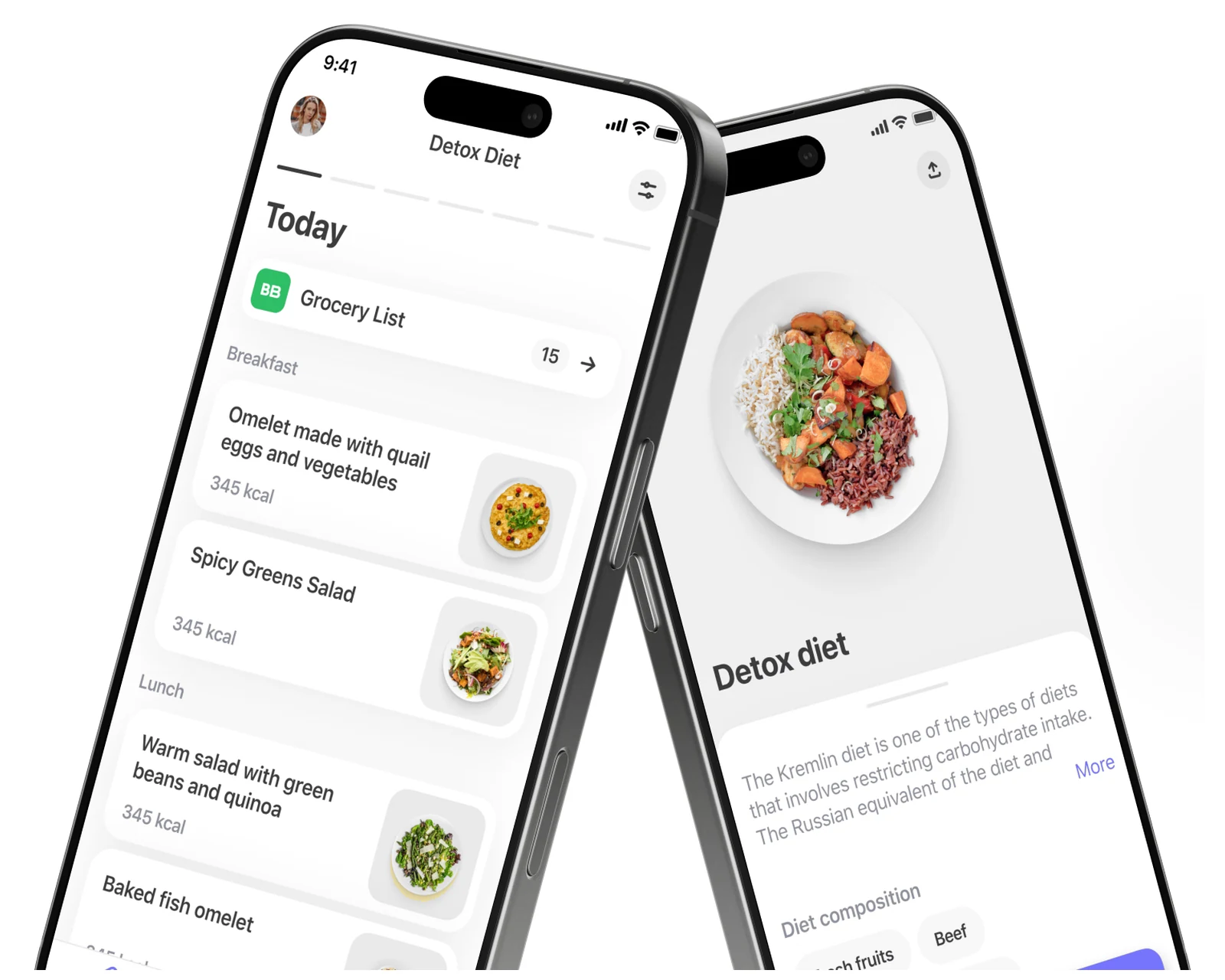
The BasilDoc product team ran an established web-based diet service and wanted a mobile counterpart on iOS and Android. The backend and a partial design system were already in place, but the team had no in-house mobile capability, an incomplete spec, and a hard requirement that In-App Purchase work cleanly across Apple StoreKit and Google Play Billing — across audiences in the United States and the European Union where storefront rules and tax handling differ in ways that matter at the codepath level. We built the mobile client in Flutter with Dart to ship both platforms from a single codebase. Because the spec was thin we ran stakeholder interviews to clarify real user flows — goal selection, calorie math, recipe consumption, weekly planning — and the answers drove backend and design adjustments that landed before any production code was written. A combined Scrum/Kanban cadence absorbed scope shifts without losing velocity, and In-App Purchase plumbing was treated as its own work stream with server-side receipt validation against both Apple's and Google's verification endpoints. The end result is a consumer HealthTech app ready for the US and EU storefronts and positioned as a flagship build in our mobile app development practice.
A snapshot of what the BasilDoc build delivered across one Flutter codebase, the calorie engine, and the In-App Purchase plumbing during its first production cycle.
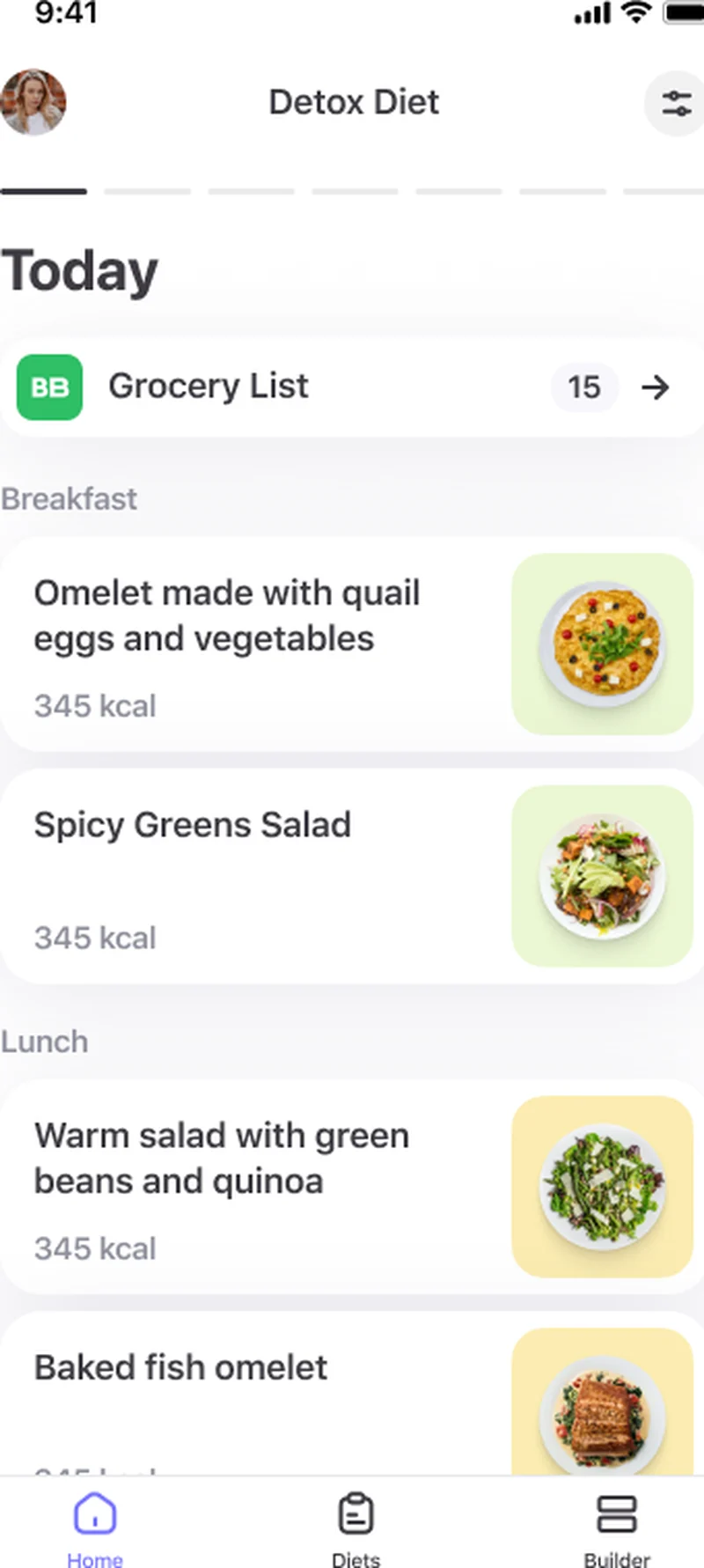
The stack decision dominates every other architectural choice in a cross-platform HealthTech build. We chose Flutter with Dart over React Native, parallel native iOS and Android, and Ionic / Capacitor because the trade-offs line up cleanly with a consumer nutrition product where pixel parity between platforms is a feature. Flutter renders through its own Skia-based pipeline rather than handing widget trees to OS-native primitives, which means a meal-plan grid behaves identically on iPhone and Pixel without per-platform layout drift. Material 3 covers Android and Cupertino widgets cover iOS, both from the same Dart source.
React Native was eliminated because the bridge overhead and rendering-pipeline differences add per-platform drift exactly where a HealthTech UI cannot afford it — the calorie engine numbers, the macro bars, the meal-plan grid all have to land on the same pixel on both platforms. Parallel native iOS and Android would have doubled build, QA, and release cycles for a feature set that does not need deep platform-specific integrations. Ionic / Capacitor's WebView-backed rendering loses the gesture fluency a consumer HealthTech app needs.
| Dimension | Flutter (BasilDoc) | React Native | Native iOS + Android / Ionic |
|---|---|---|---|
| Rendering model | Skia-based; pixel parity across platforms | OS-native primitives via JS bridge | Native: direct; Ionic: WebView |
| Codebase count | One Dart codebase for both stores | One JS/TS codebase with platform branches | Native: two codebases; Ionic: one web codebase |
| UI consistency | Material 3 + Cupertino — identical on iOS and Android | Platform-default — drift on layout edges | Native: full parity work; Ionic: web-feel |
| Build / release cadence | Single CI matrix builds both stores | Single matrix; native modules slow down | Native: two matrices; Ionic: web + wrappers |
| IAP integration depth | First-party StoreKit + Play Billing plugins | Community plugins; quality varies | Native: deepest; Ionic: WebView restrictions |
| Gesture fluency | High — Skia owns the frame | Variable — bridge can drop frames | Native: best; Ionic: WebView ceiling |
| Mature plugin ecosystem | Strong on consumer surfaces — payments, media, push | Strong, but heterogeneous quality | Native: full platform; Ionic: Cordova legacy |
Platform references: Apple StoreKit documentation, Google Play Billing reference, Material 3.
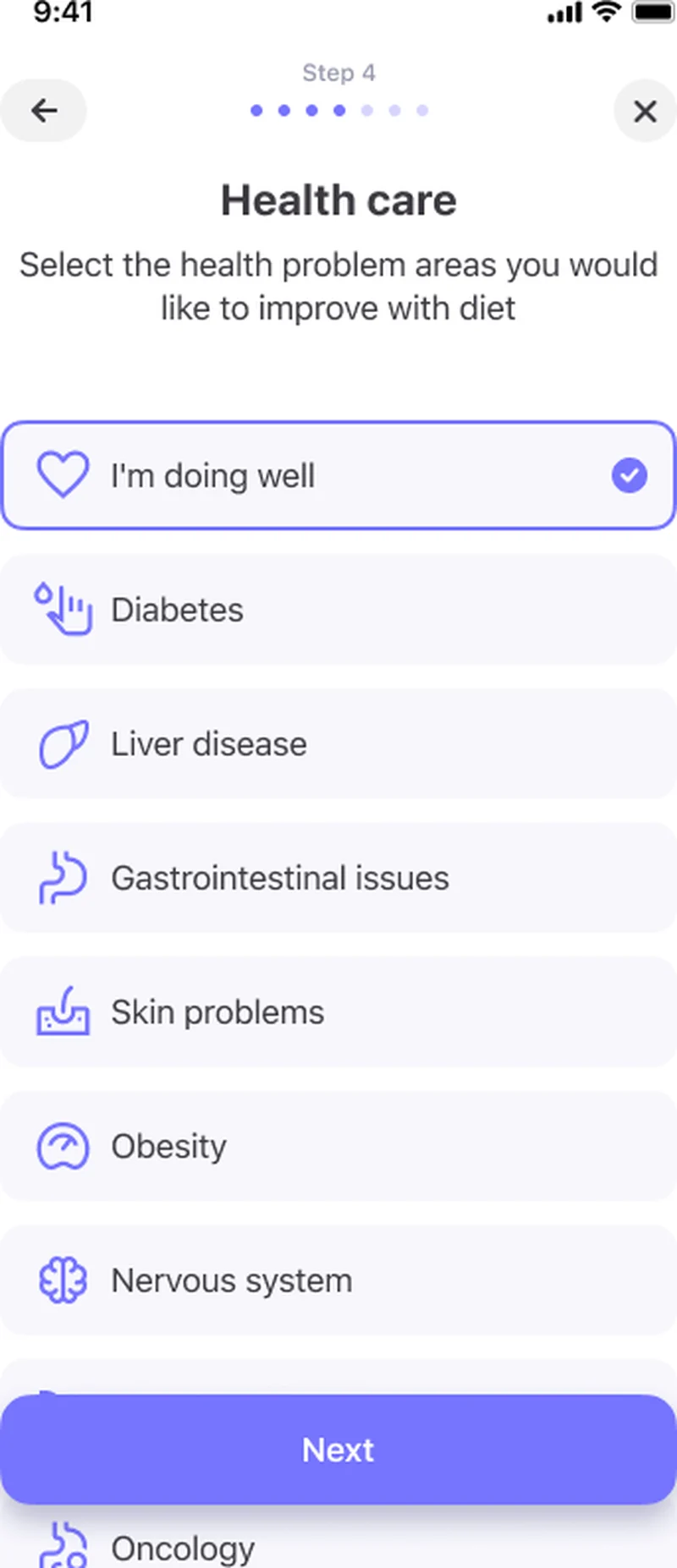
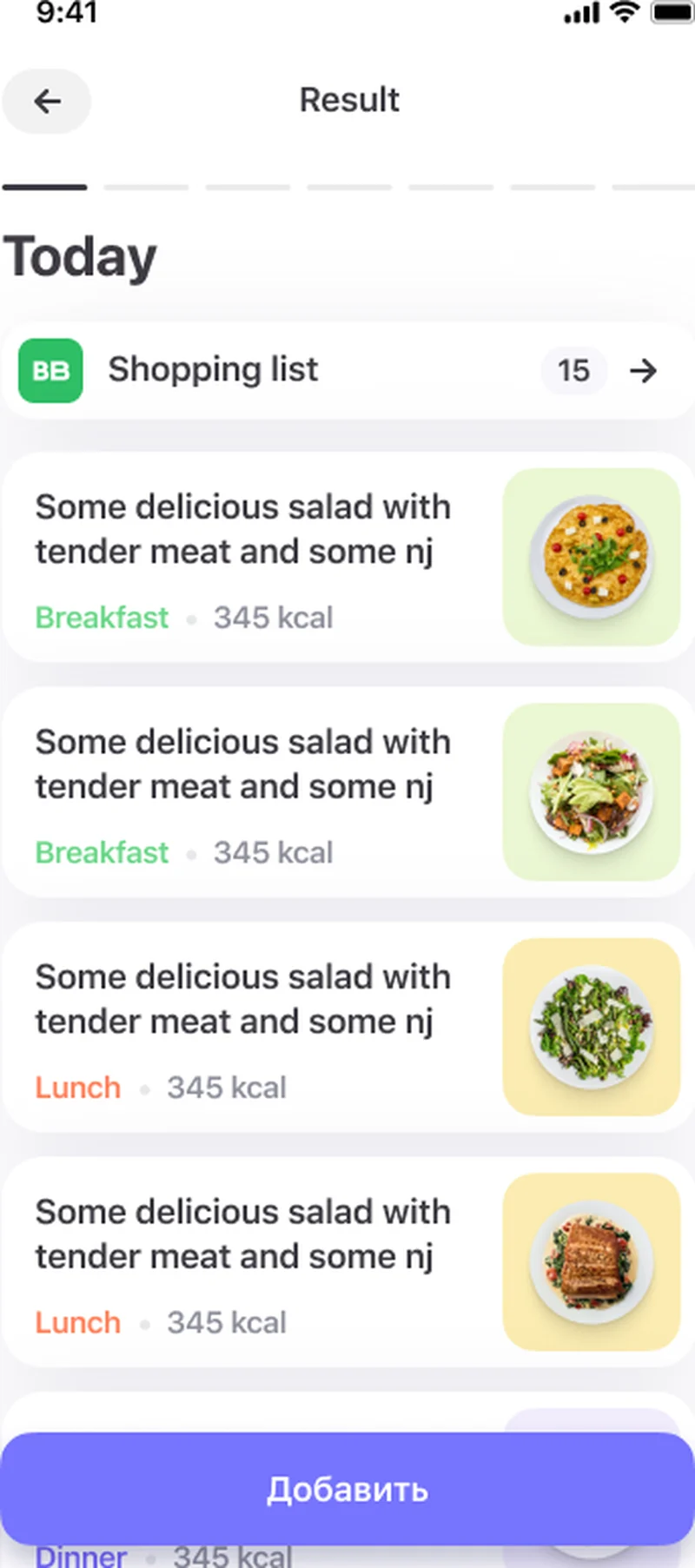
The iOS surface uses Cupertino widgets so the BasilDoc experience reads as native to an iPhone user — the navigation rhythm, the modal sheets, the picker behavior all match what a US or EU iOS audience expects out of the box. The calorie and macro engine sits in the Dart shared layer: a goal-based selector resolves to a daily calorie target and a macro split (protein, carbs, fat), the goal-based recommender surfaces programs that match the user's profile, and the recipe library renders with a video instruction player that respects iOS background-audio rules so a user can keep cooking while a step plays.
The whole iOS surface — onboarding, goal selection, calorie engine, recipe library, meal-plan constructor — is driven from the same Dart code that drives Android, with platform-aware widgets resolving the visual layer at render time. The In-App Purchase path is wired through the first-party Apple StoreKit plugin, with receipt-validation calls posting to the same server endpoint Android uses. The combined surface is delivered as part of our mobile app development practice, with a strict no-platform-drift CI gate keeping iOS and Android in lockstep on every release.
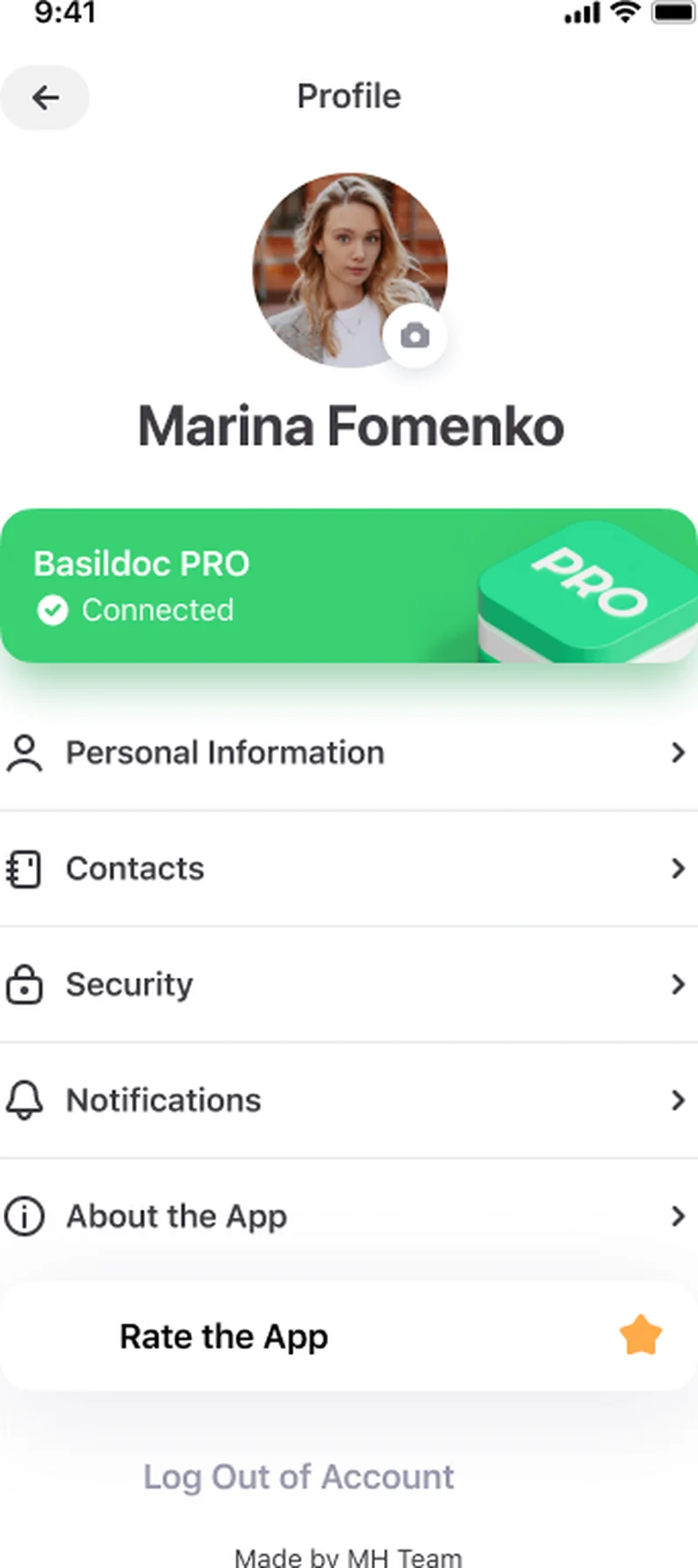
The Android surface uses Material 3 from the same Dart source, with platform-aware widgets resolving navigation, dialogs, and motion to Android-native rhythms. The weekly meal-plan constructor is the centerpiece: users pick a program, the calorie engine resolves a daily target and macro split, and the constructor populates seven days from the recipe library with swap-friendly slots so a user can substitute breakfast on Tuesday without rebuilding the rest of the week. Grocery-list export bundles the selected week into a single shareable list, and push reminders for meals are wired through Firebase Cloud Messaging on Android with an opt-in default to stay clean under GDPR for users in the European Union.
The In-App Purchase path on Android goes through Google Play Billing with the same server-side validator the iOS path uses. The single entitlement record drives feature gating across diet programs, recipe access, and meal-plan history — which means a user who subscribes on Android, then switches phones to iOS, restores access cleanly because the entitlement is server-side, not store-side. Background workers handle non-urgent operations — recipe-library sync, push-notification scheduling, certificate rotation — with backoff semantics that respect battery-saver states across Android 10 through Android 14 on Samsung, Xiaomi, OnePlus, and Pixel device families.
BasilDoc's privacy posture was an architecture decision before it was a marketing claim. The app collects only the personal data the calorie engine needs — goal, age range, weight target, dietary restrictions — and stores it under an opaque user ID that is deliberately separated from payment identity. Apple's and Google's verification endpoints hold the receipts; the server-side validator normalizes the response and writes a single entitlement record keyed by the opaque ID. The store side never sees the user's dietary profile, and the dietary side never sees the user's Apple ID or Google account.
Region-aware consent flows are wired at the client layer: users in the EU and EEA receive a GDPR-style granular consent screen with separate toggles for any optional product analytics; users in California receive a CCPA-style "Do Not Sell or Share My Personal Information" disclosure in the same flow. The posture is built to align with GDPR obligations for users in the European Union and CCPA / CPRA obligations for users in California and the broader United States — and to make a future independent privacy review a documentation exercise rather than an architectural retrofit.
Compliance posture: GDPR-aligned · ISO 27001 ready · SOC 2 Type II in progress · HIPAA-capable · CCPA-acknowledged.
A five-phase build that took BasilDoc from a thin spec and a web-only diet service to a production iOS and Android app with In-App Purchase plumbing.
Stakeholder interviews, user-flow validation, calorie-engine input/output contract, backend gap analysis, GDPR + CCPA posture mapping, Apple and Google review-policy review.
Flutter shared layer, Material 3 + Cupertino strategy, calorie and macro engine, meal-plan constructor data model, IAP entitlement schema, server-side receipt validator skeleton.
Goal-based diet selection, recipe library with video instruction player, weekly meal-plan constructor, grocery-list export, push reminders, In-App Purchase across both stores.
Server-side receipt validation hardening, privacy-policy authoring, region-aware consent flows, App Store HealthTech disclosure, Google Play sensitive-data review prep.
App Store + Google Play submission across US and EU storefronts, paid-tier rollout, push-reminder cohort tuning, opt-in analytics for goal-completion rate.
BasilDoc's monetization layer was built to keep payment identity and dietary profile provably separate, because a HealthTech privacy posture falls apart the moment a single database joins a StoreKit transaction to a goal selection. Subscriptions are sold through Apple StoreKit on iOS and Google Play Billing on Android, with server-side receipt validation hitting each store's verification endpoint and writing one entitlement record keyed by an opaque, rotated identifier — never by Apple ID, Google account, or email address. Inside the calorie engine and the meal-plan constructor, the only thing visible is a short-lived bearer token that maps to entitlement and expires aggressively. Diet program access, recipe-library unlocks, video instruction player gating, and weekly meal-plan history all read from the same entitlement record, so a single subscription resolves cleanly across reinstalls, device swaps, and the eventual web-account hand-off. The whole subsystem was built with extensibility in mind: adding a family plan, a multi-device entitlement, or a coach-and-client tier with paired profiles is a configuration change against the entitlement service, not a code release. The same posture leaves room for future AI/ML & data engineering features — personalized recommendations tuned to anonymized cohorts, not joined to payment identity.
BasilDoc was built for Apple App Store and Google Play storefronts active across the United States and the European Union. The English-language build serves users in California, New York, Texas, Florida, and Washington in the US, and users in the Netherlands, Germany, France, Ireland, and Sweden in the EU, without a separate codebase per region. Consent flows are region-aware at the client layer: users in the EU and EEA receive a GDPR-style granular consent screen with separate toggles for any optional product analytics; users in California receive a CCPA-style "Do Not Sell or Share My Personal Information" disclosure in the same flow. Data-handling practices are aligned with GDPR for European users and with the US state-privacy patchwork — CCPA / CPRA (California), VCDPA (Virginia), CPA (Colorado), CTDPA (Connecticut), UCPA (Utah), TDPSA (Texas), and Oregon CPA. Because the opaque user ID isolates dietary data from payment identity, regional compliance reduces to honest disclosure rather than per-jurisdiction data segregation.
The In-App Purchase pipelines were tested against Apple's sandbox and Google Play's license-testing channel across both regions in parallel, and the App Store age rating plus Google Play content rating were calibrated for the HealthTech feature set. The privacy policy was drafted to document exactly the architecture above, citing GDPR obligations and California CCPA obligations directly. The engineering team behind the build sits across CET and runs a CET workday with East-Coast US overlap (9 AM–1 PM ET) for stand-ups, store-review choreography, and incident response — the timezone that lets a US product team and an EU engineering team share four hours of live overlap every day.
The active custom software development roadmap for BasilDoc includes a wearable-data ingest path for Apple Health and Google Fit, an offline-first recipe cache for low-connectivity travel, a coach-and-client paired tier for nutritionists in the US and EU, and a desktop companion sharing the Flutter business logic via Flutter Desktop. A US-focused and an EU-focused growth funnel are planned with region-specific recipe libraries, and the entitlement subsystem already supports the multi-seat assignment that a future B2B nutrition tier will need.
If you are planning a cross-platform diet, nutrition, or HealthTech app where the In-App Purchase plumbing and the privacy posture have to survive an Apple and Google review for audiences in the US and EU, we have shipped this stack end-to-end and can compress the build timeline meaningfully. The engineering team behind it sits inside YuSMP Group. We work fixed-price for well-scoped MVPs and on dedicated development teams for ongoing delivery, with a CET workday and a guaranteed East-Coast US overlap (9 AM–1 PM ET) window for stand-ups, demos, and incident response.
A cross-platform diet and meal-planning MVP covering iOS and Android via Flutter, a calorie and macro engine, a recipe library, and In-App Purchase plumbing typically costs $90k–$210k. Adding a goal-based recommender, weekly meal-plan constructor, grocery-list export, video instruction player, and push reminders brings a full-featured product to $250k–$520k. The dominant cost drivers are the calorie engine accuracy, the In-App Purchase receipt validation across two stores, and the GDPR and CCPA consent flow tuned for US and EU storefronts.
Flutter ships one Dart codebase to iOS and Android with pixel-accurate Material 3 and Cupertino widgets, which suits a consumer HealthTech product where parity across platforms is a feature, not an accident. Compared with React Native, the rendering pipeline is more predictable and the bridge overhead is lower. Compared with native iOS and Android in lockstep, a single codebase cuts the build, QA, and release cycles roughly in half for a feature set that does not need deep platform-specific integrations.
In-App Purchase is its own work stream. The iOS client integrates Apple StoreKit, the Android client integrates Google Play Billing, and both client paths post receipts into a single server-side validator that hits Apple's and Google's verification endpoints, normalizes the response, and writes one entitlement record per user. That record drives feature gating across diet programs, meal plans, and recipe access. Server-side validation is mandatory — client-only receipt checks are trivially bypassable and disqualify the entire subscription posture.
The app collects only the personal data needed to run the calorie engine — goal, age range, weight target, dietary restrictions — and stores it under an opaque user ID that is not joined to payment identity. Region-aware consent flows present a GDPR-style granular consent screen to users in the EU and EEA and a CCPA-style disclosure to users in California. Push reminders are opt-in by default in both regions, and the privacy policy documents every data path the calorie engine and meal-plan constructor use.
A focused MVP with goal-based diet selection, a calorie and macro engine, a recipe library, weekly meal-plan constructor, and In-App Purchase on both stores typically takes 14–22 weeks. Adding a video instruction player, grocery-list export, personalized recommendations, and push reminders for meals adds 6–10 weeks. The store-submission and review-choreography pass — Apple's HealthTech disclosure, Google Play's sensitive-data review, and a privacy policy that covers US and EU consent flows — should be budgeted at 3–5 weeks of dedicated work.
Related cases
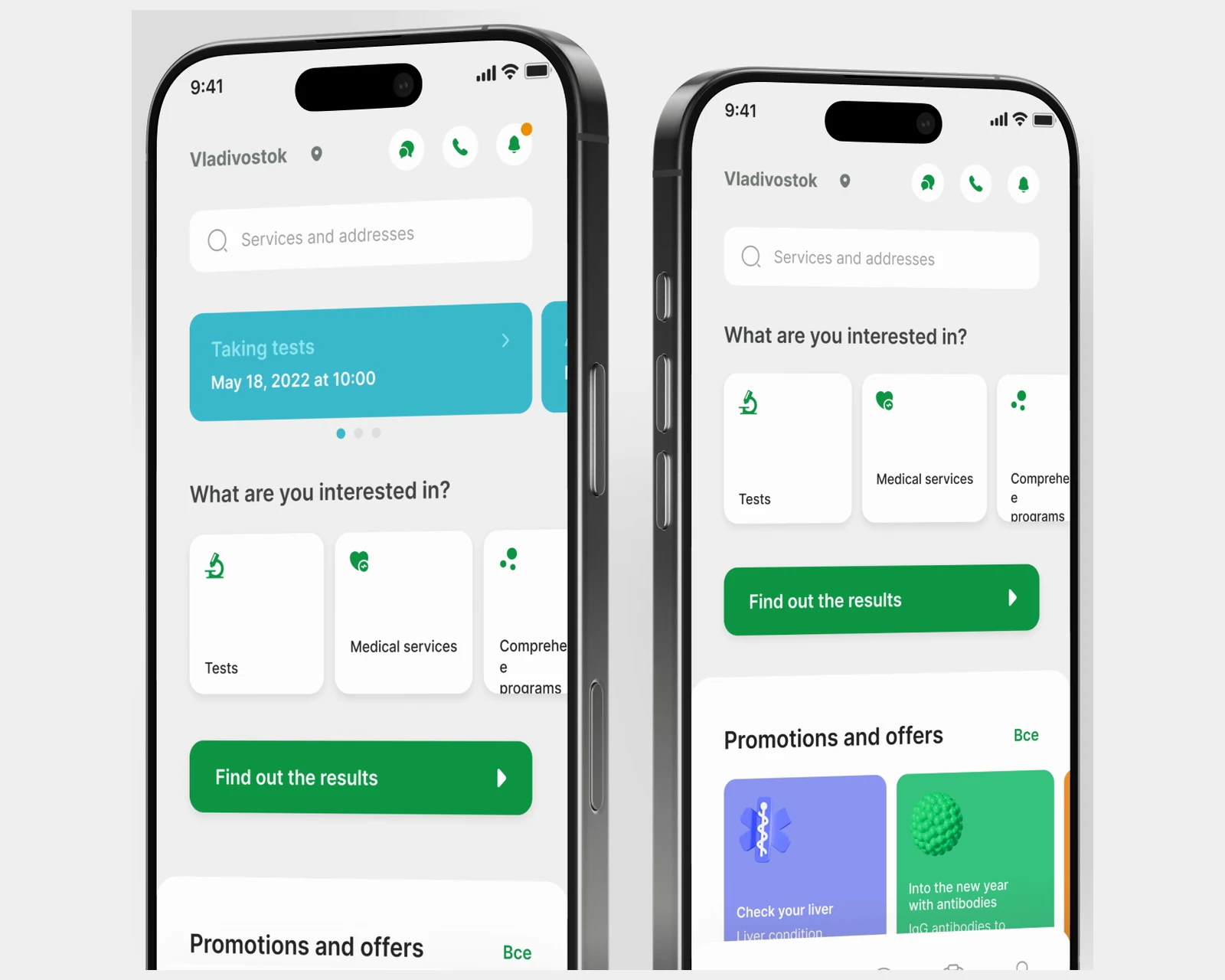
Patient app for a multi-city lab network — appointment booking, results, push notifications, accounting integration.
View case →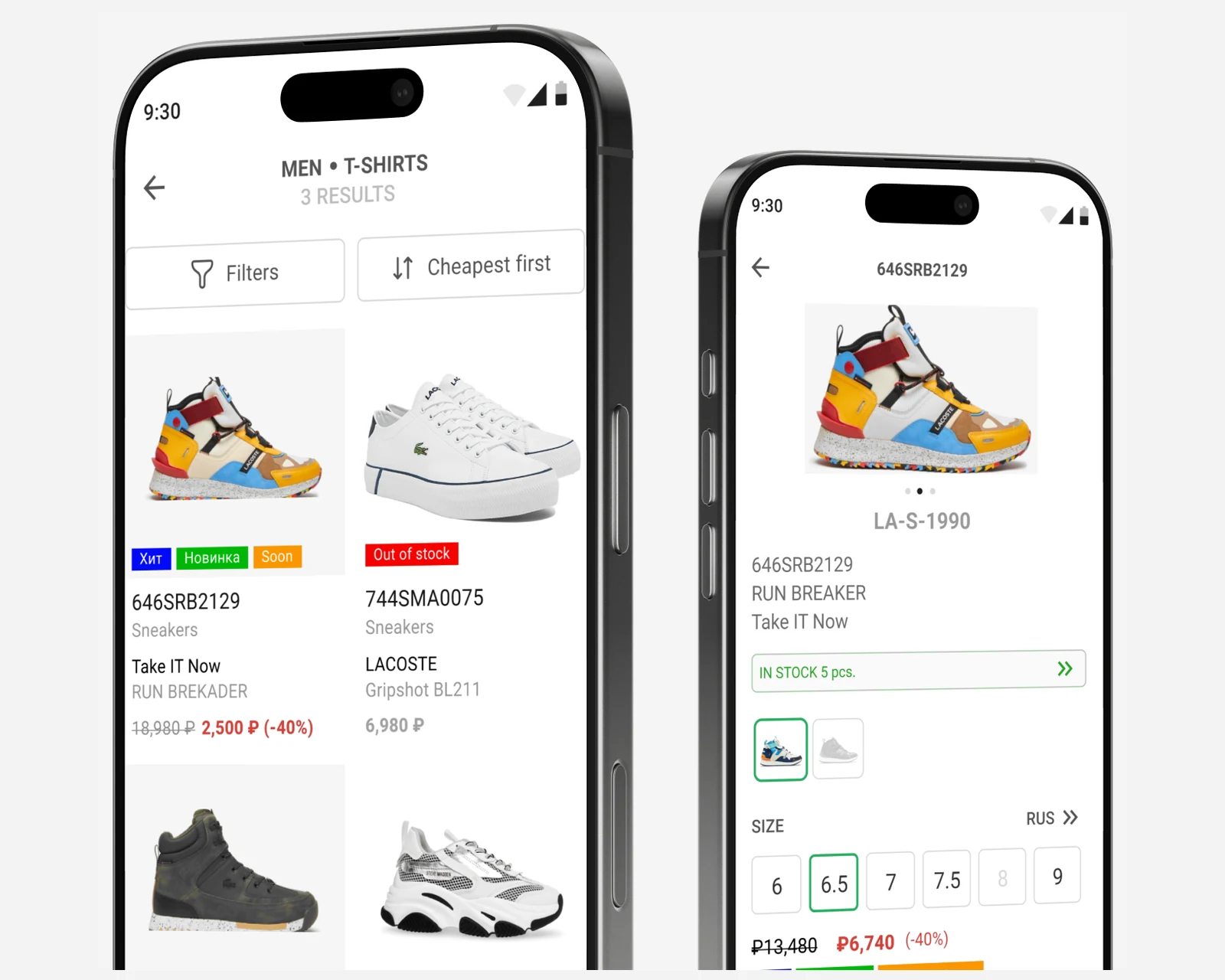
Retail consultant app for boutique inventory across stores — ElasticSearch search, 1C integration.
View case →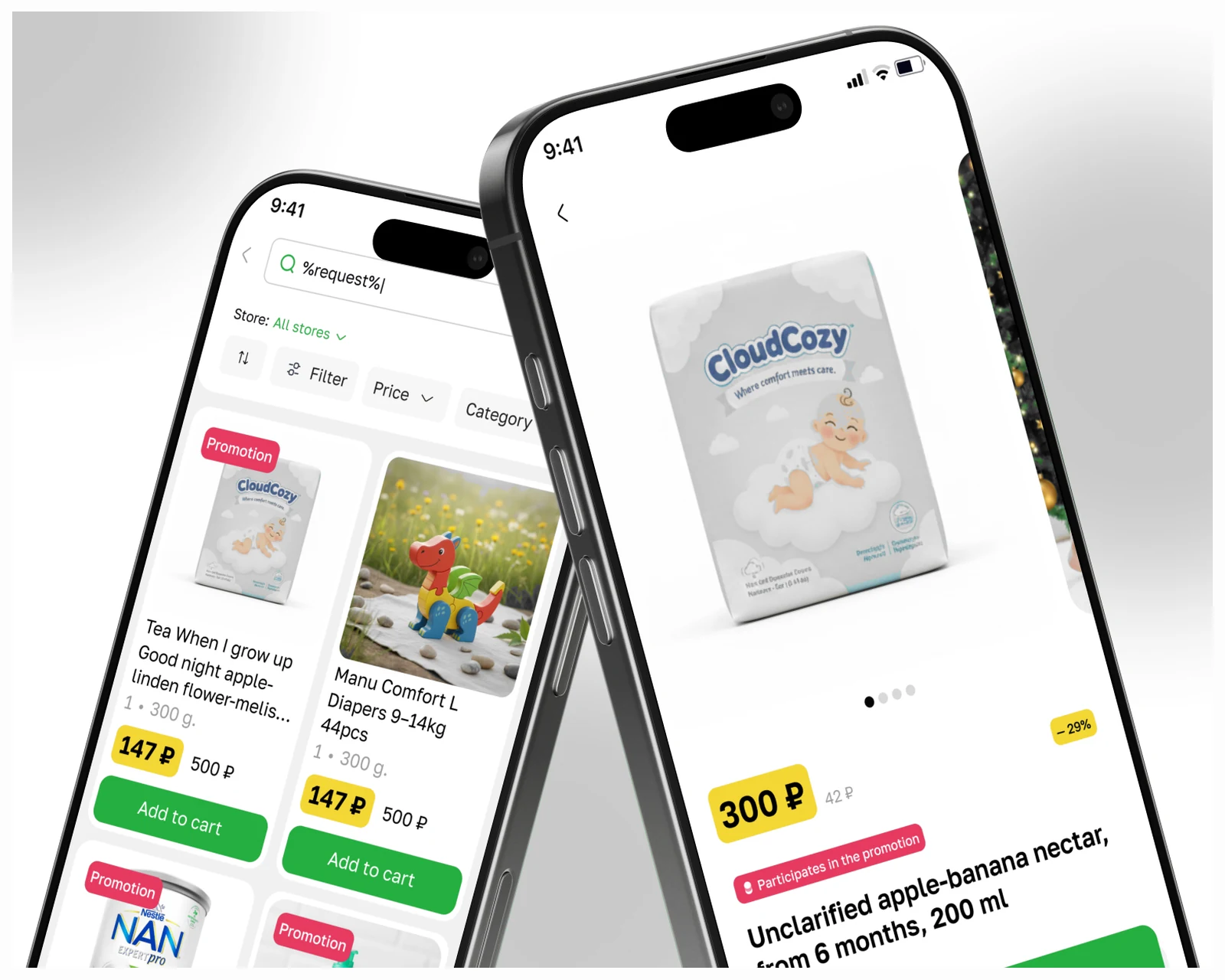
Local marketplace mobile app for an offline children's-goods chain — flexible catalog, online stock sync.
View case →
Investor-ready MVP shipped in 12 weeks for 60-120k EUR. Senior PM, designer, engineers, QA.
Learn more →
Native iOS, Android, and cross-platform apps with store-ready release pipelines.
Learn more →
Multi-tenant SaaS platforms with SSO, billing, region-pinned residency. SOC 2 in progress.
Learn more →Share a few details and a senior consultant will reply within one business day.