


Sign-up and store selection
Users start shopping quickly by choosing the store for pickup or delivery.
E-commerce · Mobile app
A kids’ goods marketplace with native iOS and Android apps and a web admin panel, integrated with 1C for products, stock and prices and with Yandex Delivery for shipping. Shoppers check out in two taps. Stack: PHP Symfony, React, Kotlin, Swift.
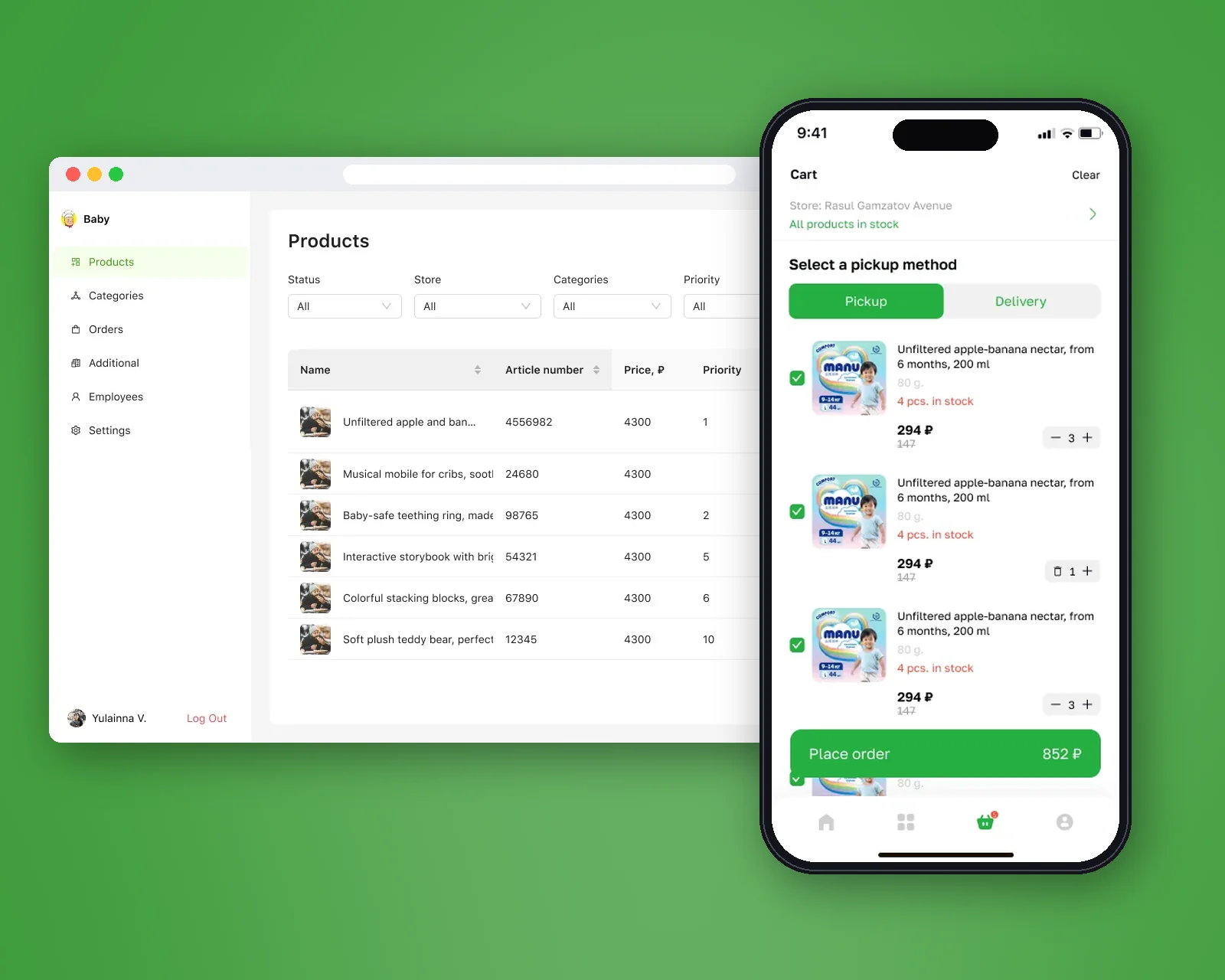
In short: what the product is and who we built it for.
The client owns an established chain of brick-and-mortar stores selling kids’ goods. Under the terms of our agreement, the owner’s name is not disclosed; this case describes our engineering work rather than the client’s brand.
We designed a connected ecosystem rather than a standalone app: the shopper picks a store, fills the cart and places a pickup or delivery order in two taps, while the business manages the catalog and orders from a single web panel. The catalog, stock and prices live in 1C and flow into the marketplace without manual entry, and delivery is handled by the Yandex Delivery integration.
The original idea was simple: build a mobile app for ordering and delivery. During analysis, however, we identified the key problems the product actually had to solve.
For customers: a purchase in just a few taps and no need to spend time driving to the store with children. For the business: delivery automation without manual coordination with courier services, a simple CRM for tracking and managing app orders, and an online assortment synced with real store stock through the 1C integration.
How we built the product, from architecture to process.
We built an ecosystem in which every element solves a specific task. The shopper gets started quickly by choosing a store for pickup or delivery, finds products by category and checks out via a short path: cart, fulfillment method, order.
On the business side, the administrator sets up the structure of categories and attributes, sees all app orders in a single feed and manages their statuses. Products, stock and prices load automatically from 1C, and delivery orders go to Yandex Delivery, all in one interface, with no manual work and no discrepancies.
The defining feature of the project was the integration stage that came right after design. We knew that reliable work with external systems (1C, delivery services) was the foundation of the future product, so we made integrations a separate, carefully planned phase: a hybrid approach with Waterfall for the 1C and delivery exchange and Agile for UI/UX let us budget the complex integrations precisely while keeping the interface work flexible.
Tools chosen to fit the product’s goals.
The stack was driven by requirements for performance, reliable data exchange with 1C and the quality of the native UX.
Native vs cross-platform. React Native and Flutter speed up the first release but limit access to system APIs and reduce performance with a large catalog. For a marketplace with thousands of items, background syncs and integrations, a native stack delivers predictable behavior and a lower crash rate.
Key capabilities that solved the business problem.
Users start shopping quickly by choosing the store for pickup or delivery.
Products are easy to find by category and, in the future, by many attributes such as brand, age and material.
Buying is as simple as possible: cart, fulfillment method, order.
The administrator sets up a rich structure of categories and attributes that makes the catalog easy to navigate.
All app orders appear in a single feed; statuses can be tracked and edited manually when needed.
Products, stock and prices load from the accounting system, and orders are sent to Yandex Delivery with full tracking data.
Key product screens, step by step.
The app storefront opens with a promo banner and a product selection: each card shows the price, the crossed-out old price, the discount and an “On promotion” label. Parents add an item to the cart in one tap without digging into details.
The bottom tab bar gives constant access to Home, Catalog, Cart and Profile, so any section is always one gesture away.
On the home screen, the shopper sees search, the status of the current order (“On the way”), the bonus points balance and a “Promotions and discounts” block. Everything needed for a repeat purchase is on one screen.
Store selection lives in a separate bottom sheet: a list of the chain’s addresses with a radio button to choose a pickup or delivery location. Product availability and prices depend on the selected store.
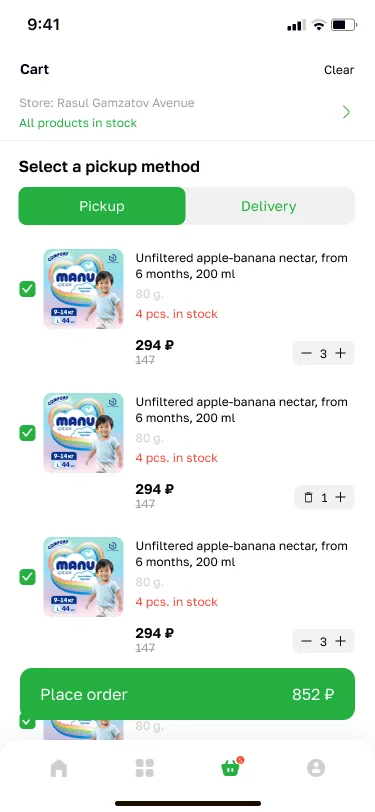
In the cart, the shopper ticks the items they need, changes quantities and immediately sees availability at the selected store and the order total. Out-of-stock items do not block checkout.
Two tabs switch the fulfillment method between “Pickup” and “Delivery”, and the order is confirmed with the “Place order” button. The purchase path is as short as it gets: cart, fulfillment method, order.
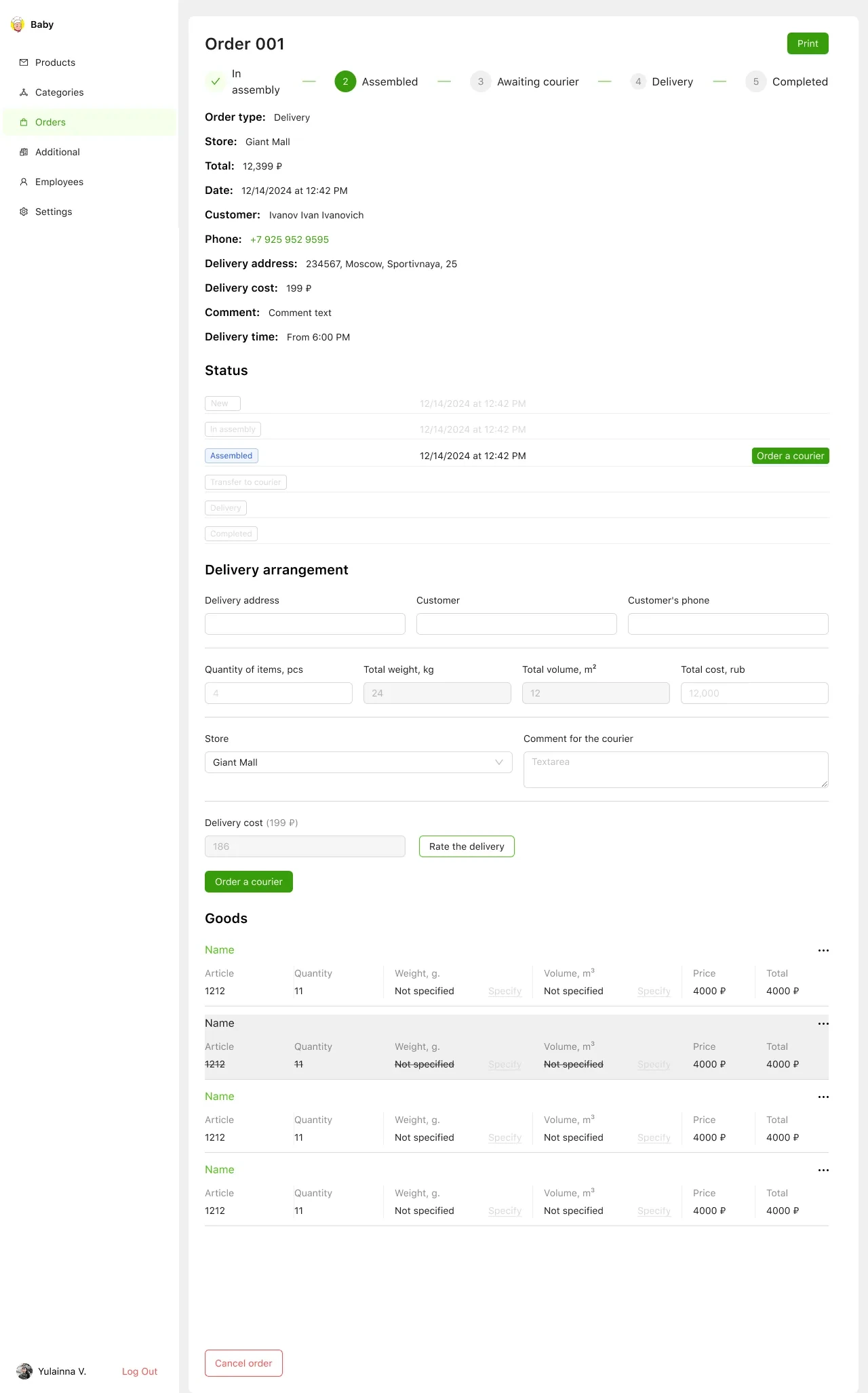
The order card in the web panel guides the manager through the statuses: “Being picked”, “Picked”, “Awaiting courier”, “Out for delivery”, “Completed”. It also holds the order details: order type, store, amount, customer, address and delivery time.
The “Delivery booking” block calculates the cost via Yandex Delivery and books a courier with the “Order courier” button; accompanying documents are printed straight from the card.
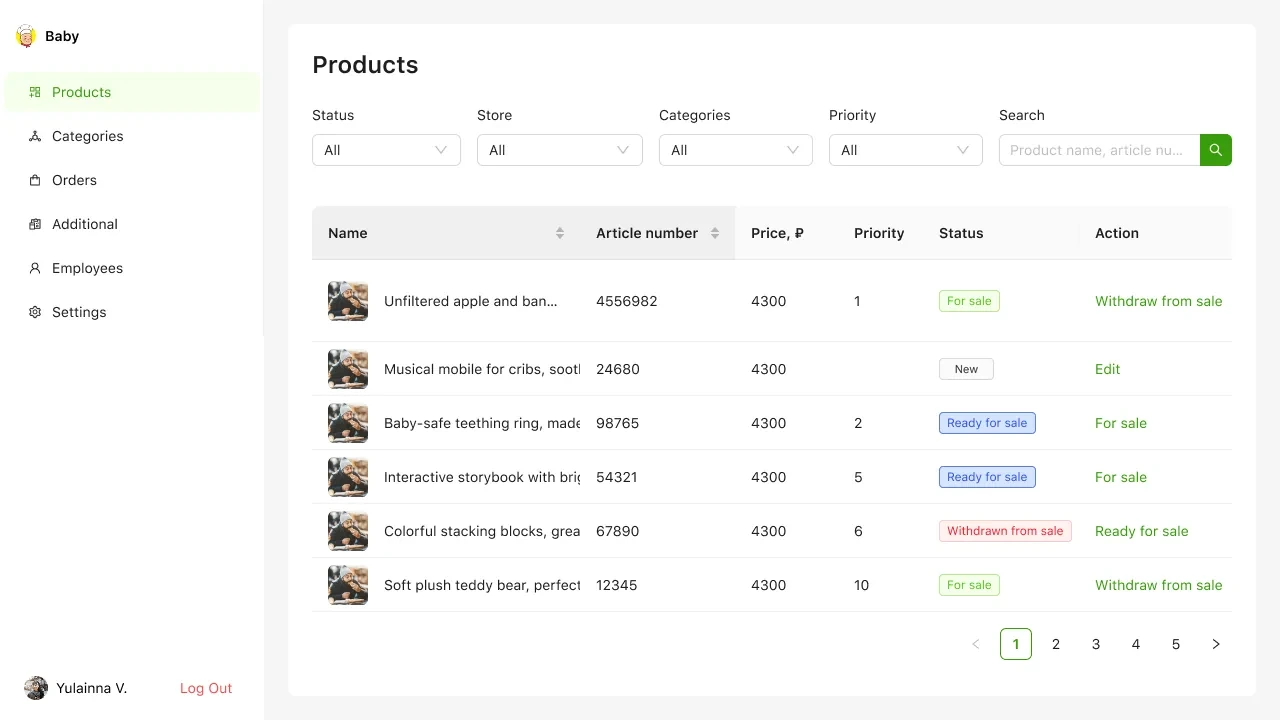
The Products section gives the administrator a full view of the assortment: filters by status, store, category and priority, search by name and SKU, thumbnails and prices in a single table.
Each item’s status (“On sale”, “New”, “Ready for sale”, “Withdrawn”) is switched right in its row, and pagination keeps the table readable even with a large catalog.
All app orders land in a single feed with filters by order type, status and store and an overall counter. The table shows the order number, customer name, store, fulfillment method, date, amount and status.
Color-coded status labels (“New”, “Picked”, “Being picked”, “Cancelled”, “Completed”) let the manager assess the queue in a second and pick up the right order.
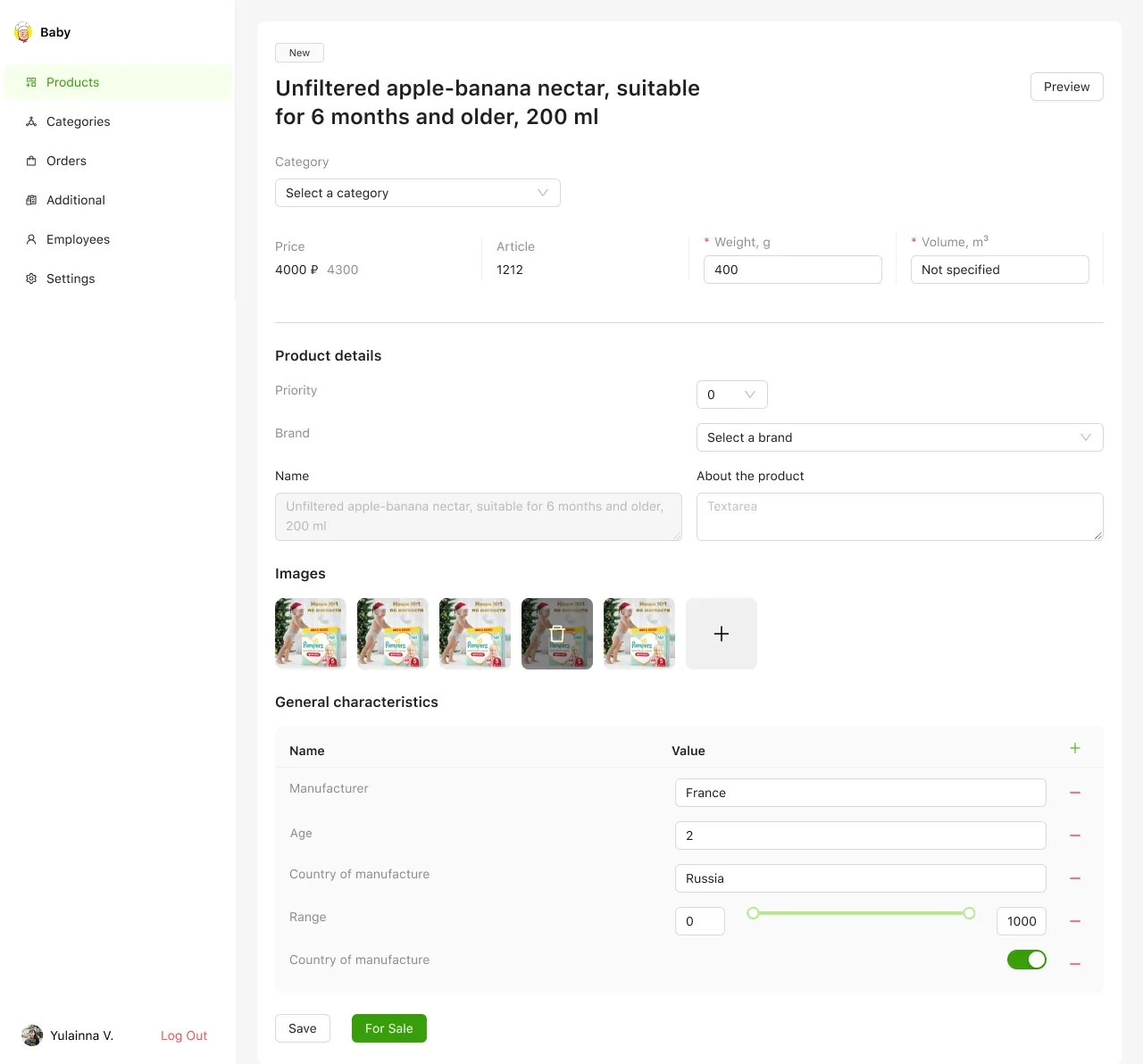
The product form brings everything together: category, price and discount, SKU, weight and volume, priority, brand, name and description. The Images block lets you upload and reorder the card’s photos.
A flexible “General attributes” editor adds custom attributes such as manufacturer, age, country and numeric ranges, which makes the catalog easy to browse and filter on the shopper’s side.
Customer data (contacts, delivery addresses, order history) is shared with Yandex Delivery only to the minimum extent needed to calculate the route and book the shipment. The 1C exchange covers only the product catalog and stock levels; no personal data is sent to 1C.
Data minimization is built into the architecture: personal data is processed under the requirements of the client’s jurisdiction, stored on the client’s locally hosted server, with role-restricted access.
2 native apps, iOS (Swift) and Android (Kotlin), plus a React web admin panel.
Automatic exchange with 1C: products, stock and prices sync without manual entry.
Yandex Delivery integration: delivery cost calculation and booking right in the app.
Two-tap checkout: choose a product, confirm the order, done.
Flexible catalog management: categories, assortment and prices via the web panel, no developer needed.
The typical window for a marketplace MVP with native apps is 16–28 weeks (an industry range, not a guarantee for a specific project).
The cost of a marketplace MVP with native iOS and Android apps, a web panel and 1C integration depends on the number of integrations, the depth of the catalog and the UX requirements. We give an exact estimate after analyzing the specification and identifying the key risks, and the final price is fixed in the contract before development starts.
Your own app gives you full control over UX, analytics and customer loyalty: no marketplace commissions, no risk of account suspension and no dependence on someone else’s algorithms. The app creates a direct communication channel through push notifications, lets you run loyalty programs and collect data on customer preferences within the applicable privacy requirements.
The integration runs through the Symfony API: 1C sends catalog updates (products, stock, prices) on a schedule or whenever something changes. Symfony processes the update queue and syncs the marketplace database without a manager’s involvement. Sync errors are logged and shown in the web admin panel, so the manager sees the status of every exchange.
Customer data (name, phone, delivery address) is stored on the client’s server under the requirements of the client’s jurisdiction. Yandex Delivery receives only the minimum set needed to book a shipment, and no personal data is sent to 1C. We also provide templates of the core privacy documents, such as a data processing policy.
A typical marketplace MVP with two native apps, a web panel and 1C integration takes 16–28 weeks. The range depends on the number of integrations, catalog complexity and how quickly approvals happen on the client’s side. The actual timeline of the Malysh project is not disclosed; it fit within the industry range.
Companies from retail, medtech, logistics and e-commerce that we helped build digital products.









The full spectrum of development — from native mobile apps to web platforms, AI and cloud. Pick a direction or order a turnkey project.
Native iOS & Android plus cross-platform Flutter and React Native — from MVPs to apps with millions of installs.
Learn moreNative Swift / SwiftUI iOS apps — with Apple Pay, Sign in with Apple, App Store Connect deployment pipelines.
Learn moreNative Kotlin / Jetpack Compose Android apps — Material 3, Google Play release pipelines, Firebase integration.
Learn moreSingle Dart codebase across iOS, Android, web and desktop — with native modules where needed.
Learn moreProduction web apps on React, Next.js, Vue and Node — SaaS dashboards, B2B portals, marketing-conversion stacks.
Learn moreREST, GraphQL and gRPC APIs — designed for partners, mobile clients and internal microservices.
Learn moreBespoke platforms for mid-market and enterprise teams — internal tools, vertical SaaS, mission-critical backends. Discovery to launch in 12–36 weeks.
Learn moreFocused MVPs in 12–20 weeks — one or two integrations, real users on day one, telemetry built-in.
Learn moreEnd-to-end ownership of a digital product — design, build, ship and continuous evolution.
Learn moreTool-using agents that plan, retrieve, act and self-evaluate — in customer service, ops automation, internal copilots.
Learn moreAWS, Azure and GCP architecture, Kubernetes, Terraform/Pulumi, CI/CD and observability — SRE-grade operations for product teams.
Learn moreTechnical SEO, Core Web Vitals, structured data, internal-link architecture — built into your engineering process.
Learn moreRelated cases
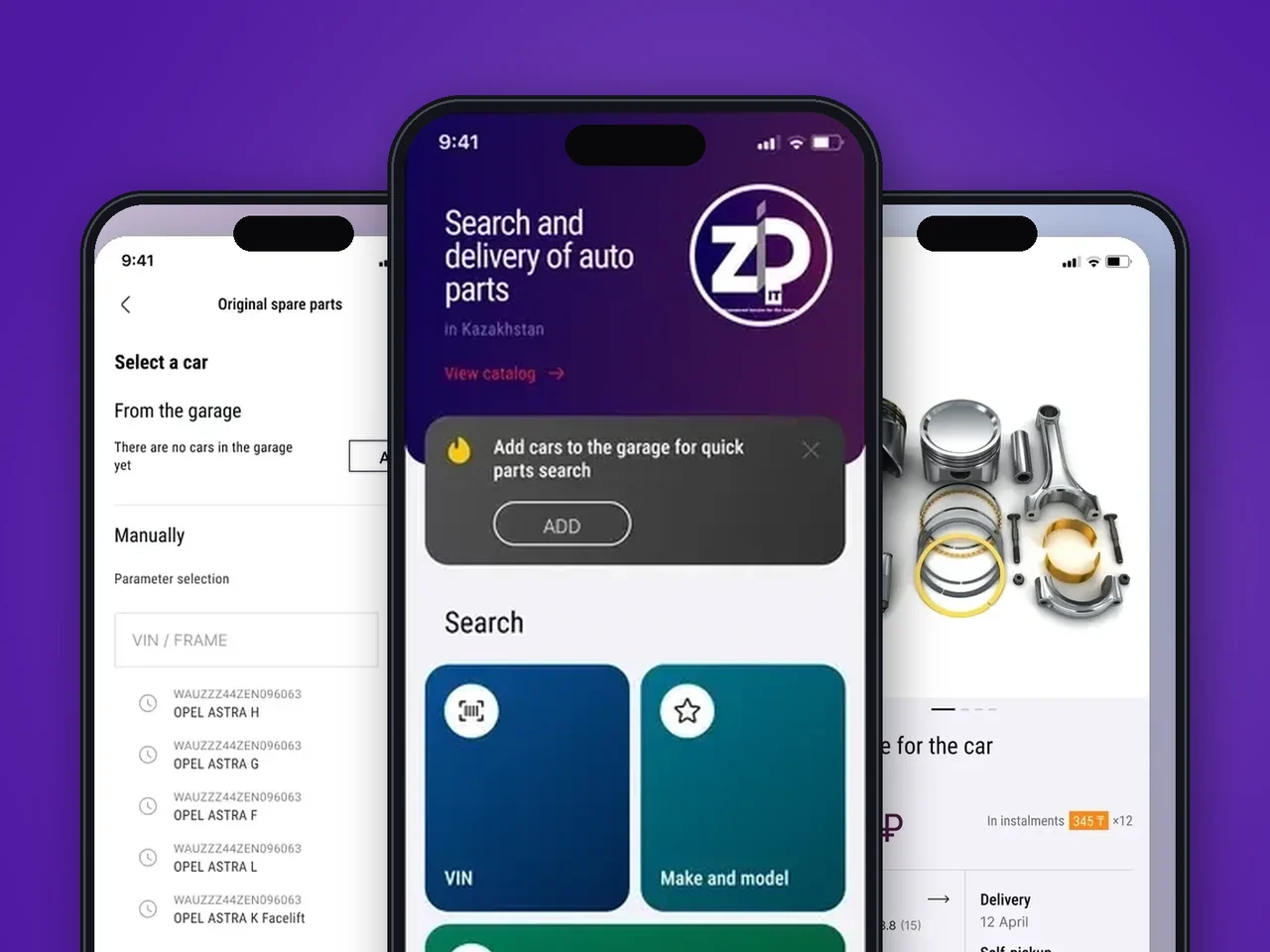
Auto-parts marketplace plus multi-tenant seller CRM — VIN search via Laximo, cross-location inventory, integrated delivery.
View case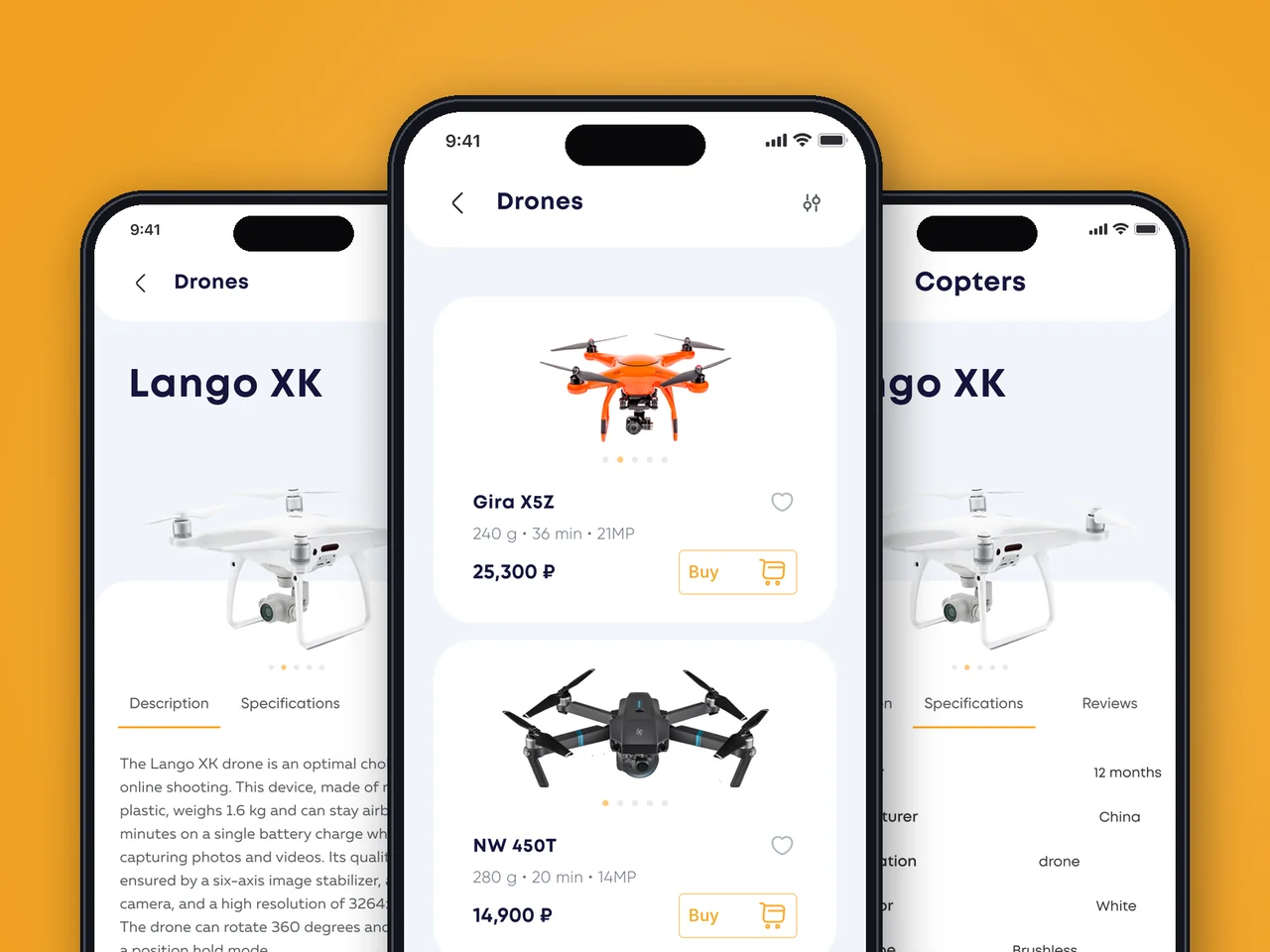
A training and product-knowledge app for retail staff that links sellers, retailers and vendors: catalog, courses and tests, requests, offline mode and an admin panel.
View case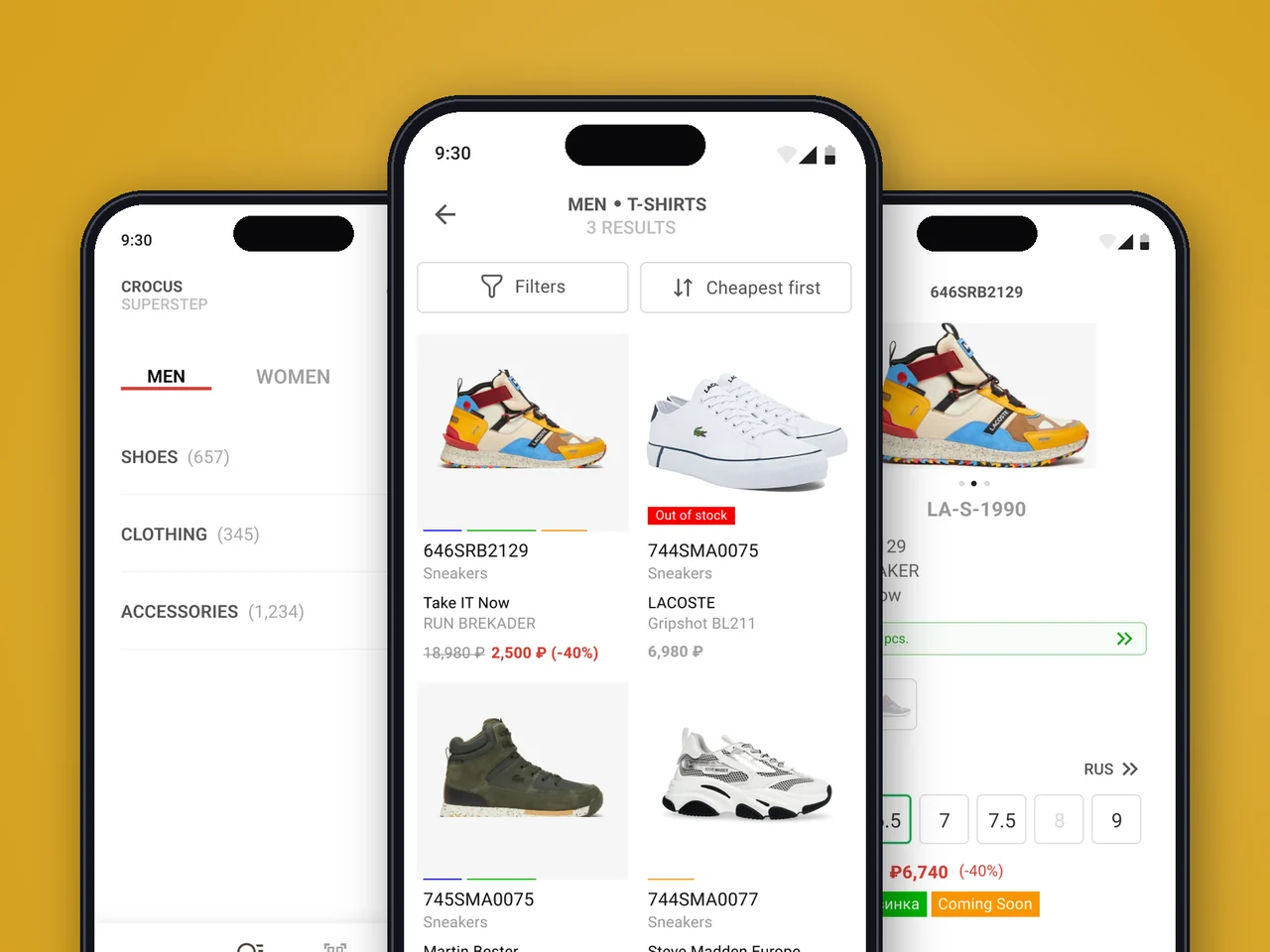
Retail POS companion app for a multi-brand boutique chain — ElasticSearch cross-store inventory search, 1C-system integration.
View case20 articles across 5 categories — engineering-led guides on AI, SaaS, MVP, compliance and mobile for US and EU product teams.

Performance-tested comparison of RN (New Architecture) and Flutter (Impeller) across hiring, time-to-market and EU/US compliance.
Read article
Real cost ranges by region (US onshore, Western EU, EU nearshore), team and feature scope. With a worked fintech example.
Read article
Data-driven framework for choosing iOS-first or Android-first in 2026 — US & EU market share, ARPU, review timelines, EU DMA.
Read articleTell us about your stores, your accounting system and how you deliver today, and we will help you design apps that sync with it automatically. Let’s discuss how a similar solution could work for your business.
Share a few details and a senior consultant will reply within one business day.
Email: sales@yusmpgroup.com
Phone: +374 44 871 811
Offices: KAMAR Business Center, Vazgen Sargsyan St. 2, Yerevan, Armenia · Remote — East-Coast US overlap (9 AM–1 PM ET)