Stakeholder interviews
Founder and florist interviews, analytics on the existing operation, customer journey mapping for gift-buyers in the US and EU, scope of the substitution policy.

Case study · Retail · Floristry
How we ran a full discovery for FlowDelivery — a paired customer-and-florist mobile product covering analytics, UX, and system architecture, with a stock-aware catalog, dynamic product cards, a three-step customer checkout, and a unified data model that holds up to US and EU audience expectations under GDPR and CCPA from day one.

FlowDelivery's founders came to us with a coordinated pair of mobile products to design: a customer-facing app for ordering bouquets with delivery, and an internal florist app for managing assortment and tracking component availability. The two apps had to share a data model so catalog visibility reflected real-time stock without manual intervention, and the customer experience had to compress the bouquet-buying decision — historically a high-anxiety purchase — into a three-step checkout. The buyer profile spans the United States and the European Union for floristry delivery: gift-buyers who arrive with under two minutes of attention, a strong visual taste filter, and a real expectation that what they see on the product card is what shows up at the recipient's door. Code-first MVP approaches were eliminated early because the inventory rules, the substitution policy, and the multi-store catalog reconciliation cannot be inferred from screens alone — a first build typically rebuilds the data model two or three times in the first six months. Off-the-shelf marketplace templates were eliminated because their bouquet-as-product model assumes a flat SKU catalog and cannot represent the recipe-of-components structure floristry actually requires. The result is a Figma-driven discovery package — customer journey map, typed data model, OpenAPI specification, clickable prototype, design tokens, substitution policy table, and a discovery-to-build handover document. The package is the artifact a build team can use to scope a fixed-price build, and the founder can use to evaluate vendor proposals on a level playing field.
A snapshot of what the FlowDelivery discovery delivered across the customer app, the florist app, and the shared data model in its first cycle.

The methodology decision dominates every other architectural choice on a paired customer-and-operator product. We chose a Figma-driven discovery process producing a typed data model, an OpenAPI specification, and a clickable prototype before any production code was written, because the trade-offs line up cleanly with how a paired customer-and-florist product actually fails when rushed. A code-first MVP typically rebuilds the data model two or three times in the first six months because the inventory rules and the substitution policy cannot be inferred from screens alone — and each rebuild costs more than the discovery phase would have. Off-the-shelf marketplace templates were eliminated because their bouquet-as-product model assumes a flat SKU catalog and cannot represent the recipe-of-components structure floristry requires.
The third candidate, a pure UX wireframes pass without architecture, is a legitimate cost-saver — but for a paired customer-and-operator product the data model is the product, and a wireframes pass that does not address the typed data model and the API contract leaves the build team to invent both. The discovery package — customer journey map, typed data model, OpenAPI specification, Postman collection, component library with design tokens, clickable prototype, and architecture decision record — is open and citable end-to-end, with no vendor or template chain that locks the build team into a single methodology.
| Dimension | Discovery-led (FlowDelivery) | Code-first MVP | Off-the-shelf template |
|---|---|---|---|
| Rework rate | Low — data model and API are validated in design | High — two or three data-model rebuilds typical | Hidden — template constraints force shape |
| Spec quality | OpenAPI + Postman + journey map | Inferred from code as it ships | Documented by vendor; varies |
| Architecture clarity | ADRs for every significant trade-off | Implicit; team-dependent | Vendor-defined; opaque |
| Time-to-investable artifact | 6–10 weeks — fundable on a prototype | 3–6 months — depends on build pace | 2–4 weeks — but undifferentiated |
| Change cost | Low — change spec, not code | High — code refactor every iteration | Bounded by template flexibility |
| Vendor portability | High — spec is build-team-agnostic | Low — code is build-team-coupled | Zero — locked to vendor |
| Compliance fit (US & EU) | Designed in — consent in user flow | Bolted on post-launch | Vendor-controlled; varies |
Methodology references: OpenAPI Initiative, Figma documentation, Postman learning center.
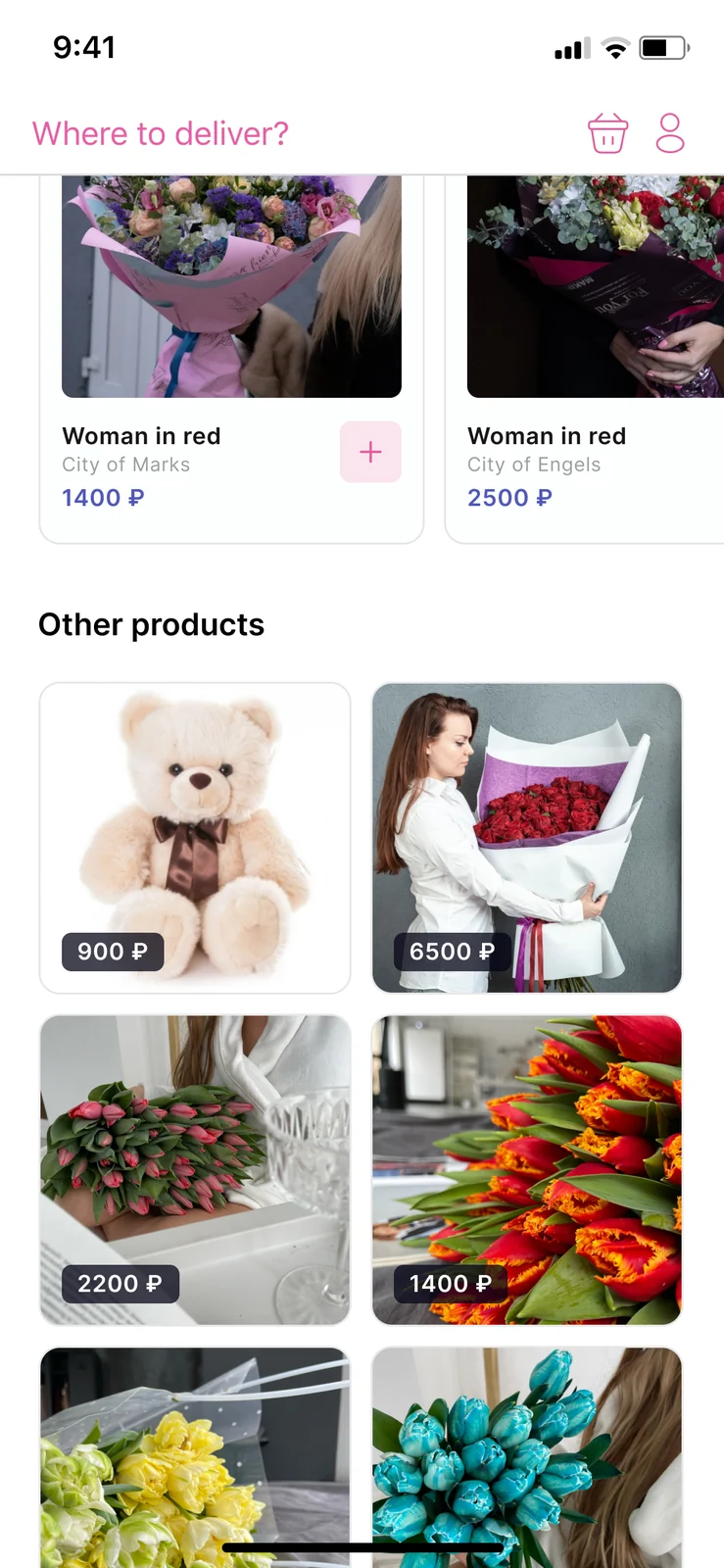
The customer app is designed around a smart catalog that hides bouquets whose component flowers are unavailable rather than letting a buyer fall in love with an arrangement they cannot have today. Dynamic product cards recompute price from the current cost-of-goods rather than reading a denormalized cache, so a price the buyer sees on the card is the price they pay at checkout. The card hierarchy puts the visual first (an oversized photo with consistent crop), the recipient-ready price second, and the delivery-window affordance third — the order of decisions a gift-buyer actually makes in the under-two-minute attention window.
The checkout is three steps — cart, delivery selection, payment — and every step is reversible without losing prior context. The first step shows the cart with substitution badges if any recipe is on the edge of availability; the second step picks the recipient's address, the delivery window, and an optional contactless-handoff toggle; the third step is payment with stored-card and one-tap re-purchase support. The whole flow is mobile-first, the design tokens are documented in a Figma library, and the prototype is clickable enough for user testing without writing code. The customer app is the surface our mobile app development practice carries into the build phase.
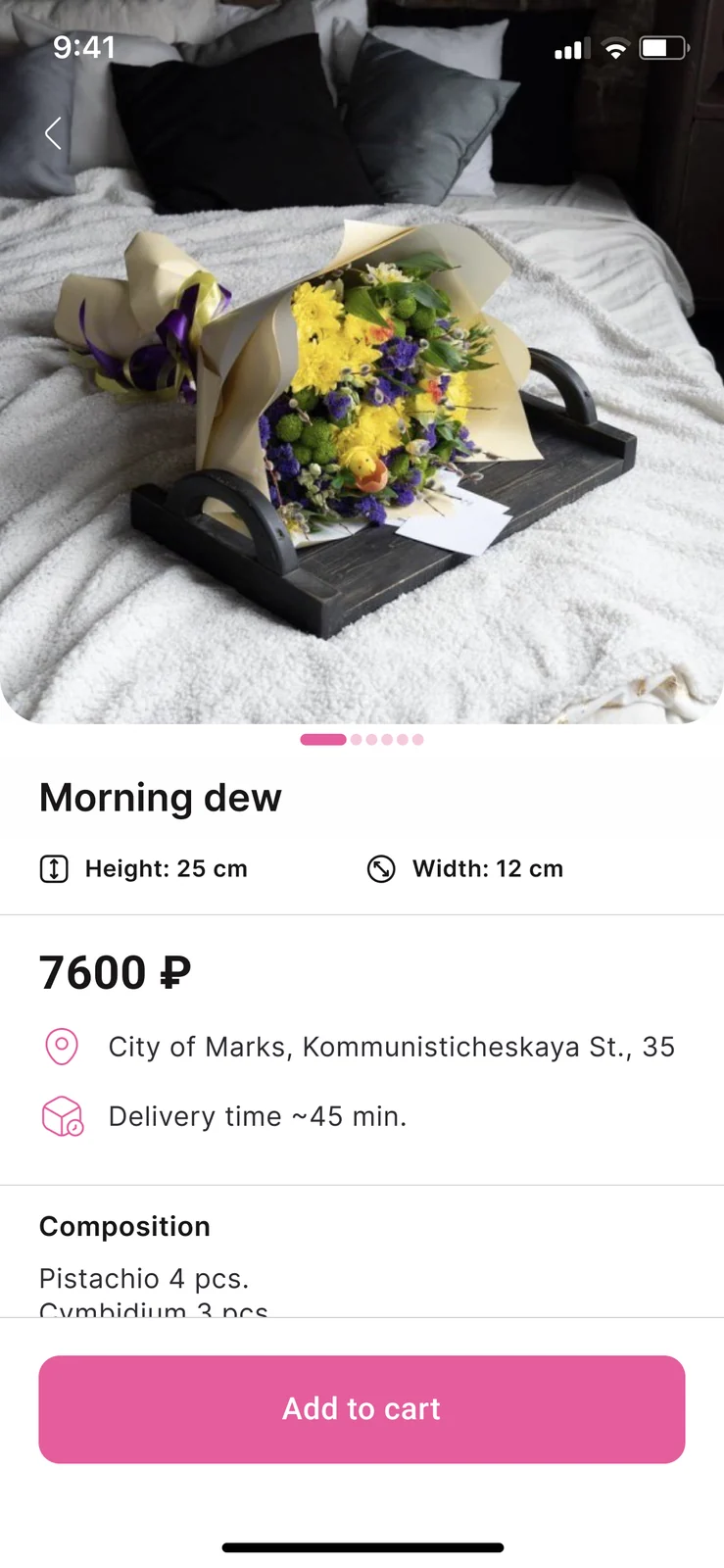
The florist app is the operational heart of the product and the part that, done wrong, sinks the customer app within a month. The florist sees the same data model the customer sees, from the opposite side: a list of bouquet recipes, the components each recipe requires, the live inventory across stems and accessories, and a per-recipe substitution policy that lets the florist define approved swaps that preserve visual identity. When a component runs short, the catalog recomputes availability automatically; recipes that can be made with substitutions show a soft badge on the customer side, while recipes that cannot be made at all are hidden until inventory is replenished.
Bouquet and price editing live in the florist app under a typed form that emits validated updates to the shared backend. A change to a recipe's component count, to a price, or to a substitution rule propagates to the customer catalog within seconds — no manual sync. Where the founder's initial spec called for an expensive feature, we proposed a lighter alternative that kept full functionality while shrinking the budget and timeline: the live availability recomputation is the canonical example, replacing a planned per-store dashboard with a single auto-recalculating list. The whole architecture is delivered as part of our custom software development practice.

FlowDelivery's privacy posture was a design decision before it was a banner. The spec minimizes personal data by design: the customer app holds only what is necessary for checkout, delivery, and re-purchase, and the florist app holds nothing about the buyer beyond a recipient name and address scoped to a single delivery. The data model encodes retention windows per entity so the build team has explicit guidance on how long to keep a delivered-order record and what to purge.
Consent design is part of the discovery package, not a post-launch retrofit. The customer flow renders a GDPR-style granular consent for users in the European Union and a CCPA-style "Do Not Sell or Share My Personal Information" disclosure for users in California in the same checkout step. The architecture is built to align with GDPR obligations for users in the European Union and CCPA / CPRA obligations for users in California and the broader United States — and to make the build phase's privacy work a documentation exercise rather than an architectural retrofit.
Compliance posture: GDPR-aligned · ISO 27001 ready · SOC 2 Type II in progress · HIPAA-capable · CCPA-acknowledged.
A five-phase discovery that took FlowDelivery from a one-line founder pitch to a fundable, build-ready spec for the paired customer-and-florist app.
Founder and florist interviews, analytics on the existing operation, customer journey mapping for gift-buyers in the US and EU, scope of the substitution policy.
Typed data model for bouquets, recipes, components, inventory, orders, and substitutions; OpenAPI specification; Postman collection exercising every endpoint.
Customer app prototype with three-step checkout, florist app prototype with recipe and inventory management, Figma component library, design tokens.
Substitution policy per recipe, availability recalculation logic, audit-ready privacy framing, region-aware consent design for the US and EU launch.
Architecture decision records, build-team handover package, vendor-evaluation framework for the founder, and a fixed-price scoping document for the build.
FlowDelivery's discovery package was deliberately designed as a multi-purpose artifact. The first audience is the build team — internal or external — who can use the typed data model, the OpenAPI specification, the Postman collection, and the clickable prototype to scope a fixed-price build with confidence and no scope-creep premium. The second audience is the founder, who can use the same package to evaluate vendor proposals on a level playing field — every vendor sees the same spec, returns a quote against the same scope, and the founder is no longer in the unenviable position of comparing apples to oranges across vendor-flavored documents. The third audience is investors: a clickable prototype that demonstrates a credible product without the cost or risk of a code-first build is a fundable artifact, especially for a non-technical founder going to a seed round. We documented every significant architecture trade-off as an ADR — substitution policy granularity, inventory recalculation cadence, payment-provider selection, delivery-window granularity — so the founder has a defensible answer when an investor or a vendor asks "why this way and not that way". Where the founder's initial spec called for an expensive feature, we proposed a lighter alternative that kept full functionality while shrinking the budget and timeline; those substitutions are documented as scope-tradeoffs the founder can revisit when the product matures.
FlowDelivery's discovery was structured for a single-codebase launch into US and EU audiences. The customer app design serves gift-buyers in California, New York, Texas, Florida, and Washington in the US, and gift-buyers in the Netherlands, Germany, France, Ireland, and Sweden in the EU, without per-region forks of the codebase. Consent flows are region-aware at the design layer: customers from the EU and EEA receive a GDPR-style granular consent screen with separate toggles for any optional product analytics; customers from California receive a CCPA-style "Do Not Sell or Share My Personal Information" disclosure in the same checkout step. Data-handling practices are aligned with GDPR for European users and with the US state-privacy patchwork — CCPA / CPRA (California), VCDPA (Virginia), CPA (Colorado), CTDPA (Connecticut), UCPA (Utah), TDPSA (Texas), and Oregon CPA. Because the data model minimizes personal data by design and encodes retention windows per entity, regional compliance reduces to honest disclosure and a clean consent flow rather than per-jurisdiction data segregation.
The build phase is architected to deploy across EU and US regions in parallel — Netherlands, Germany, France, Sweden, and Ireland for EU coverage; US East and US West for North America — so the paired app pair serves both markets with low latency from launch. The privacy-policy template that ships with the discovery package documents the architecture above, citing GDPR obligations and California CCPA obligations directly. The discovery team sits across CET and runs a CET workday with East-Coast US overlap (9 AM–1 PM ET) for stakeholder interviews, prototype reviews, and ADR conversations — the timezone that lets a US-based founder and an EU discovery team share four hours of live overlap every day. The discovery package serves a US & EU launch as one unified spec.
The active custom software development roadmap for FlowDelivery — once discovery hands off to build — includes the customer iOS and Android clients, the florist Android client, a Symfony or Laravel backend behind the OpenAPI spec, an availability-recalculation worker, a payment-provider integration with Stripe and Apple Pay / Google Pay, and a delivery-routing layer that picks the lowest-friction florist per order. A B2B tier for corporate gifting in the US and EU is scoped as a phase-two extension, with the entitlement subsystem already structured for multi-recipient assignment. Infrastructure plans include a future independent readiness assessment scaffolded into the cloud & DevOps roadmap, plus a structured analytics pipeline that respects the consent flow on day one.
If you are planning a paired customer-and-operator product, a marketplace, or any platform where the data model is the product and a build-team-agnostic spec is the right starting point for audiences in the US and EU, we have run this discovery process end-to-end and can compress the time-to-investable-artifact meaningfully. The engineering and design team behind FlowDelivery sits inside YuSMP Group. We work fixed-price for well-scoped discoveries and on dedicated development teams for ongoing delivery into the build phase, with a CET workday and a guaranteed East-Coast US overlap (9 AM–1 PM ET) window for stand-ups, prototype reviews, and ADR conversations.
A focused discovery covering analytics, UX design, system architecture, and the shared data model for a paired customer plus operator product typically costs $35k–$90k. Adding a clickable Figma prototype, an OpenAPI spec, a Postman collection, a component library with design tokens, and a discovery-to-build handover package brings full-spec discovery to $95k–$180k. The dominant cost drivers are the customer journey mapping, the data model design, and the inventory-and-substitution policy work that prevents rework in the build phase.
A code-first MVP on a paired customer plus operator product typically rebuilds the data model two or three times in the first six months because the inventory rules, the substitution policy, and the multi-store catalog cannot be inferred from screens alone. Discovery-led design produces a typed data model, an API contract, and a UX prototype before any production code is written, which compresses the build phase, reduces rework, and gives the founder a fundable artifact for investor conversations long before the first line of Swift or Kotlin.
A stock-aware catalog is a data-model decision before it is a UI decision. Each bouquet is a recipe of component flowers; the catalog computes availability per recipe by joining live inventory across the florist's locations and hides recipes whose components are unavailable. Dynamic product cards recompute price from the current cost-of-goods rather than reading a denormalized cache. A substitution policy table per recipe gives the florist an approved swap list that preserves visual identity when a component runs short.
A discovery-led handover package contains a customer journey map, a typed data model with relationships and constraints, an OpenAPI specification, a Postman collection that exercises every endpoint, a Figma component library with design tokens, a clickable prototype covering the priority flows, and a written architecture decision record per significant trade-off. The package is the artifact a build team — internal or external — can use to scope a fixed-price build with confidence and a founder can use to evaluate vendor proposals on a level playing field.
A focused discovery for a paired customer plus operator product typically takes 6–10 weeks. The first two weeks are stakeholder interviews and analytics on the existing operation; weeks three through six cover the data model, the API specification, and the UX prototype; the final two to four weeks are the substitution policy, the inventory recalculation logic, and the discovery-to-build handover package. The audit-ready hardening of the resulting spec — secrets and privacy framing, region-aware consent design — should be budgeted in the last week.
Related cases
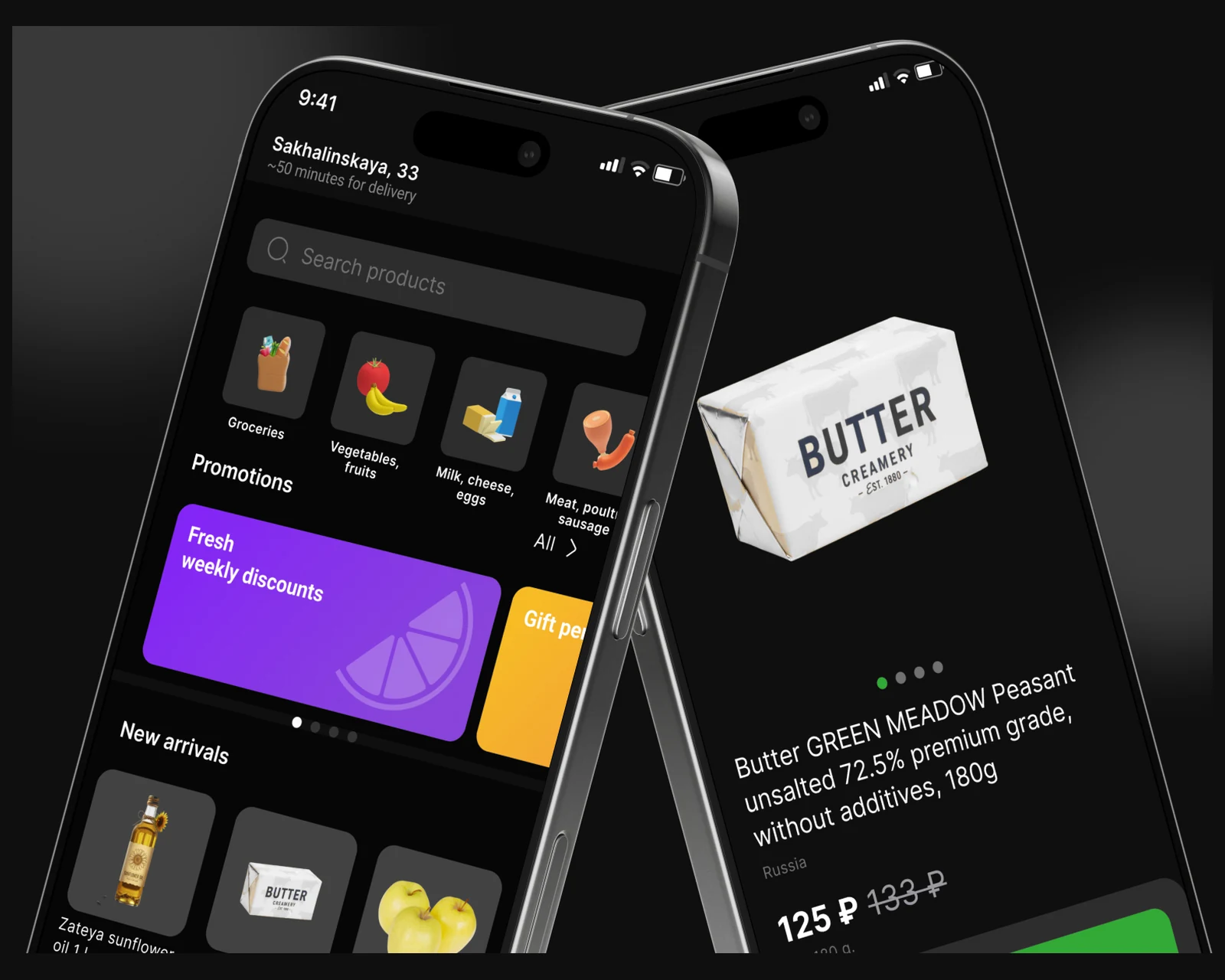
Customer app, picker app, admin panel for a regional grocery chain — designed-from-scratch logistics process.
View case →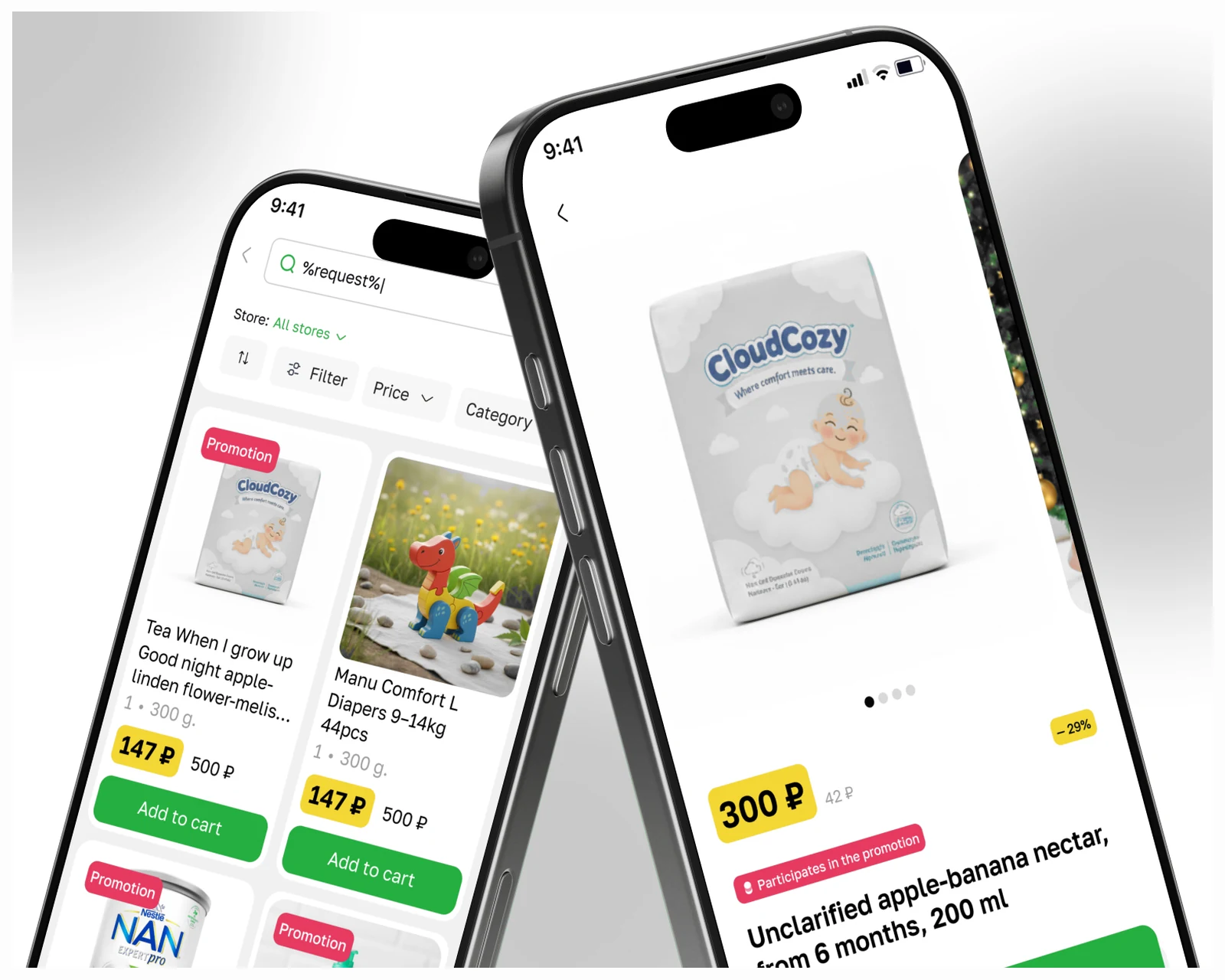
Local marketplace mobile app for an offline children's-goods chain — flexible catalog, online stock sync.
View case →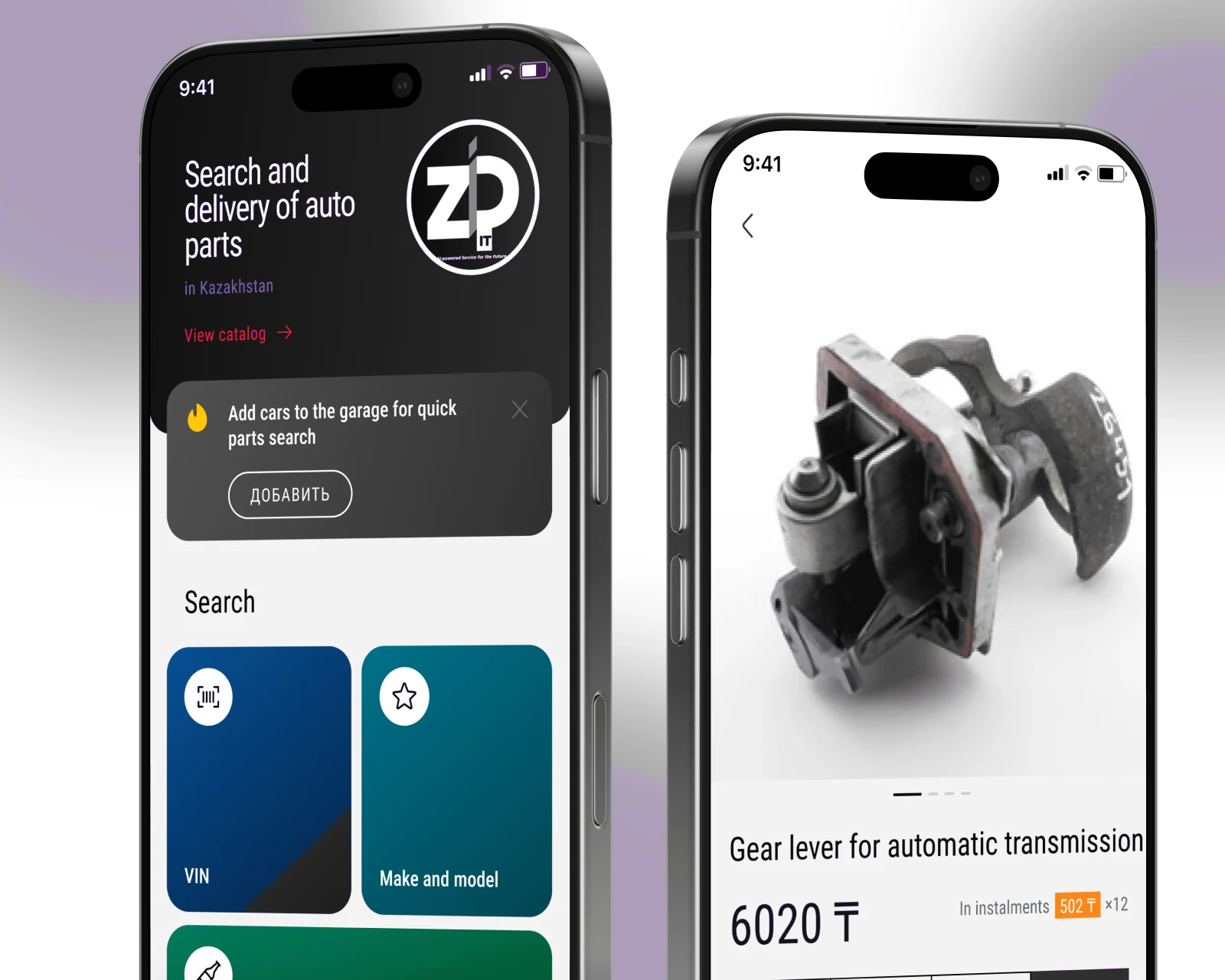
Auto-parts marketplace plus seller CRM — VIN search, multi-location inventory.
View case →
Native iOS, Android, and cross-platform apps with store-ready release pipelines.
Learn more →
Multi-tenant SaaS platforms with SSO, billing, region-pinned residency. SOC 2 in progress.
Learn more →
Senior engineers embedded into your Jira and standups in two weeks. CET workday with US East Coast overlap.
Learn more →Share a few details and a senior consultant will reply within one business day.