

What is IoT software development?
IoT software development is the process of building the software that makes connected devices useful — the firmware, the connectivity layer, the cloud platform and the applications. In 2026 a typical IoT platform costs $40,000–$200,000+ and takes 4–9 months to build, with device count, edge computing and the new EU Cyber Resilience Act as the main cost and scope drivers.
IoT software development is the end-to-end process of creating the software behind Internet of Things products: physical devices — sensors, machines, wearables, vehicles or appliances — that collect data, send it over a network, and act on the insights. It spans four distinct worlds: embedded firmware on the device, the connectivity that moves data, the cloud platform that ingests and stores it, and the applications and dashboards people actually use.
Why most teams bring in a full-stack partner
Because it stitches those worlds together, IoT is one of the hardest categories of software to get right — few teams hold embedded, networking, cloud and data skills all in-house, so most companies building a connected product bring in a partner for end-to-end product engineering services that cover the whole stack rather than one slice of it. That breadth is also why so many pilots stall: research from Cisco and McKinsey has found that 60–75% of IoT projects fail to scale beyond the pilot stage, usually because teams underestimate fleet management, treat connectivity as a solved problem, or leave security and compliance until the end.
This guide covers the IoT architecture layers, the modern tech stack and development software, the connectivity protocols that matter, realistic 2026 cost and timeline ranges — broken down by project type and by cost component — the build process step by step, and the security rules led by the EU Cyber Resilience Act. The goal is a clear picture of what you are commissioning before you write a brief or sign a contract.
The four layers of IoT architecture
Every IoT system is built from four layers, and the health of the whole product depends on how well they fit together. Understanding them is the fastest way to scope a project honestly, because each layer carries its own cost, risk and specialist skill set.
- Device / perception layer. The physical hardware — microcontrollers, sensors and actuators — plus the firmware that runs on it. This is where data is born and where power, memory and cost constraints are tightest.
- Connectivity / network layer. How data moves from device to cloud: Wi-Fi, cellular (LTE-M/NB-IoT), LoRaWAN or Bluetooth Low Energy, carrying a messaging protocol such as MQTT. Getting this wrong is the single most common reason fleets fail to scale.
- Cloud / platform layer. The IoT platform that ingests data, holds a device registry, stores time-series data, runs rules and manages over-the-air updates. This is where AWS IoT Core, Azure IoT Hub or Google Cloud sit.
- Application layer. The web and mobile apps, dashboards, alerts and analytics that turn raw telemetry into something a person or another system can act on.
A fifth concern — edge computing — sits between the device and cloud layers, running logic close to the hardware so decisions happen in milliseconds and only useful data travels onward. Edge processing can cut bandwidth by around 95% and cloud costs by up to 80%, which is why it has moved from optional to standard for any fleet of real size. It is closely related to the on-device intelligence trend we cover in our guide to on-device AI in mobile apps.
The IoT development tech stack in 2026
The modern IoT stack maps directly onto the four layers, with a well-established default tool at each one. When people search for "IoT development software," this is the practical answer — not a single program, but a coordinated stack.

| Layer | Typical tools (2026) | What it does |
|---|---|---|
| Device firmware | C / C++, Rust, MicroPython; FreeRTOS, Zephyr | Runs on the microcontroller, reads sensors, controls actuators |
| Connectivity | MQTT, CoAP over Wi-Fi, cellular, LoRaWAN, BLE | Moves telemetry from device to cloud efficiently and securely |
| Cloud platform | AWS IoT Core, Azure IoT Hub, Google Cloud IoT | Ingestion, device registry, rules, storage, OTA updates |
| Data & analytics | InfluxDB, TimescaleDB, Kafka, Grafana | Stores time-series data and turns it into insight |
| Application | React, Node.js, Python; iOS / Android apps | Dashboards, alerts and controls for users |
| Edge | AWS Greengrass, Azure IoT Edge, gateway hardware | Local processing for low latency and lower bandwidth |
The choice that shapes everything else is the cloud platform. A managed IoT platform such as AWS IoT Core or Azure IoT Hub gives you device identity, secure messaging, a rules engine and OTA updates out of the box, which is almost always cheaper than building those primitives yourself. Building the connected product on top of that platform is a classic software product development effort — the same discovery, architecture and iteration discipline, applied to hardware-plus-software instead of software alone.
What is the best protocol for IoT communication?
MQTT is the default protocol for IoT device-to-cloud communication in 2026, because it is lightweight, uses a publish/subscribe model that scales to large fleets, and copes well with flaky networks. It runs over TCP with TLS encryption and offers three quality-of-service levels (0, 1 and 2) so you can trade reliability against overhead per message. For most projects, standardising on MQTT and adding other protocols only where a specific device or integration needs them is the right call.
| Protocol | Best for | Trade-off |
|---|---|---|
| MQTT | Most device-to-cloud telemetry at scale | Needs a broker; TCP overhead vs the very smallest devices |
| CoAP | Very constrained, low-power devices | Smaller ecosystem than MQTT |
| HTTP / REST | Occasional updates, simple integrations | Heavy and chatty for constant telemetry |
| AMQP | Enterprise messaging, gateway-to-cloud | Larger footprint, overkill for tiny sensors |
The connectivity bearer matters as much as the protocol. Wi-Fi is cheap indoors, cellular (LTE-M and NB-IoT) suits mobile or wide-area devices, LoRaWAN carries tiny payloads for kilometres on a coin cell, and BLE fits short-range wearables. Choosing the bearer early — before hardware is locked — avoids the expensive redesigns that sink so many pilots.
How much does IoT software development cost in 2026?
IoT software development costs from about $40,000 for a basic monitoring app to $200,000 or more for an enterprise platform in 2026, and large multi-site deployments can run well beyond that. The software is only part of the picture — device count, hardware, connectivity plans and compliance all add real, recurring cost that a pure software estimate misses.
| Project type | Typical 2026 cost | Example |
|---|---|---|
| Basic monitoring app | $40,000–$80,000 | Small fleet, sensor readings on a dashboard |
| Mid-complexity platform | $80,000–$150,000 | Device management, alerts, dashboards, integrations |
| Enterprise platform | $150,000–$200,000+ | Edge computing, predictive analytics, OTA firmware |
| Multi-site deployment | $500,000–$1.6M+ | Thousands of devices across sites, smart-building scale |
Two cost drivers surprise first-time IoT teams. The first is cloud cost at scale: every device sends data continuously, so ingestion, storage and egress bills grow with the fleet — which is exactly why edge computing, by cutting bandwidth ~95%, pays for itself. The second is the long tail: firmware updates, security patching, connectivity subscriptions and device replacement are ongoing, not one-off. Building a realistic model for both up front is the core of good software project estimation for connected products.
IoT software development cost broken down by component
The project-type ranges above answer "how much in total," but a budget also needs to know where the money goes. Across a typical IoT build, the spend splits roughly as follows, with security and the cloud/device-management layer usually the two biggest line items after core development:
| Cost component | Typical share of the build budget | What it covers |
|---|---|---|
| Device firmware | 15–25% | Embedded code, drivers, power management on the microcontroller |
| Connectivity & integration | 5–10% | Protocol implementation (MQTT/CoAP), bearer setup, carrier/gateway integration |
| Cloud platform & device management | 20–30% | Ingestion, device registry, rules engine, OTA update pipeline |
| Application & dashboards | 15–25% | Web/mobile UI, alerts, analytics and reporting |
| Security & compliance | 10–20% | Device identity, encryption, signed firmware, CRA/HIPAA/GDPR work |
| Annual maintenance (ongoing, not one-off) | 15–25% of the build cost, per year | Cloud hosting, security patching, OTA firmware pushes, support and monitoring |
On top of the one-time build, the cloud and connectivity bill is recurring and scales with the fleet: managed IoT platforms typically charge per device connection and per message, and cellular connectivity plans run roughly $0.50–$20 per device per month depending on data volume and bearer, so a 1,000-device fleet carries a materially different monthly bill than a 50-device pilot even on identical software. Budgeting the annual maintenance line from day one — rather than treating it as a surprise after launch — is what keeps a project's real, multi-year cost close to the number the first estimate promised.
Off-the-shelf IoT platform or custom software?
A managed IoT platform such as AWS IoT Core, Azure IoT Hub or Google Cloud IoT is the right default for most products: it ships device identity, secure MQTT messaging, a rules engine and OTA updates out of the box, which is almost always cheaper than building those primitives from scratch. Custom infrastructure only earns its cost when a product has requirements a managed platform cannot meet: ultra-low latency at the edge, data-residency rules a vendor's regions cannot satisfy, or a device fleet large enough that per-message platform fees start to outweigh the engineering cost of owning the stack.
| Factor | Managed platform (AWS IoT Core, Azure IoT Hub) | Custom-built infrastructure |
|---|---|---|
| Time to market | Weeks — device identity, messaging and rules are ready-made | Months — every platform primitive is built and hardened first |
| Upfront cost | Lower; pay-as-you-go for messages and device connections | Higher; an engineering team builds and tests the platform layer first |
| Cost at large scale | Per-device and per-message fees can add up past tens of thousands of devices | Can be cheaper once volume justifies the fixed engineering investment |
| Vendor lock-in | Real, but mitigated by open protocols like MQTT and standard device APIs | None, but you own every future migration, patch and outage |
| Customization ceiling | High for most use cases; limits appear at extreme latency or compliance needs | Unlimited, at the cost of building and maintaining it yourself |
In practice, start on a managed platform and only peel off pieces onto custom infrastructure as a specific, measured limit is hit — not because of a theoretical future scale that may never arrive.
How long does it take to build an IoT platform?
Building an IoT platform usually takes 4 to 9 months in 2026, depending on scope — and the honest end-to-end timeline is longer once hardware lead times, certification and field testing are counted, because unlike pure software you cannot ship a fix to a warehouse full of sealed devices overnight.
- Pilot / MVP (3–4 months) — one device type connected, data flowing to a basic dashboard, enough to validate the idea in the field.
- Production platform (6–9 months) — device management, alerts, third-party integrations, a hardened cloud backend and real security.
- Enterprise / multi-site (9–12+ months) — edge computing, predictive analytics, regulatory certification and rollout across locations.
Hardware is the wild card. Firmware bugs found after devices ship are expensive to fix, certification (radio, safety, cybersecurity) can add weeks, and field conditions rarely match the lab. Budgeting time for a real pilot before mass production is what keeps the delivered date close to the planned one.
The IoT development process, step by step
A well-run IoT project moves through six stages, each with an output that feeds the next. The early stages carry more weight than in ordinary software, because a wrong hardware or connectivity choice is far harder to undo later.

- Discovery & use case. Define what the connected product must sense, decide and do — and the business metric it moves. Scope, hardware and connectivity are all decided here.
- Hardware & connectivity selection. Choose the microcontroller, sensors, connectivity bearer and protocol together, since each constrains the others.
- Architecture & platform setup. Stand up the cloud IoT platform, device registry, security model and data pipeline before feature work begins.
- Firmware & application development. Build device firmware and the cloud and app layers in parallel, integrating over the chosen protocol.
- Testing & field pilot. Test on the bench, then run a real-world pilot across the device conditions you will actually meet — network drops, power limits, environment.
- Deploy, monitor & update. Roll out at scale with over-the-air updates, fleet monitoring and a security-patching process built in from day one.
The process is deliberately staged so the riskiest, hardest-to-reverse decisions — hardware and connectivity — are made and validated before you commit to volume. That discipline is what separates the connected products that scale from the 60–75% of pilots that never do.
IoT security and 2026 compliance
Security is now a legal requirement, not a nice-to-have, and 2026 is the year the rules get teeth. Every connected device is an attack surface, and regulators in the EU, UK and US have moved to make manufacturers responsible for securing them across the whole product life.
- EU Cyber Resilience Act (CRA). From 11 September 2026, makers of products with digital elements must report actively exploited vulnerabilities to EU authorities — an early warning within 24 hours and a detailed notification within 72 hours. Full CRA conformity becomes mandatory for products placed on the EU market from 11 December 2027, covering secure-by-design, vulnerability handling and update obligations.
- UK PSTI Act. In force since April 2024, it bans default passwords, requires a vulnerability-disclosure contact, and mandates a stated minimum security-update period for consumer connectable products.
- US Cyber Trust Mark. A voluntary label that signals a consumer IoT device meets baseline security criteria — increasingly a buyer expectation even though it is not mandatory.
- Security by design. Give every device a unique identity (a device ID plus an X.509 certificate), encrypt all traffic with TLS, sign firmware, and ship over-the-air updates so you can patch a fleet in the field.
The practical implication is simple: design for these obligations from the first architecture diagram. Retrofitting device identity, encryption and an update mechanism onto a deployed fleet costs far more than building them in — the same lesson product teams learned about privacy in our mobile app security & GDPR compliance guide.
How does IoT software development cost vary by industry?
The core architecture is the same across industries, but cost, timeline and compliance shift with the vertical. Two patterns come up often enough to call out directly.
Healthcare and medical IoT. Connected medical devices and remote patient monitoring add a compliance layer on top of the base IoT budget: HIPAA controls in the US, GDPR in the EU, and in many cases a path toward medical-device certification if the software influences a clinical decision. That compliance work — audit trails, encrypted storage, access controls — typically pushes a healthcare IoT project toward the higher end of the mid-complexity to enterprise cost bands above, even when the device count itself is modest. The same privacy-by-design discipline covered in our mobile app security & GDPR compliance guide applies here, extended to device data.
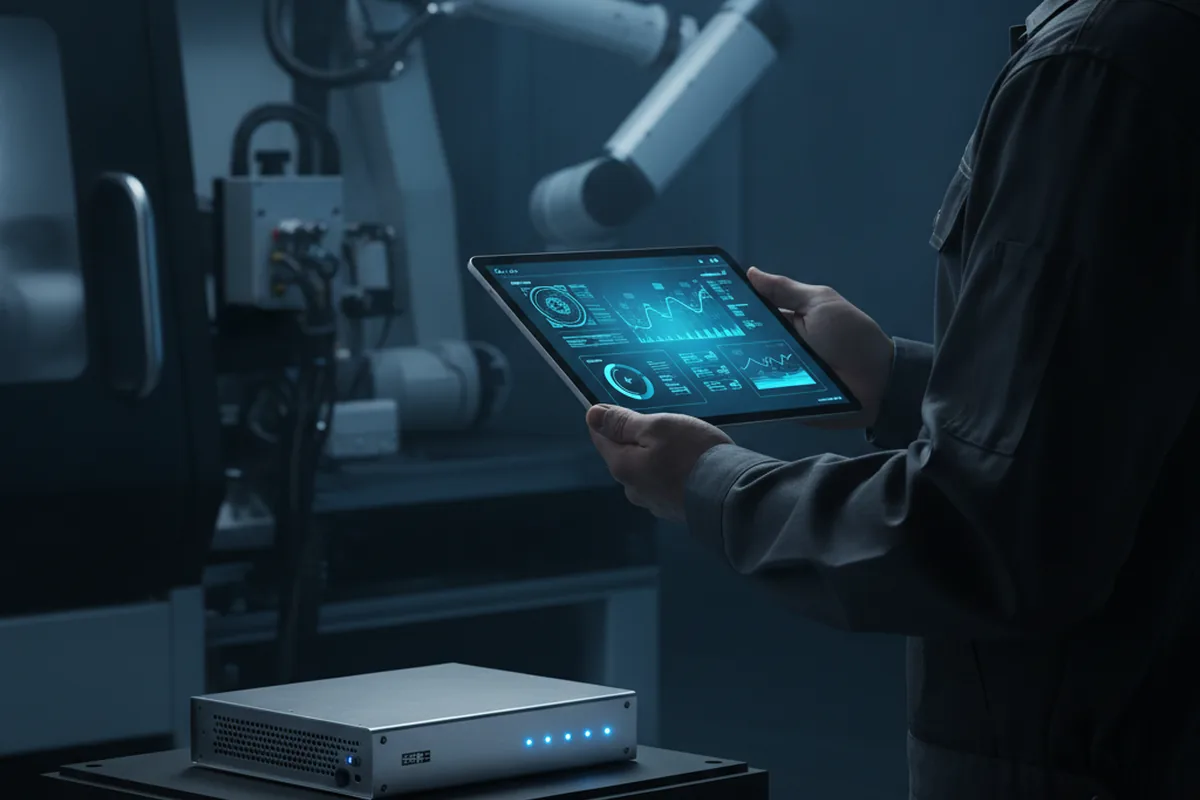
Industrial IoT and edge analytics. Factory floors and energy sites generate far more telemetry than a consumer fleet, which is exactly where edge computing pays for itself: processing vibration, temperature or throughput data on-site before it reaches the cloud is what delivers the roughly 95% bandwidth cut and up to 80% cloud-cost reduction mentioned earlier. Industrial projects also carry integration cost that consumer IoT rarely does — connecting to existing SCADA/PLC systems and brownfield equipment that was never designed to be networked.
Choosing an IoT software development company
Choose an IoT software development company that can build across all four layers — firmware, connectivity, cloud and application — because a partner strong in only one layer will quietly push the hard integration work back onto you. IoT failures rarely come from a single bad component; they come from the seams between components that nobody owned.
When you evaluate an IoT software development partner, look for shipped connected products (not just apps), a clear point of view on device management and OTA updates, real security and CRA-readiness practices, and a cloud-cost model they can defend at fleet scale. Ask how they run a field pilot, how they handle firmware rollback, and who owns the seam between hardware and software. Also ask directly how their architecture changes between a 50-device pilot and a 50,000-device fleet — device provisioning, OTA rollout speed and the cloud-cost model all look different at that scale, and a partner who has taken a previous client from pilot to a large fleet can speak to it in specifics rather than generalities. A good partner will talk about those risks before you do — and will start with a small, honest pilot rather than a nine-thousand-unit order.
FAQ
What does an IoT software development company do?
An IoT software development company designs and builds the software that makes connected devices useful: the firmware on the device, the connectivity layer that moves data, the cloud platform that ingests and stores it, and the applications and dashboards people use. A full-service IoT software development company also handles device management, over-the-air updates, security and integration with existing business systems, so a fleet of sensors becomes a product rather than a science project. Many teams hire an external partner for this because IoT spans embedded, networking, cloud and data skills that are rarely all in-house.
How much does IoT software development cost in 2026?
IoT software development typically costs from about $40,000 for a basic monitoring app to $200,000 or more for an enterprise platform in 2026, and multi-site deployments with thousands of devices can exceed $500,000 to $1.6 million. A basic app that reads a small fleet of sensors runs $40,000–$80,000, a mid-complexity platform with device management, alerts and dashboards $80,000–$150,000, and an enterprise system with edge computing, predictive analytics and over-the-air firmware updates $150,000–$200,000+. Hardware, the number of devices, connectivity and compliance are the biggest cost drivers on top of the software itself.
What is the tech stack for IoT software development?
A modern IoT stack has four layers. On the device, firmware in C or C++ (or MicroPython/Rust) runs on the microcontroller. The connectivity layer uses a lightweight protocol — most often MQTT over TLS — to move data over Wi-Fi, cellular, LoRaWAN or BLE. The cloud layer is an IoT platform such as AWS IoT Core, Azure IoT Hub or Google Cloud IoT that handles ingestion, a device registry, storage and rules. The application layer is a web or mobile app, usually in React, Node.js or Python, with time-series storage and analytics. Edge computing sits between device and cloud for low-latency processing.
How long does it take to build an IoT platform?
Building an IoT platform usually takes 4 to 9 months in 2026, depending on scope. A focused pilot or MVP that connects one device type and shows data on a dashboard can ship in 3–4 months, a production platform with device management, alerts and integrations takes 6–9 months, and a large multi-site enterprise system with edge computing and strict compliance runs 9–12 months or more. Hardware lead times, certification and field testing add calendar time that pure software estimates miss.
What is the best protocol for IoT device communication?
MQTT is the default protocol for IoT device-to-cloud communication in 2026 because it is lightweight, uses a publish/subscribe model that scales to large fleets, and handles unreliable networks gracefully with quality-of-service levels 0, 1 and 2. It runs over TCP with TLS encryption. CoAP is a good alternative for very constrained, low-power devices, HTTP/REST suits occasional updates and simple integrations, and AMQP fits enterprise messaging where reliability matters more than device footprint. Most fleets standardise on MQTT and add others only where a device or integration needs them.
What security regulations apply to IoT devices in 2026?
The most important new rule is the EU Cyber Resilience Act (CRA): from 11 September 2026 manufacturers of products with digital elements must report actively exploited vulnerabilities to EU authorities — an early warning within 24 hours and a detailed notification within 72 hours — and full CRA conformity is mandatory for products placed on the EU market from 11 December 2027. The UK's PSTI Act has been in force since April 2024 with baseline device-security requirements, and the US promotes the voluntary Cyber Trust Mark label. Any connected product sold into these markets should design for these rules from the start rather than retrofit them.
Should I use an off-the-shelf IoT platform or build custom infrastructure?
For most products, a managed IoT platform such as AWS IoT Core or Azure IoT Hub is the right default: it ships device identity, secure messaging, a rules engine and OTA updates out of the box, and is almost always cheaper and faster than building those primitives from scratch. Custom infrastructure only earns its cost at very large device counts, where per-message platform fees outweigh the engineering cost, or when a product needs edge latency or data-residency guarantees a managed vendor cannot meet.
Does IoT software cost more for healthcare or industrial projects?
Yes. Healthcare and medical IoT projects add compliance work — HIPAA and GDPR controls, audit trails, encrypted storage, and sometimes medical-device certification — that pushes cost toward the higher end of the ranges above even with a modest device count. Industrial IoT projects add integration cost for connecting to existing SCADA/PLC systems and brownfield equipment, plus the edge-computing investment needed to process high-volume factory or energy-site telemetry close to the source.
How much does it cost to maintain an IoT platform after launch?
Annual maintenance for an IoT platform typically runs 15–25% of the original build cost, covering cloud hosting, security patching, over-the-air firmware pushes, and support and monitoring. On top of that, connectivity is a recurring, per-device bill: cellular plans commonly run $0.50–$20 per device per month depending on data volume, and managed cloud platforms charge per device connection and per message, so the monthly bill scales with the fleet size rather than staying fixed after the initial build.
Last updated 21 November 2026. Cost and timeline ranges reflect common 2026 US and EU market data and vary by scope, hardware, region and device count; regulatory dates reflect the EU Cyber Resilience Act (vulnerability reporting from 11 September 2026, full conformity from 11 December 2027) and the UK PSTI Act. Treat the figures as planning ranges, not quotes — ask for a scoped estimate for your specific project.