Discovery & audit
Existing site audit, ranking inventory, brand refresh scoping, portfolio asset preparation, pricing-block discovery with the business team.

Case study · Home Renovation · Web
How we rebuilt FinishRemont on Tilda — a modern brand redesign, a portfolio gallery of completed renovations, a transparent pricing block, structured lead capture, an expert blog, and a video blog — all staged on a test domain and migrated cleanly under SEO patterns that hold up to US and EU audience expectations and GDPR and CCPA framing.
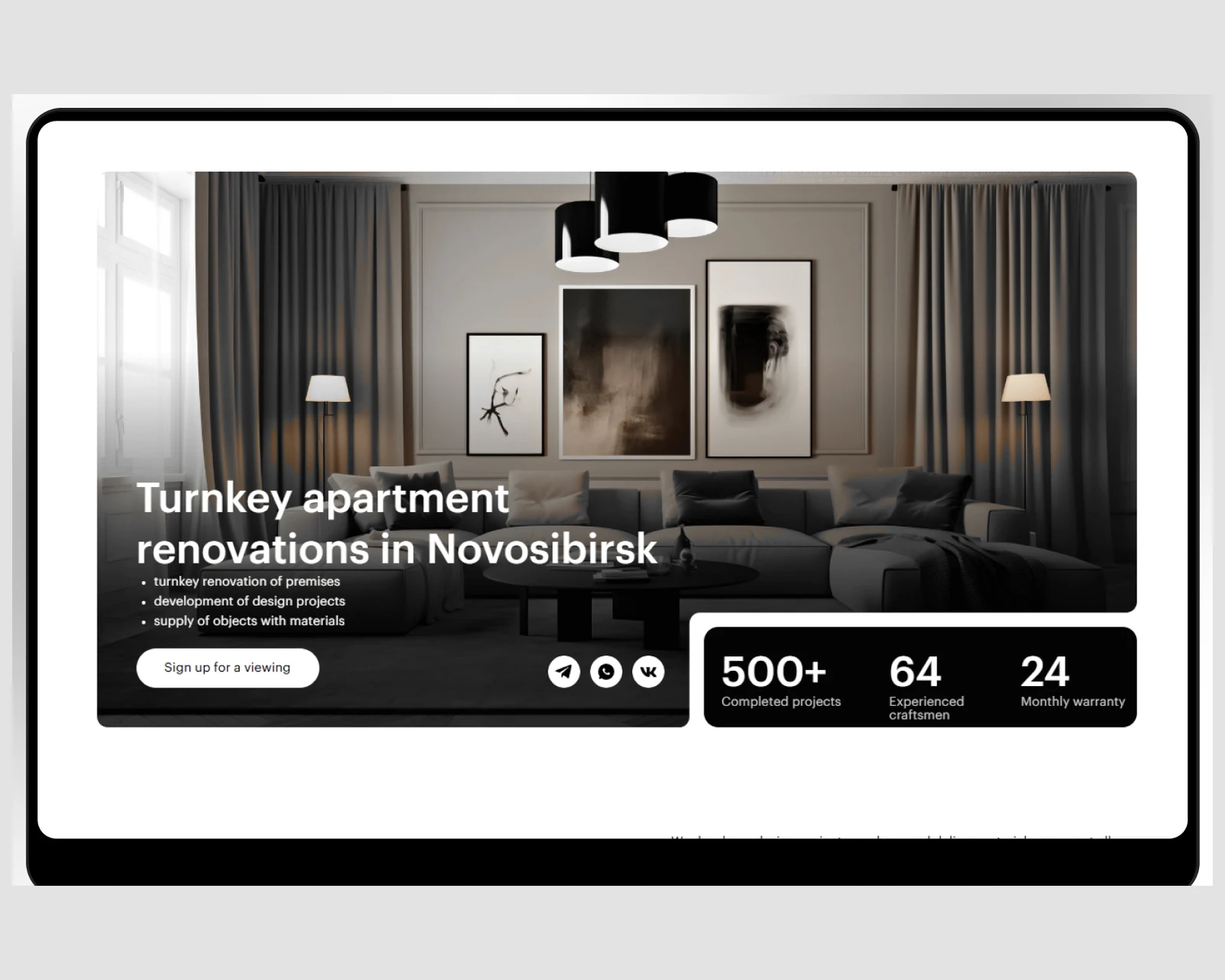
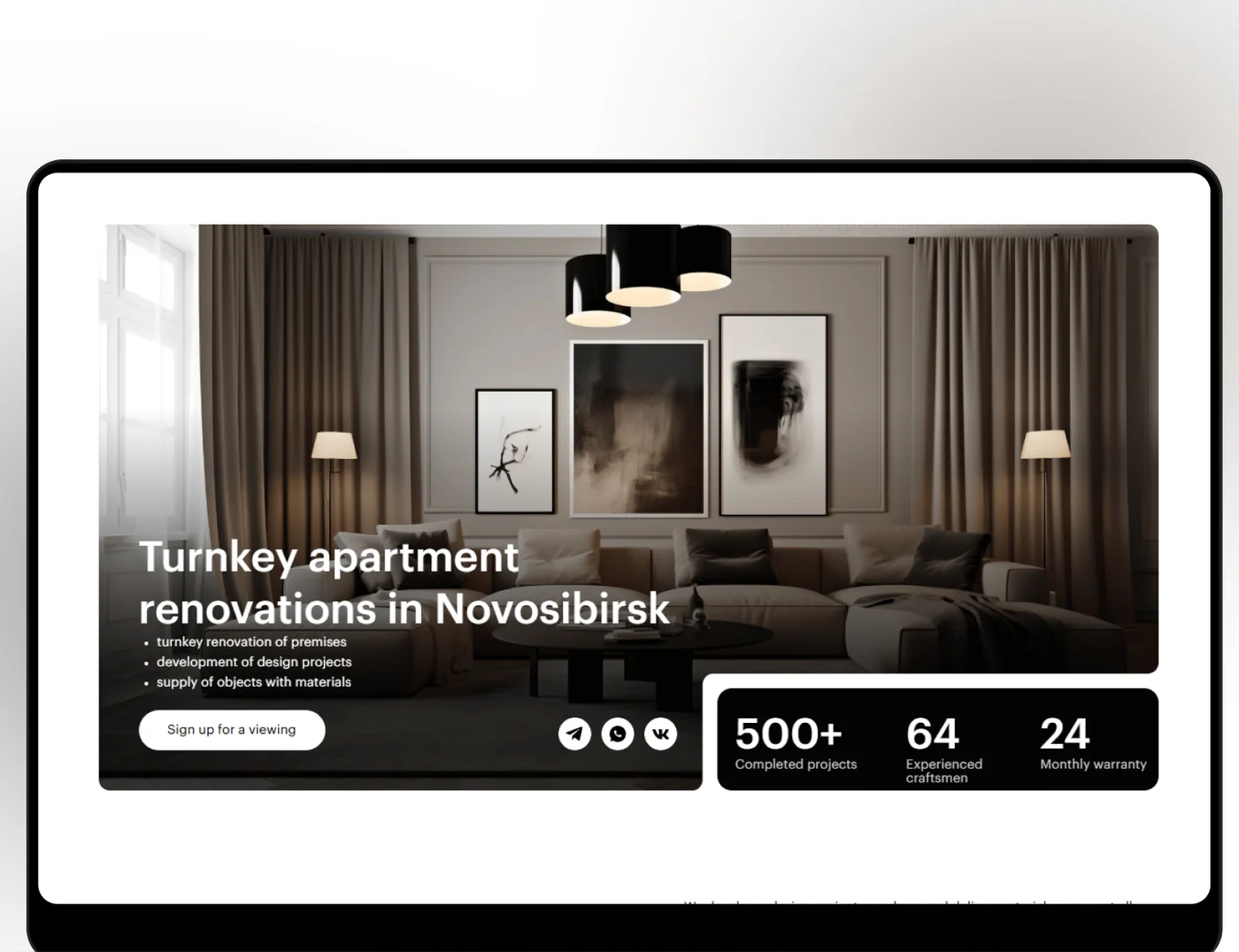
FinishRemont already had a working website, but its visuals and search rankings no longer matched the company's current business goals. The team came to us with a clear set of constraints: refresh the visual brand, systematize lead acquisition, separate renovation work from design services in a way visitors could self-qualify in 30 seconds, and ship the rebuild without losing the SEO surface the existing site had accumulated over years. The buyer profile spans the United States and the European Union for businesses in this category — homeowners and small commercial clients researching contractors, comparing pricing transparency, and choosing the provider whose portfolio looks closest to the work they are about to commission. Existing site builders were eliminated for different reasons: WordPress carried a plugin patch cadence and a security surface the marketing team did not want to own, and a custom Next.js build was overkill for a service-business marketing surface with no real-time integrations. The result is a Tilda-based site with structured content blocks, a portfolio gallery, a transparent pricing module, and a hybrid Agile-Waterfall delivery process that absorbed scope shifts without losing the launch date. The MVP was first staged on the test domain finisher54.ru for review before the primary-domain cutover.
A snapshot of what the FinishRemont rebuild delivered across the site, the lead funnel, and the content engine in its first production cycle.
The platform decision dominates every other architectural choice on a service-business marketing site. We chose Tilda over WordPress and a custom Next.js build because the trade-offs line up cleanly with the business profile FinishRemont presents to its US and EU audience. Tilda gives a same-week launch path, a managed CDN with predictable performance scores, a content-editing surface the owner can use without a developer, and a structured-block library that maps cleanly onto service-business archetypes — pricing block, portfolio gallery, lead form, expert blog, video block. WordPress was eliminated because its plugin patch cadence is a real, recurring operational cost; the marketing team would have inherited a security surface that compounds across every theme and plugin upgrade. A custom Next.js build was eliminated because there is no dynamic integration, no real-time pricing, and no customer portal that justifies the operational weight.
The third candidate, Webflow, is a legitimate alternative — its export and CMS story are comparable to Tilda — but Tilda's structured-block library mapped onto the existing FinishRemont content faster, and the team's existing Tilda muscle memory meant the content team could take editorial ownership the day after launch. The whole site — pages, blocks, lead form taxonomy, SEO metadata — is open and citable end-to-end, with no proprietary plugin chain that locks the marketing team into a single agency.
| Dimension | Tilda (FinishRemont) | WordPress + plugins | Custom Next.js build |
|---|---|---|---|
| Time to launch | 4–8 weeks with portfolio + blog + lead capture | 6–12 weeks; longer with custom theme | 10–16 weeks; team-dependent |
| SEO defaults | Managed metadata, sitemap, canonical, schema.org blocks | Plugin-dependent (Yoast / Rank Math) | Built per-project; no defaults |
| Lead-form fit | Structured native blocks, webhook to ops | Plugin (Gravity, CF7); GDPR varies | First-party, but cost of building |
| Plugin patch cadence | None — managed by Tilda | Monthly minimum; security CVEs cluster | npm dependency tree — team-owned |
| Performance scores | CDN-managed; typically 85–95 on PSI | Plugin-dependent; varies 50–90 | Architectable to 95+; cost varies |
| Editor surface | Block-based; owner-friendly | Gutenberg + plugin patchwork | Headless CMS required; extra cost |
| Compliance fit (US & EU) | Cookie banner + consent block built-in | Plugin-dependent; integration risk | First-party; full control |
Platform references: Tilda help center, WordPress developer documentation, Next.js documentation.

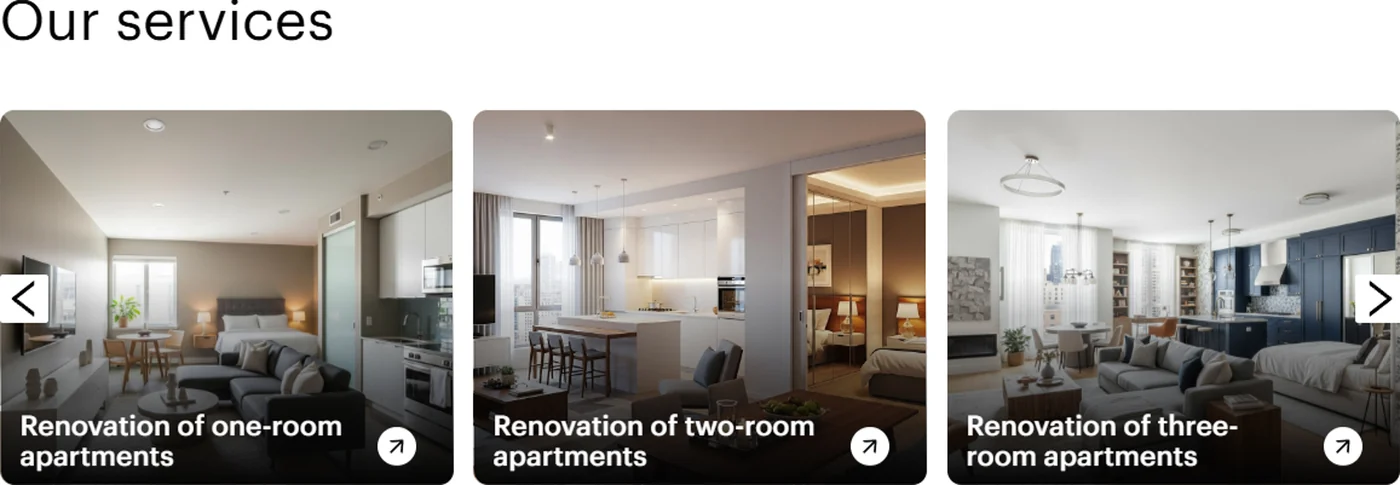
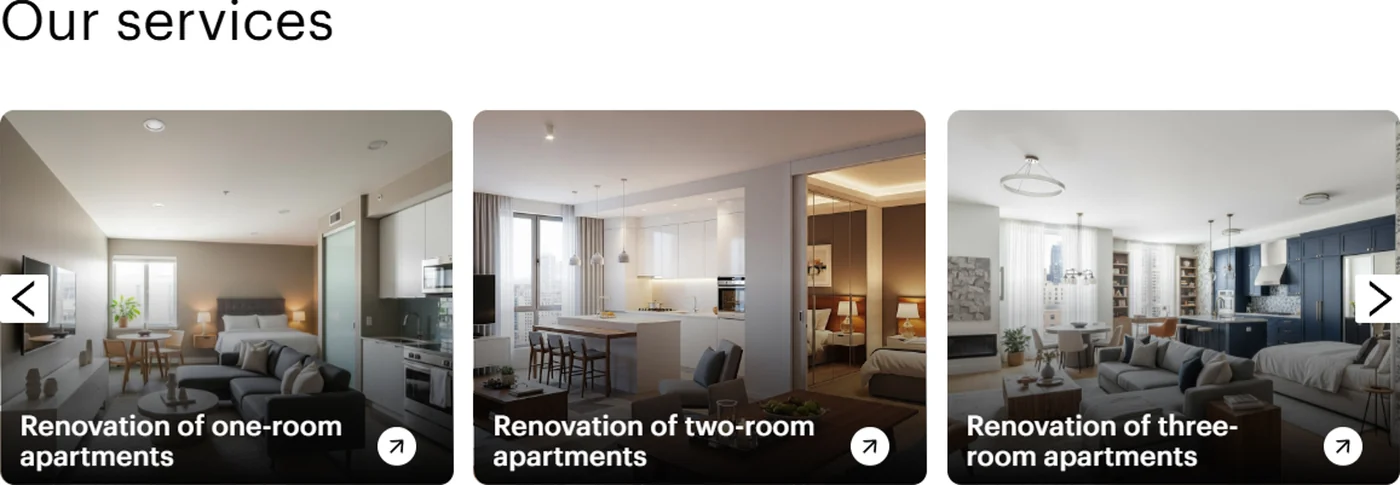
The FinishRemont front end is built on Tilda's structured-block library with a custom block taxonomy mapped to the renovation business profile. The portfolio gallery uses lazy-loaded images with descriptive alt text and explicit per-project filtering by room type, square footage, and finish style — so a visitor can find a project that resembles theirs in three taps. The transparent pricing block separates renovation work from design services, lists each labor category with an indicative range, and frames materials as cost-plus or client-supplied — the structure that lets a visitor self-qualify in 30 seconds without a call.
The site is mobile-first by default; the design system uses fluid typography, lazy-loaded media, and the Tilda CDN's edge caching to keep largest-contentful-paint under two seconds on US and EU mobile networks. The header carries a single high-intent CTA — "Get a free estimate" — wired to a structured Tilda form that pipes submissions to the ops team's preferred channel. The same approach carries across our web application development practice when a service business needs a marketing surface that converts without manual sales work in the funnel.
The back-end story for FinishRemont is the lead-capture taxonomy, the SEO migration, and the video blog. Lead capture is split by intent: a hero form for general inquiries, a pricing-block form for self-qualified estimates, and a contact-page form for the few buyers who arrive with a fully-formed brief. Each form is structured — Tilda native, no third-party plugin — and emits a typed payload to a webhook the ops team owns. Region-aware consent text is part of the form schema so the EU and EEA flow shows GDPR-style granular consent and the California flow shows a CCPA-style disclosure without forking the underlying form.
The SEO migration was the highest-stakes part of the rebuild. We mapped every existing URL to a new counterpart in a 1:1 spreadsheet, deployed server-side 301 redirects in batches with a verification pass after each batch, preserved title and H1 patterns where the original ranked, and submitted a refreshed sitemap on cutover. The expert-content blog was re-published under stable URLs so post-level inbound links survived. The video blog runs on Tilda's native video block with renovation walkthroughs as the editorial spine — the format that converts a renovation buyer faster than any text article. Editorial calendar handover is the last delivery, so the marketing team owns the cadence on day one as part of our technical SEO and growth practice.
FinishRemont's privacy posture was an architecture decision before it was a banner. Personal data on the site is limited to what the lead forms collect and is governed by a single consent flow that records region-aware choices for users in the European Union and California in the same submission. The forms do not auto-share data with third-party brokers; the typed payload goes directly to the ops team's owned channel, which keeps the GDPR data-processor chain short and auditable.
Cookie consent is presented in a single, clear banner with separate toggles for any optional analytics; the Tilda CDN serves the same site to US and EU visitors without per-region forks. The posture is built to align with GDPR obligations for users in the European Union and CCPA / CPRA obligations for users in California and the broader United States — and to make a future privacy-policy review a documentation exercise rather than a forms-rebuild.
Compliance posture: GDPR-aligned · ISO 27001 ready · SOC 2 Type II in progress · HIPAA-capable · CCPA-acknowledged.
A five-phase rebuild that took FinishRemont from a stale legacy site to a modern Tilda surface with portfolio, pricing, lead capture, and a video blog.
Existing site audit, ranking inventory, brand refresh scoping, portfolio asset preparation, pricing-block discovery with the business team.
Tilda block library mapped to renovation service archetypes, mobile-first layout, lead-form taxonomy with region-aware consent text.
Page assembly on Tilda, portfolio gallery, transparent pricing block, expert blog seed, and the first three video-blog walkthroughs.
URL mapping, 301 redirect batches with verification, title and H1 preservation, sitemap refresh, test-domain staging at finisher54.ru.
Primary-domain cutover, analytics instrumentation, editorial calendar handover, and a two-week post-launch ranking watch.
FinishRemont's content engine is the part of the rebuild that compounds. The expert blog is structured around the renovation buyer's actual research path — pricing transparency, contractor selection, materials trade-offs, timeline expectations — with each post tagged by service type so the site's internal link graph reinforces the pricing block and the portfolio gallery. The video blog is the higher-conversion surface: a 60–90 second walkthrough of a finished renovation outperforms a 2,000-word article on the same project for an audience that is making a six-figure spending decision and wants to see the work. We seeded the editorial calendar with three video walkthroughs and ten expert articles on launch, then handed the cadence to the marketing team with a one-page playbook covering topic selection, video shot list, and the SEO checklist for each post. The whole engine sits inside Tilda's native CMS surface so the marketing team can publish without a developer in the loop, and the SEO metadata defaults are wired so a new post inherits canonical, OpenGraph, and schema.org Article markup without manual configuration.
FinishRemont's rebuild was structured as a single-language launch with an architecture that travels cleanly into US and EU audiences for similar service businesses across the United States and the European Union. The same site architecture serves a renovation business in California, New York, Texas, Florida, or Washington in the US, and in the Netherlands, Germany, France, Ireland, or Sweden in the EU, without per-region forks. Consent flows are region-aware at the form layer: visitors from the EU and EEA receive a GDPR-style granular consent screen with separate toggles for any optional product analytics; visitors from California receive a CCPA-style "Do Not Sell or Share My Personal Information" disclosure in the same flow. Data-handling practices are aligned with GDPR for European users and with the US state-privacy patchwork — CCPA / CPRA (California), VCDPA (Virginia), CPA (Colorado), CTDPA (Connecticut), UCPA (Utah), TDPSA (Texas), and Oregon CPA. Because the forms minimize personal data by design and do not auto-share with third-party brokers, regional compliance reduces to honest disclosure and a clean consent flow rather than per-jurisdiction data segregation.
Hosting runs on Tilda's managed CDN, which serves edges across EU and US regions in parallel — Netherlands, Germany, France, Sweden, and Ireland for EU coverage; US East and US West for North America — so visitors in both markets get the same sub-two-second largest-contentful-paint on mobile. The schema.org LocalBusiness markup, sitemap, and canonical metadata are wired correctly on day one, citing GDPR obligations and California CCPA obligations in the in-page privacy policy. The engineering and editorial team sits across CET and runs a CET workday with East-Coast US overlap (9 AM–1 PM ET) for content reviews, SEO check-ins, and incident response — the timezone that lets a US-based client and an EU engineering team share four hours of live overlap every day. The site serves US & EU audiences as one unified surface.
The active technical SEO and growth roadmap for FinishRemont includes a deeper schema.org Service taxonomy that splits renovation work from design services for richer search snippets, a structured FAQ block per service page targeting People-Also-Ask intent, a video-blog cadence of one walkthrough per month, and an analytics dashboard with funnel attribution from first visit through lead form. A future migration path to a custom Next.js build is intentionally scaffolded — the content model is portable, the lead-form schema is documented, and the SEO patterns survive — so the business can graduate from Tilda when its operational profile warrants the move. Infrastructure plans include further conversion-rate experimentation on the pricing block and a CRM hand-off scaffolded into the custom software development roadmap.
If you are planning a renovation, contractor, or home-service website rebuild, or any service-business marketing surface where the brand refresh, the lead funnel, and the SEO migration all have to land together for audiences in the US and EU, we have shipped this stack end-to-end and can compress the build timeline meaningfully. The live product is available at finisher54.ru, and the engineering team behind the rebuild sits inside YuSMP Group. We work fixed-price for well-scoped rebuilds and on dedicated development teams for ongoing delivery, with a CET workday and a guaranteed East-Coast US overlap (9 AM–1 PM ET) window for stand-ups, demos, and incident response.
A focused service-business rebuild with a modern Tilda template, a portfolio gallery, transparent pricing blocks, two or three lead-capture forms, and an expert blog typically costs $8k–$22k. Adding a video blog with walkthroughs, schema.org LocalBusiness markup, a multi-page service taxonomy, and a structured editorial calendar brings a full-featured rebuild to $24k–$55k. The dominant cost drivers are the portfolio asset preparation, the pricing-block discovery work with the business, and the SEO migration plan that preserves existing rankings.
Tilda gives a service business a same-week launch path, a managed CDN, predictable performance scores, and an editing surface the owner can use without a developer. WordPress carries plugin patch cadence overhead and a security surface that compounds across themes and plugins. A custom Next.js build is the right call when integrations, dynamic pricing, or a customer portal are core to the product — overkill for a service-business marketing site. For FinishRemont the right answer was Tilda with structured content blocks and a clean lead-capture taxonomy.
A defensible SEO migration is a checklist, not a hope. Map every existing URL to its new counterpart with a 1:1 spreadsheet, deploy server-side 301 redirects in batches with a verification pass after each, preserve title and H1 patterns where the original ranked well, keep an editorial inventory of expert-blog posts and re-publish them under stable URLs, and submit a refreshed sitemap. Stage the redesign on a test domain like finisher54.ru first so the production cutover is a swap rather than a build.
A transparent pricing block separates labor categories from materials and from design services so a visitor can self-qualify in 30 seconds. The block lists each work type — demolition, electrical, plumbing, finishing, flooring, painting — with an indicative price range and a clear note that the final figure depends on inspection. Materials are framed as cost-plus or client-supplied. Design services are a separate line so a buyer who only wants construction does not feel pushed into a bundle they did not ask for.
A focused rebuild with a portfolio gallery, pricing block, expert blog seed, and a test-domain launch typically takes 4–8 weeks. Adding a video blog with three to five professionally edited walkthroughs, a schema.org LocalBusiness rollout, and a multi-region SEO migration with redirect validation adds 3–5 weeks. Editorial-calendar handover and analytics instrumentation should be budgeted at 1–2 weeks of dedicated work so the business team owns the cadence after launch.
Related cases
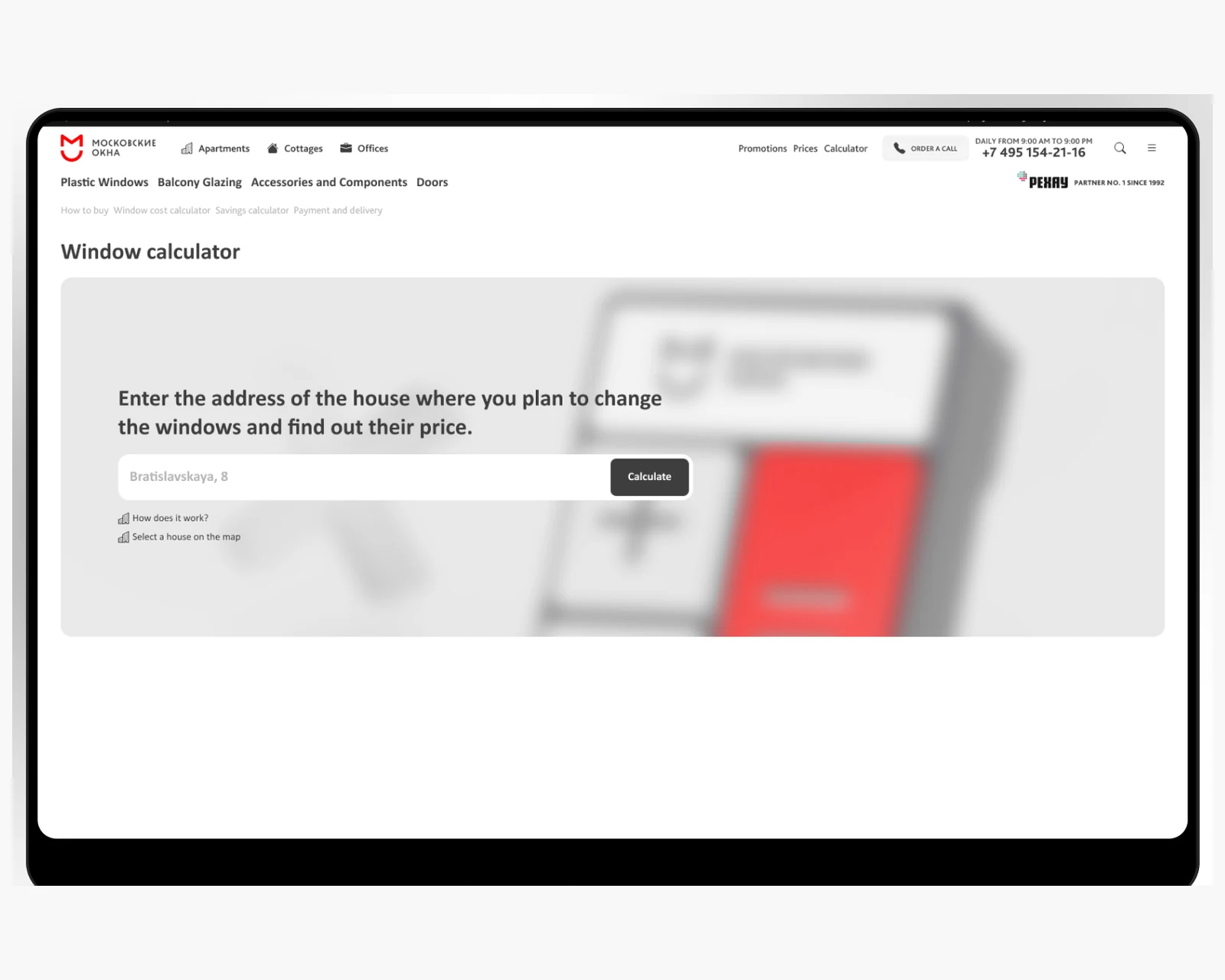
Unified online window calculator and CRM — multi-tenant across three brand sites.
View case →
Tilda landing with Telegram-bot lead capture — fast inbound funnel for a service business.
View case →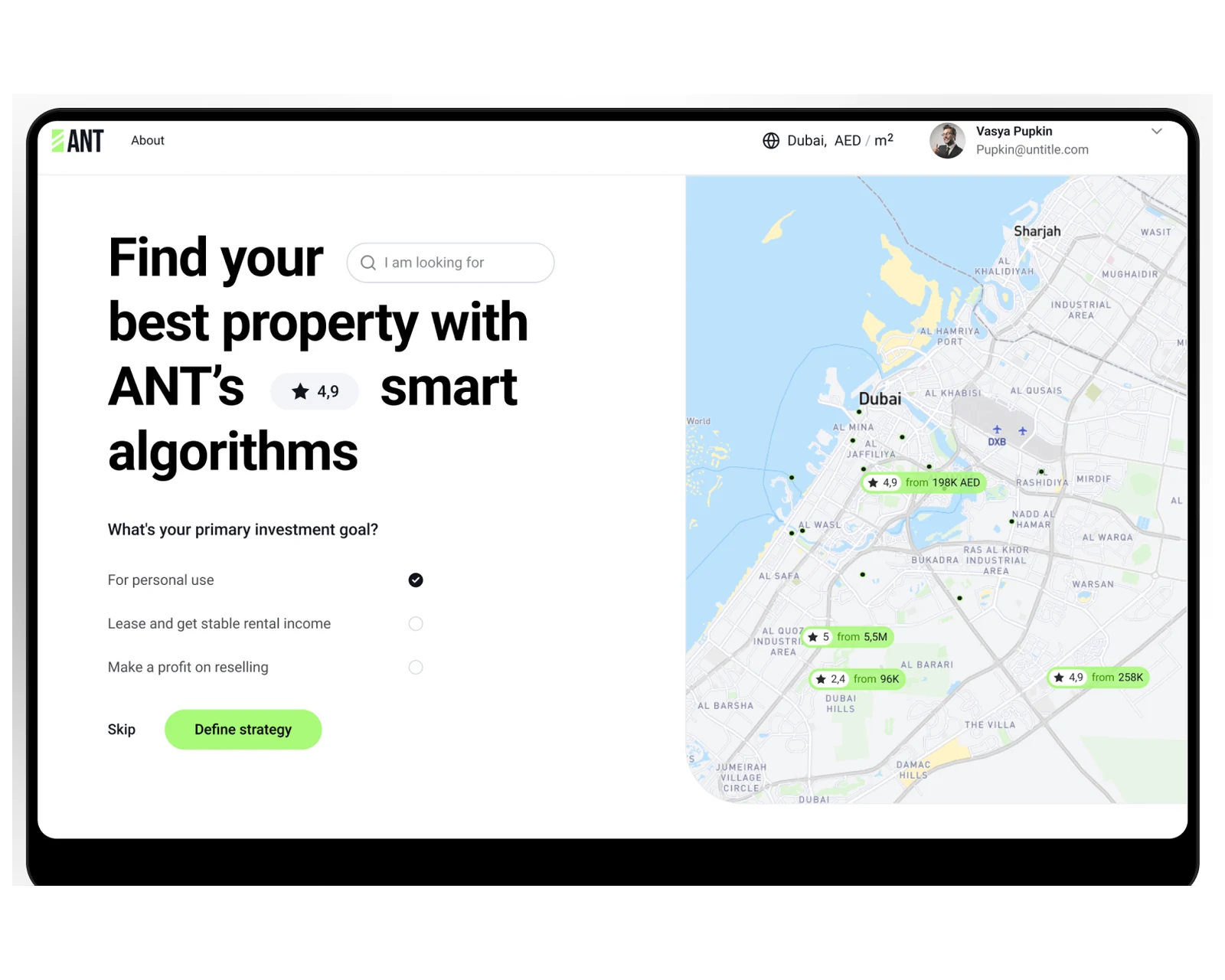
PropTech marketplace + admin for residential developers — apartment-level inventory grids.
View case →
Investor-ready MVP shipped in 12 weeks for 60-120k EUR. Senior PM, designer, engineers, QA.
Learn more →
Fast, accessible React and Next.js web apps with WCAG 2.2 AA and edge-first delivery.
Learn more →
Custom platforms engineered to your business model, scaling cleanly from MVP to millions of users.
Learn more →Share a few details and a senior consultant will reply within one business day.