Discovery & business analysis
User stories, BPMN business-process diagrams, requirements specification (SRS), role-permission matrix, content-gating model, GDPR + CCPA posture mapping.
Case study · EdTech · Online learning
How we shipped a production online learning platform on Laravel and React, with three role-isolated workspaces, cohort and self-paced courses, certificates, InfoProtector content gating, and a creator-payout engine — built for instructors and course owners across the United States and the European Union under GDPR and CCPA expectations.
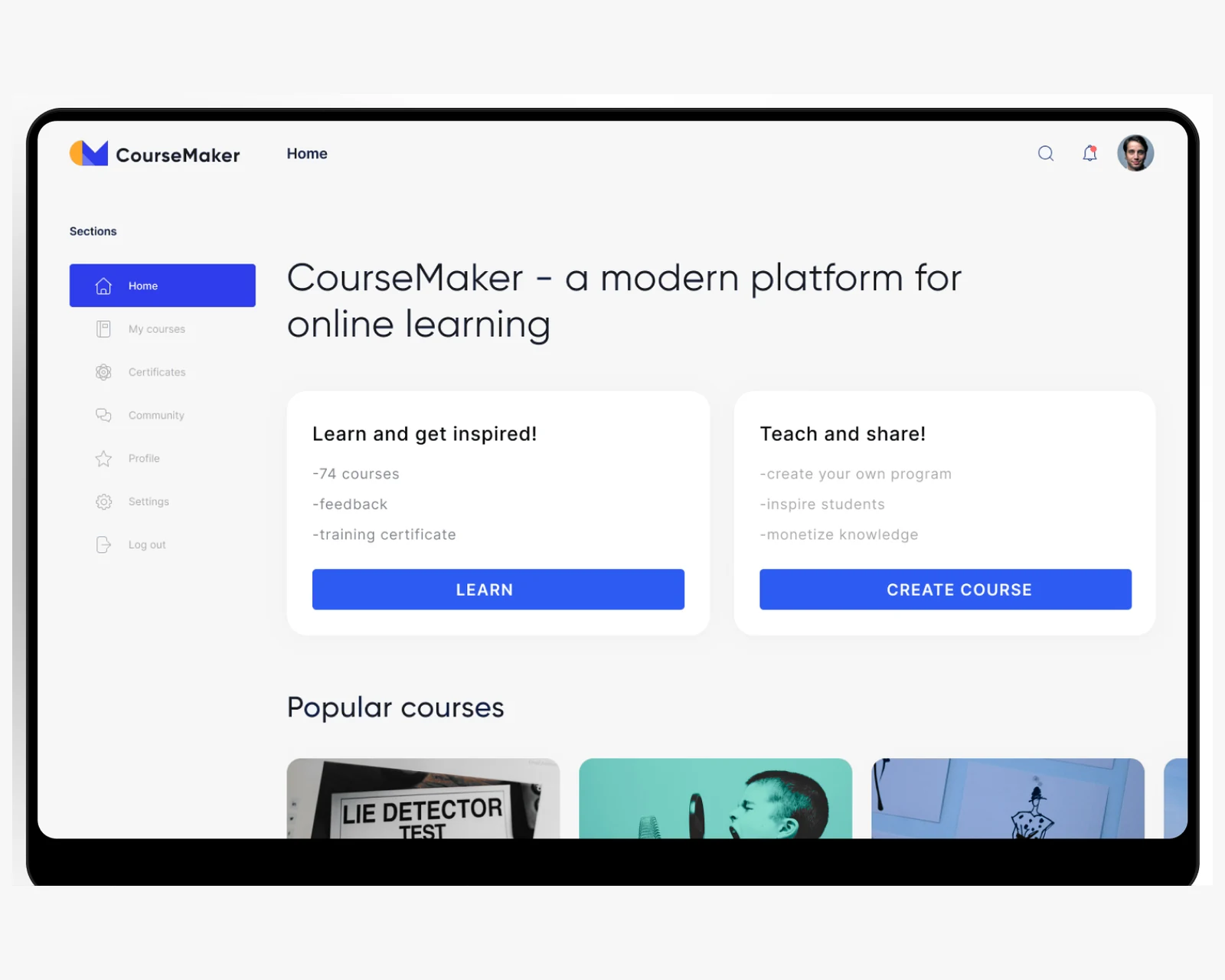
In early 2020 the client — a distance-learning services operator — needed a dedicated platform for running structured courses end to end, not another bolted-on Zoom plus Google Docs workflow. The remote-work shift across the United States and the European Union meant the buyer pool was suddenly enormous, but the off-the-shelf LMS options were either too rigid (Moodle, Canvas) or too opinionated about pricing (Teachable, Thinkific) for an operator running their own catalog and their own pricing. We built CourseMaker from a fresh business-process analysis: three roles, isolated workspaces, cohort and self-paced delivery, integrated certificates, content protection, and creator payouts — all on a single Laravel + React stack with a PostgreSQL system of record.
A snapshot of what the CourseMaker build delivered across web, mobile, and back-office systems in its first production cycle.
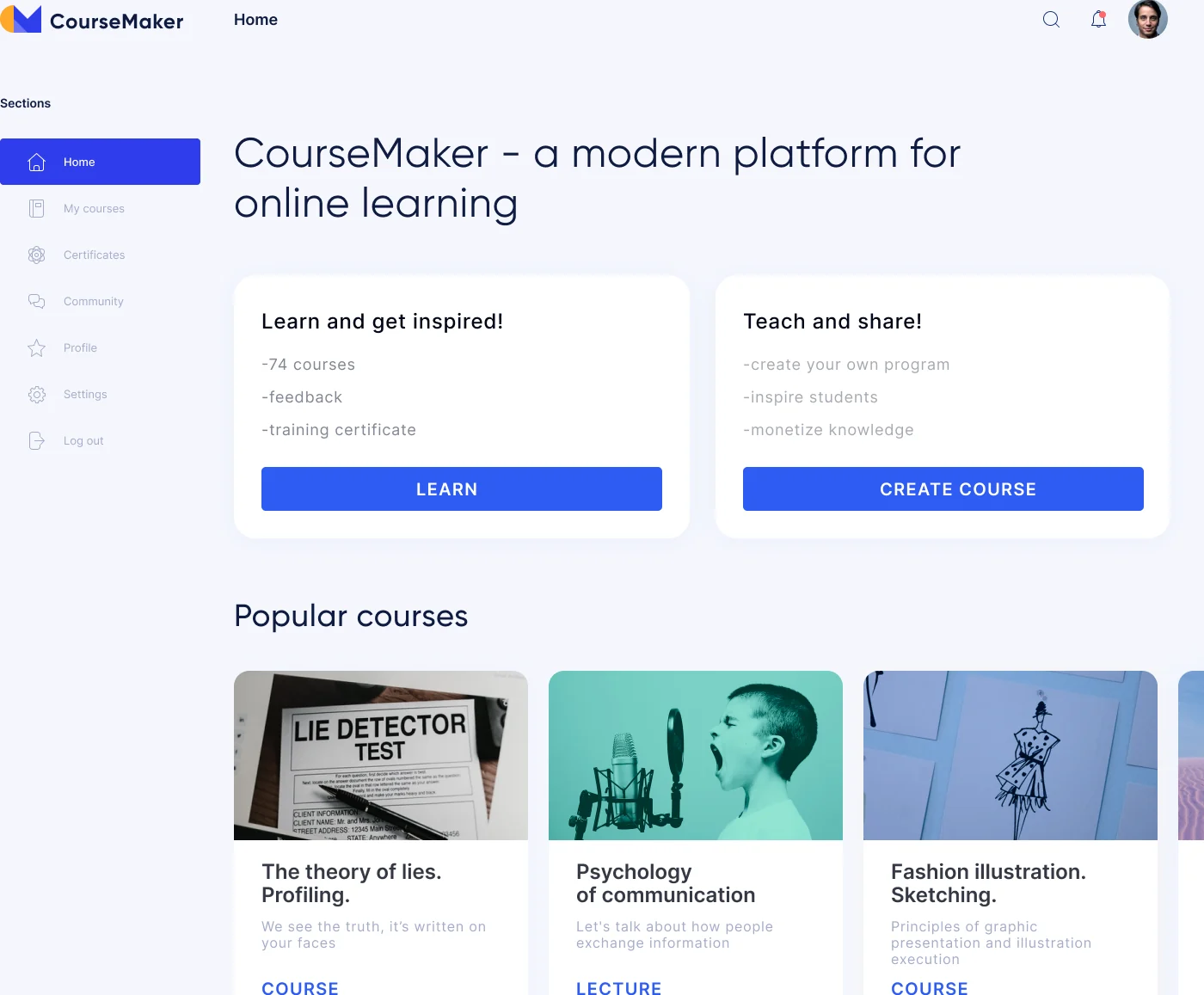
The platform serves three sharply different audiences from a single codebase: learners taking courses, instructors authoring and grading them, and course owners (independent coaches, business trainers, and small EdTech operators) who run the catalog as a business. Each role sees a dedicated workspace built in React with isolated navigation, role-scoped data, and permission checks enforced at the Laravel API layer rather than the UI.
The role split is not just UX — it is a data-model decision. A single user account can hold multiple role grants (an instructor can also be a learner on someone else’s course), and entitlements are resolved per course, per role, per session. This is the same pattern we apply across our custom software development practice when a product needs to scale from a single SaaS tenant to a marketplace of independent operators in the United States and the European Union.
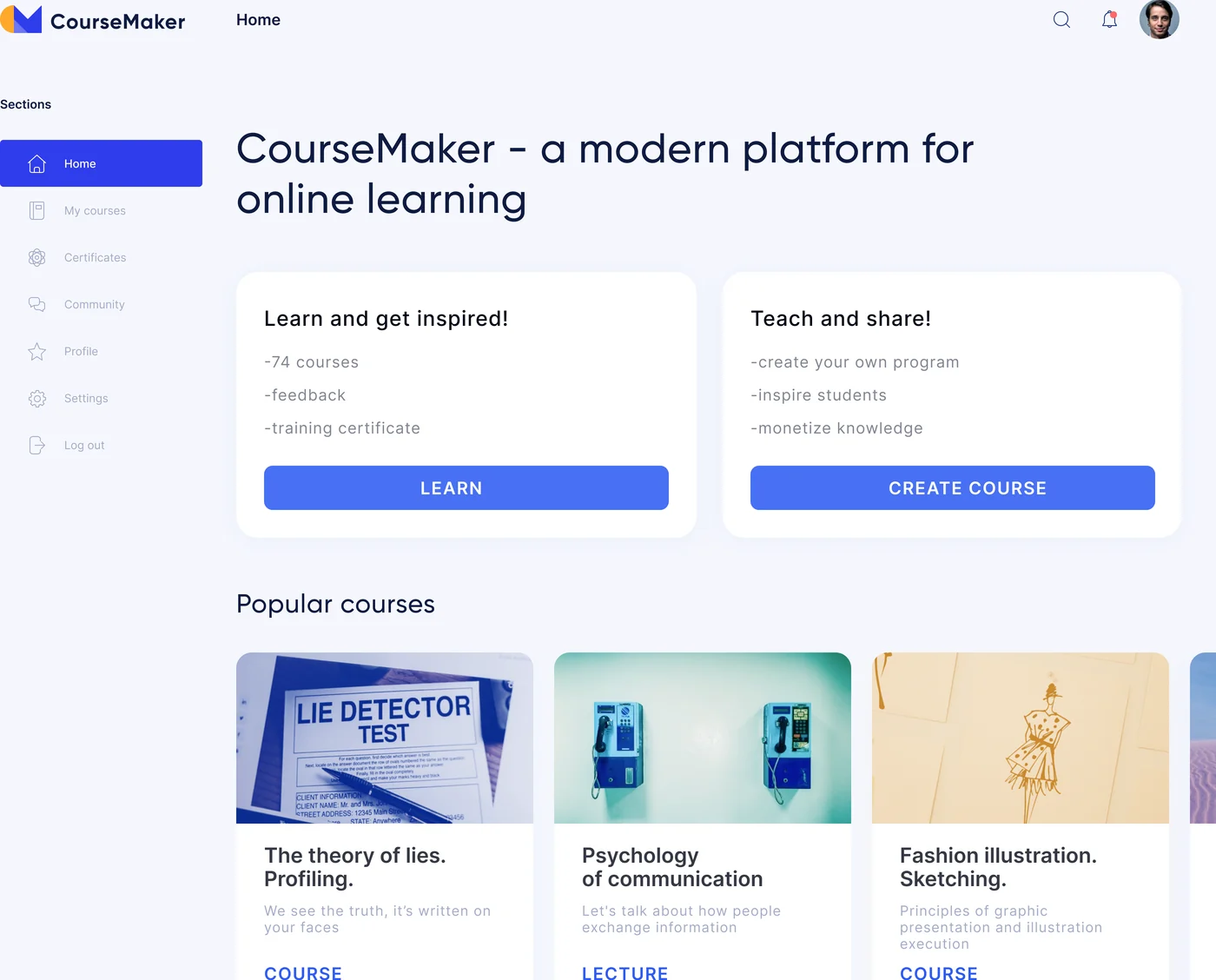
The learner dashboard collapses the entire student journey into one screen: enrolled courses with progress bars, upcoming live sessions, graded assignments, and earned certificates. Cohort-based courses pace the learner against the group; self-paced courses unlock the next lesson the moment the previous one is completed. The same dashboard component renders on desktop and on mobile via responsive React layouts, which means a learner who starts a lesson on a US East-coast lunch break can finish it on the train home that evening without a separate mobile app install.
Progress tracking is event-sourced — every lesson view, quiz attempt, and assignment submission is a discrete event in PostgreSQL, which lets the platform recompute completion percentages, generate certificates, and feed the recommendation engine without rebuilding state. Certificates are generated server-side as PDFs and stored against the user, then shareable as a public verification link with a unique hash. This is the same engineering pattern we use on web application development projects where audit trails and content protection are non-negotiable.
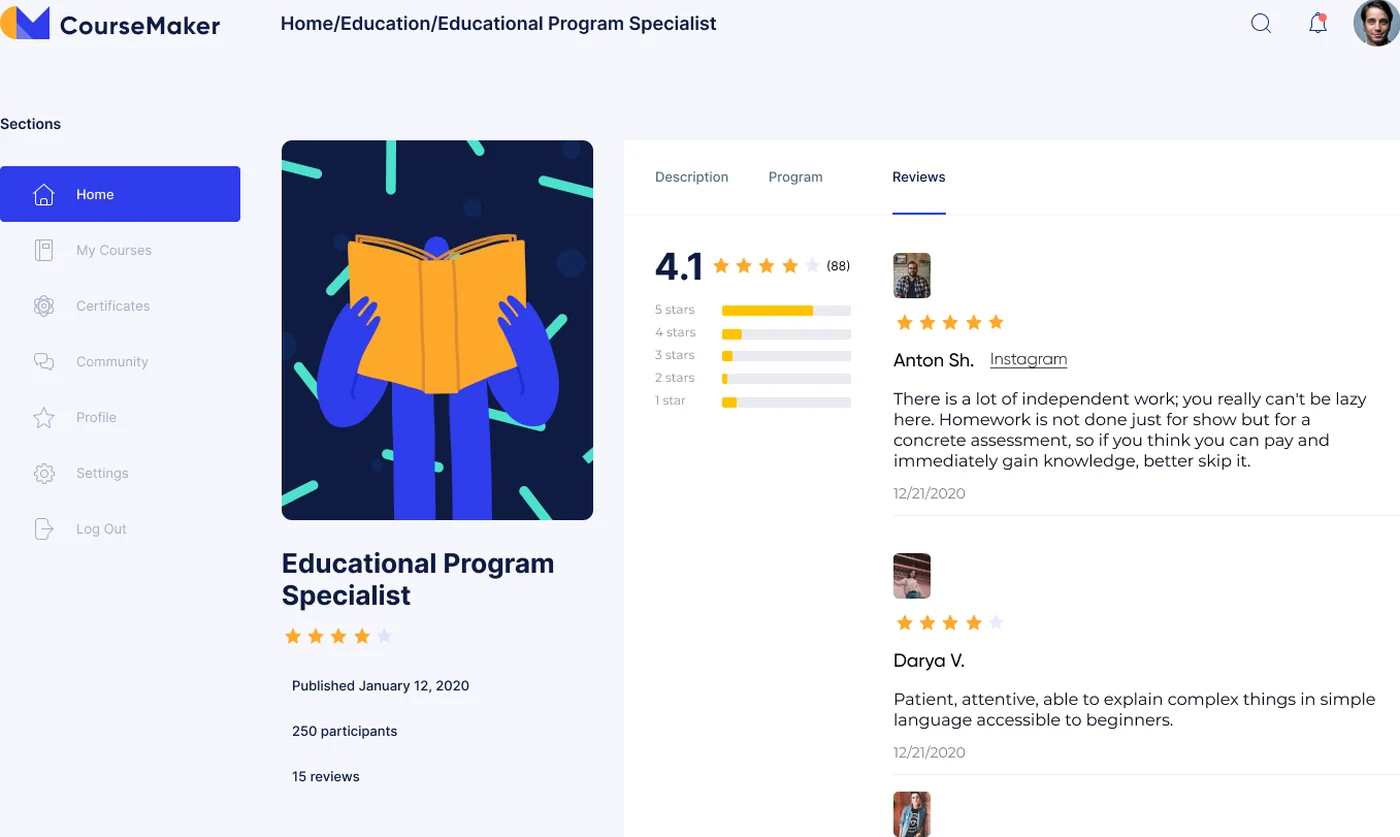
Online learning lives or dies on content protection. CourseMaker integrates InfoProtector at the asset layer: course videos and downloadable PDFs are served through a token-gated proxy that watermarks the user’s session ID into the stream, blocks right-click and screen-recording on supported browsers, and revokes access the moment a subscription lapses. Instructors keep ownership of their courses, course owners keep margin, and learners get a clean playback experience without DRM nags.
Certificates are first-class objects. When a learner completes a course, the platform generates a signed PDF with the instructor’s name, course title, completion date, and a public verification URL. Recruiters and hiring managers in the United States and the European Union can verify the credential without an account, and instructors can revoke a certificate (e.g. on plagiarism review) which flips the public verification page to a clear “revoked” state. The verification endpoint is cached at the edge and built on the same Laravel API as the rest of the platform.
Compliance posture is built in from day one. Data-handling practices are aligned with GDPR obligations for users in the European Union and CCPA / CPRA obligations for users in California and the broader United States.
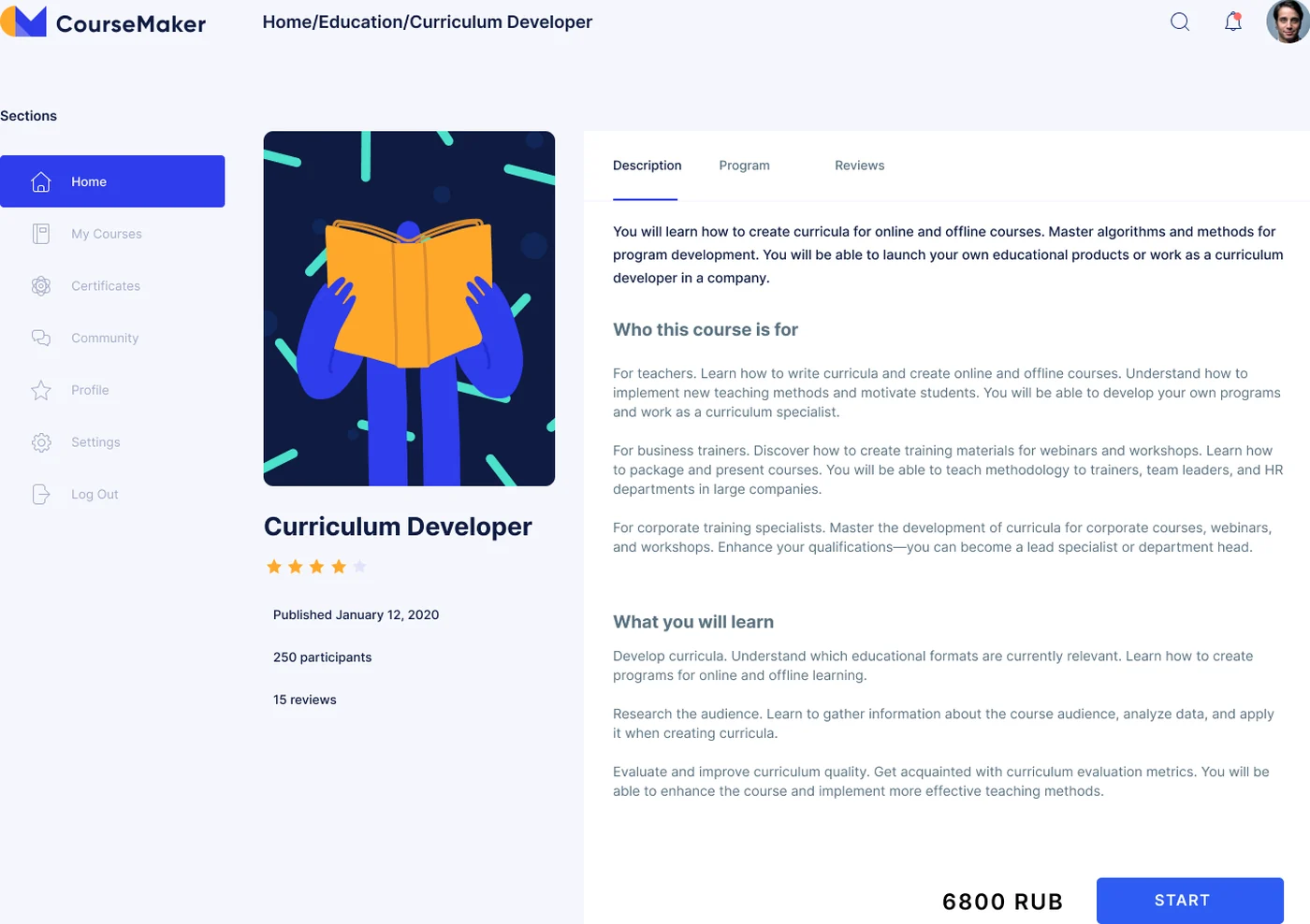
CourseMaker is a two-sided platform: learners pay for courses, and a slice of every transaction flows back to the instructor that authored them. The monetization layer handles three flows in parallel — one-off course purchases by card, bundled subscriptions across multiple courses, and instructor payouts to the bank account on file. Card payments go through a vaulted processor; learner receipts and instructor payout statements are emailed automatically and archived against the user record for audit.
Course owners can configure pricing tiers per course, set introductory discounts, and apply coupon codes for marketing campaigns. The payout calculator runs on a nightly job in Laravel, rolls up per-instructor earnings from the previous day’s transactions, deducts platform fees, and queues bank transfers for the operations team to release. The same subsystem powers analytics dashboards the owner uses to track course-level revenue, refund rates, and instructor-level lifetime value across audiences in the US and the EU.
Compliance posture: GDPR-aligned · ISO 27001 ready · SOC 2 Type II in progress · HIPAA-capable · CCPA-acknowledged.
A five-phase build that took CourseMaker from product specification to production across web, mobile-responsive layouts, and an administrative content management panel.
User stories, BPMN business-process diagrams, requirements specification (SRS), role-permission matrix, content-gating model, GDPR + CCPA posture mapping.
Laravel API skeleton, PostgreSQL schema with event-sourced progress tracking, role-scoped entitlements, certificates engine, payout-calculator job.
Three role-isolated React workspaces (student, instructor, course owner), responsive layouts, cohort and self-paced course flows, certificates and verification pages.
InfoProtector integration, token-gated asset proxy, card payments, subscription tiers, instructor payouts, course-owner analytics dashboards.
Production rollout, content-onboarding choreography for the first wave of instructors, centralized support handoff, GDPR + CCPA compliance documentation.
Behind the three learner-facing workspaces sits an operations console the support team uses to keep the platform healthy day to day. Refund requests, payment disputes, certificate revocations, and instructor onboarding all flow through a single queue with full audit history. The console runs on the same Laravel API as the rest of the platform, with a permission-tiered React frontend that lets first-line support handle routine cases while escalating policy decisions to the course owner. Every action writes to an append-only audit log, which means a GDPR data-subject-access request from a learner in the European Union or a CCPA right-to-know request from a learner in California can be served with a single export against the user’s event stream. The same pattern carries forward into our cloud & DevOps practice when audit-readiness is part of the buyer’s due diligence rather than a launch-day surprise.
CourseMaker launched as a responsive web platform with no separate native apps, which kept the surface area tight and the time-to-market under a year. The English-language build serves learners in California, New York, Texas, Florida, and Washington in the US, and learners in the Netherlands, Germany, France, Ireland, and Sweden in the EU, without a separate codebase per region. Consent flows are region-aware at the client layer: learners in the EU and EEA receive a GDPR-style granular consent screen with separate toggles for any optional product analytics; learners in California receive a CCPA-style “Do Not Sell or Share My Personal Information” disclosure in the same flow. Data-handling practices are aligned with GDPR for European users and with the US state-privacy patchwork — CCPA / CPRA (California), VCDPA (Virginia), CPA (Colorado), CTDPA (Connecticut), UCPA (Utah), TDPSA (Texas), and Oregon CPA.
The platform infrastructure was rolled out across EU and US data centers in parallel, with content delivery served from a CDN that places media nodes close to learners on both sides of the Atlantic. The matching service that picks the lowest-RTT edge per learner runs stateless workers that can be pinned to EU or US regions independently for future data-residency commitments. The in-platform privacy policy was drafted to document the architecture above, citing GDPR obligations and California CCPA obligations directly. The engineering team behind the build sits across CET and runs a CET workday with East-Coast US overlap (9 AM–1 PM ET) for stand-ups, content-onboarding choreography, and incident response — the timezone window that lets a US product team and an EU engineering team share four hours of live overlap every day.
The active custom software development roadmap for CourseMaker includes a native mobile companion app for offline lesson playback, an instructor-to-instructor revenue split for co-authored courses, a B2B tier with bring-your-own-domain and SSO for corporate training departments in US and EU mid-market companies, and a recommendations engine that surfaces next-course suggestions based on cohort completion patterns. A deeper analytics layer is planned for course owners — cohort retention curves, certificate-issuance velocity, and refund-rate tracking — with the entitlement subsystem already structured for multi-seat assignment under the cloud & DevOps roadmap.
If you are planning an online learning platform, a course marketplace, or any multi-role SaaS where content protection and creator payouts have to coexist with audit-ready posture for audiences in the US and EU, we have shipped this stack end to end and can compress the build timeline meaningfully. The reference build is documented at case reference, and the engineering team behind it sits inside YuSMP Group. We work fixed-price for well-scoped MVPs and on dedicated development teams for ongoing delivery, with a CET workday and a guaranteed East-Coast US overlap (9 AM–1 PM ET) window for stand-ups, demos, and incident response.
A focused EdTech MVP covering learner and instructor workspaces, course authoring, payment processing, and certificate generation typically costs $80k–$220k. Adding a course-owner role with marketplace mechanics, creator payouts, InfoProtector-style content gating, subscription tiers, and a B2B SSO tier brings a full-featured product to $260k–$540k. The dominant cost drivers are the role-isolated permission model, the content-protection layer, and the payout-calculation subsystem that has to reconcile cleanly with the buyer’s accounting practices.
Laravel gives you a mature PHP framework with eloquent ORM, a strong job-queue system, and a community-tested authentication layer — well-matched to the role-scoped data model an EdTech platform needs. React on the frontend lets you ship three role-isolated workspaces from a single codebase with shared design tokens and component primitives. The Laravel API plus React SPA pattern keeps the team boundary clean: backend engineers own the data model and the payout-calculator job, frontend engineers own the workspace UX, and the contract between them is a typed REST API.
Content protection is an architecture decision, not a marketing claim. Videos and PDFs are served through a token-gated proxy that watermarks the learner’s session ID into the stream and blocks right-click and screen-recording on supported browsers via InfoProtector. The token expires aggressively, revokes the moment a subscription lapses, and is bound to a single device fingerprint to prevent shared-credential abuse. Determined attackers can still re-record a screen from a separate device — no DRM is unbreakable — but the watermarked stream gives the platform attribution if leaked content surfaces.
The payout subsystem runs nightly: a Laravel job rolls up the previous day’s course transactions per instructor, deducts platform fees and refund holdbacks, and queues bank transfers for the operations team to release on a weekly cadence. Instructors see live earnings in their workspace, course owners see platform-level revenue per instructor and per course in the analytics dashboard, and the entire payout ledger is append-only for audit. The same subsystem extends cleanly to revenue splits for co-authored courses, marketplace affiliate cuts, and B2B-tier per-seat reconciliation.
A focused MVP with learner and instructor workspaces, course authoring, payment processing, and certificate generation typically takes 16–24 weeks. Adding a course-owner workspace with marketplace mechanics, InfoProtector-style content gating, subscription tiers, and creator payouts adds 8–12 weeks. A native mobile companion app for offline lesson playback adds another 10–14 weeks. The audit-ready hardening pass — GDPR + CCPA documentation, content-protection threat modeling, third-party readiness assessment — is frequently underestimated and should be budgeted at 4–6 weeks of dedicated work.
Related cases
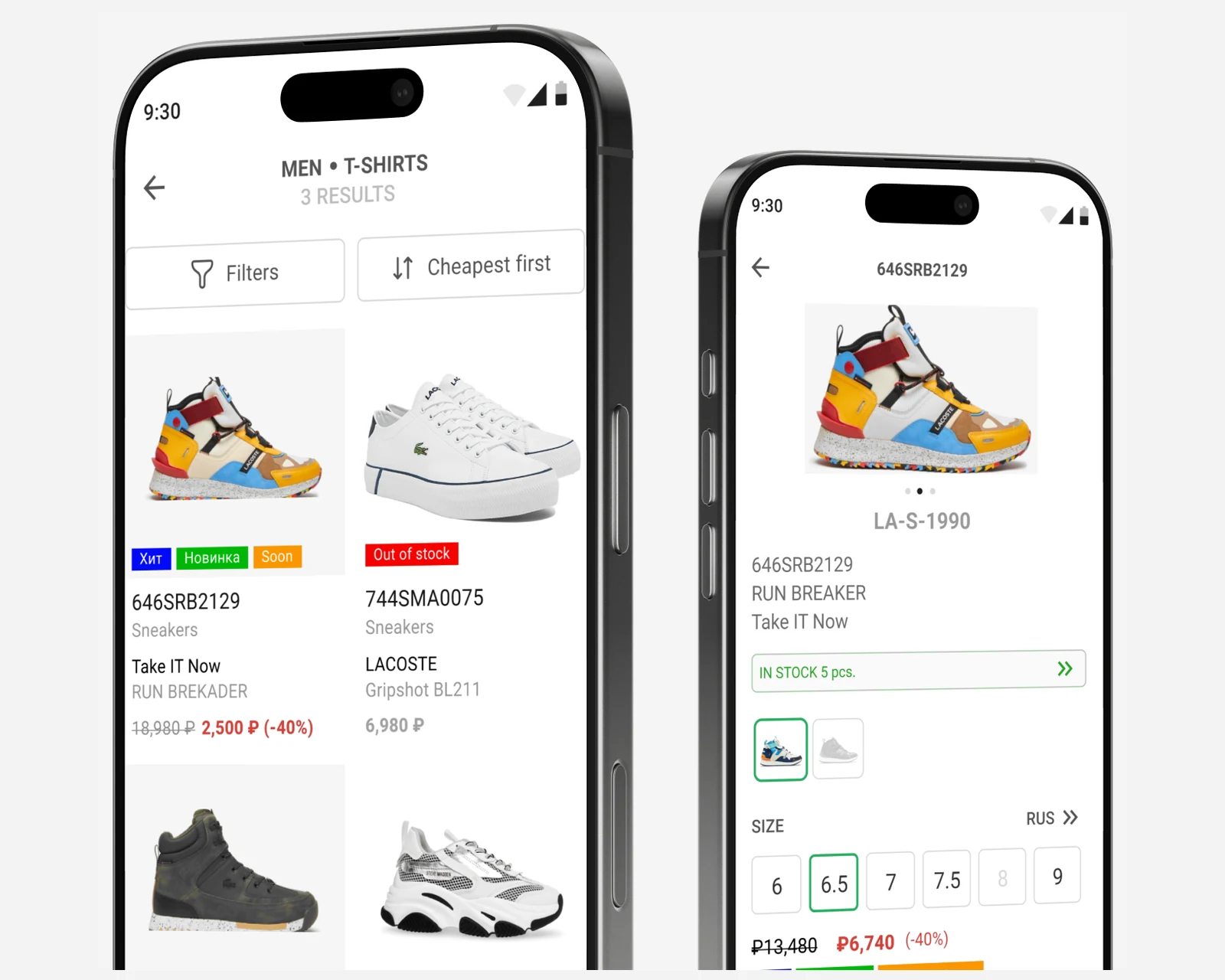
Internal training and operations platform for a multi-store retail network — cohort training, performance tracking, US + EU rollout.
View case →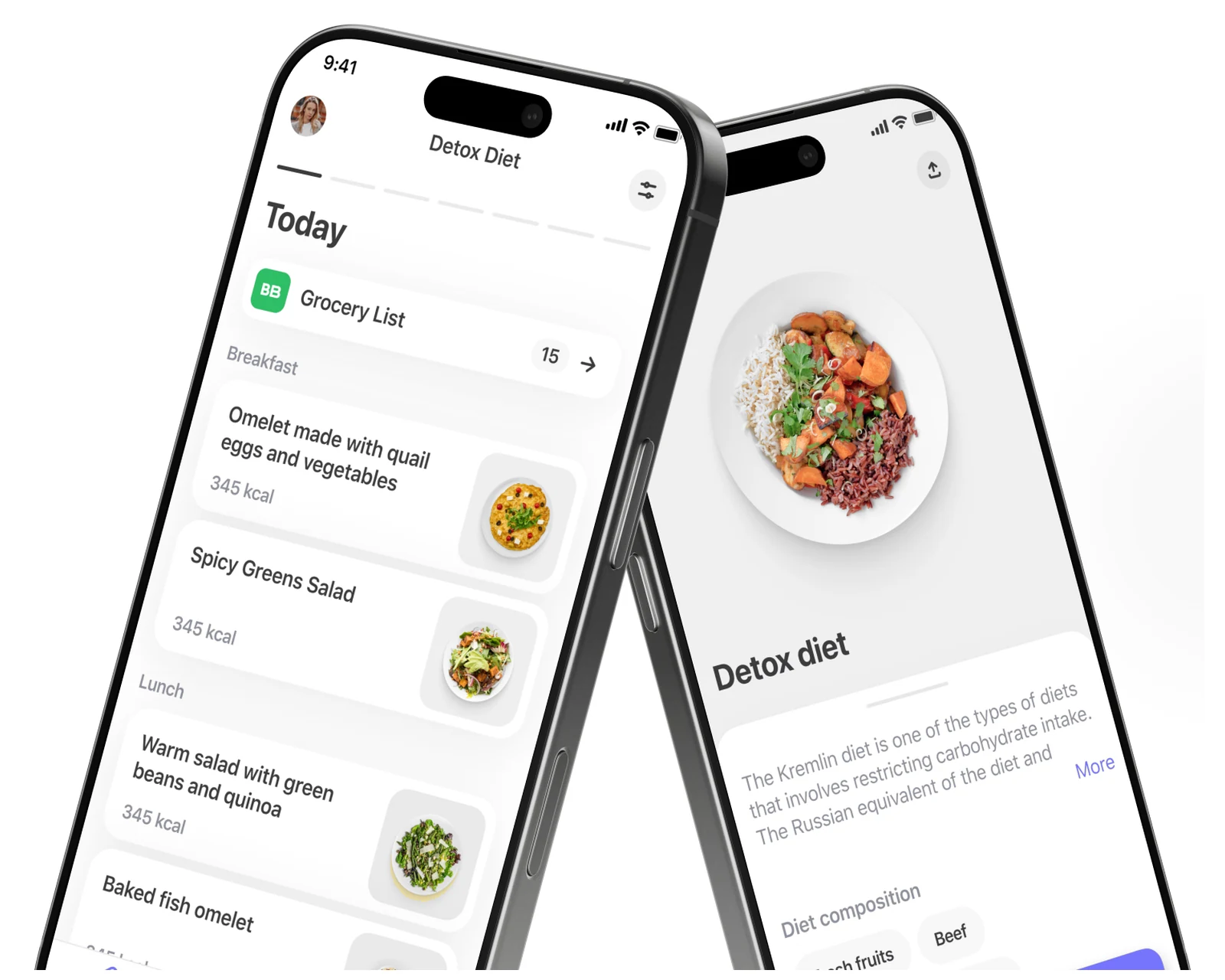
Cross-platform meal-planning and recipe app with subscription tiers, audit-ready data handling, US + EU launch.
View case →
Offline-first multi-role workspace ecosystem — Android, admin console, controller dashboard, GDPR-aligned audit trail.
View case →Share a few details and a senior consultant will reply within one business day.