Discovery & document model
Mapping the seven document categories, six roles, and per-category approval routes, plus the GDPR + CCPA data-ownership posture for the back-office workflow.
Case study · Retail · EDM
How we shipped an internal electronic document management system for a large retail chain — a React web platform on a Laravel backend with electronic document exchange, optional e-signatures, multi-step approval routing, counterparty tracking, task management, in-app messaging, and a centralized archive with role-based access — built for back-office and compliance teams across the United States and the European Union under GDPR and CCPA expectations from day one.
The client runs a large retail grocery chain with a complex organizational structure and a heavy load of internal documentation. The source of truth lived in printed contracts, email threads, and a sprawl of shared drives, so a single supply contract could pass through HR, a department head, accounting, and legal with no shared record of who had seen it, signed it, or sent it back for changes. For back-office teams in the United States and the European Union, that model breaks the moment the organization scales: approvals stall, signed versions diverge from drafts, and a compliance lead has no defensible audit trail of who did what. The brief was to digitize the entire internal document lifecycle — creation, exchange, signing, approval routing, and archival — across seven document categories (HR, commercial, production, financial, warehouse, archive, and management) and six roles, and to let high-level users adjust who can see what without calling a developer. Off-the-shelf document software failed the first acceptance test: it assumes a generic folder-and-share model and could not express category-specific approval routes or self-service permission administration. We built the system from first principles at YuSMP Group as a unified React web platform on a Laravel backend, engineered with our custom software development practice for the US and EU markets.
A snapshot of what the document management build delivered as a single web platform spanning document exchange, approval routing, and a permission-aware archive.
The platform decision dominates every other architectural choice in a document management build. We chose a custom system over packaged document software because the retail chain's reality — seven document categories, six roles, and approval routes that differ per category — does not fit the generic folder-and-share template that off-the-shelf products assume. The configuration tax of bending a packaged platform to those rules typically exceeds a clean custom build, and it leaves the most operationally important behavior, the permission model and the approval routing, locked behind a vendor's roadmap. A custom EDM let us model the real organization, give high-level users self-service control over access, and own the data end-to-end — which matters for US and EU companies that have to answer to GDPR and CCPA obligations.
The trade-off most teams underweight is the audit trail. Packaged document suites rarely produce a defensible, immutable record of who created, signed, approved, or edited each document and when, yet that record is exactly what a compliance review depends on. Building the platform ourselves meant the approval history, the e-signature method capture, and the granular archive permissions were first-class concerns rather than add-ons, and the entire stack — React front end, Laravel API, document store — is open and maintainable for the long run.
| Dimension | Custom EDM (this build) | Off-the-shelf software | Email / shared drives |
|---|---|---|---|
| Document categories | Seven categories, per-category rules | Generic folders and tags | Ad-hoc folders |
| Approval routing | Ordered, role-aware routes per type | Linear or limited templates | Manual forwarding |
| E-signatures | Optional signature or login confirm | Often a paid add-on | Print, sign, scan |
| Permission administration | Self-service, no developer needed | Admin console, vendor-bounded | Folder ACLs by IT |
| Audit trail | Immutable history per document | Varies; often partial | None |
| Data ownership (GDPR / CCPA) | Full ownership and residency control | Vendor-hosted, shared tenancy | Uncontrolled |
| Counterparty tracking | Documents grouped per counterparty | Rarely first-class | None |
Platform references: React documentation, Laravel documentation, WCAG 2.1 accessibility guidelines.
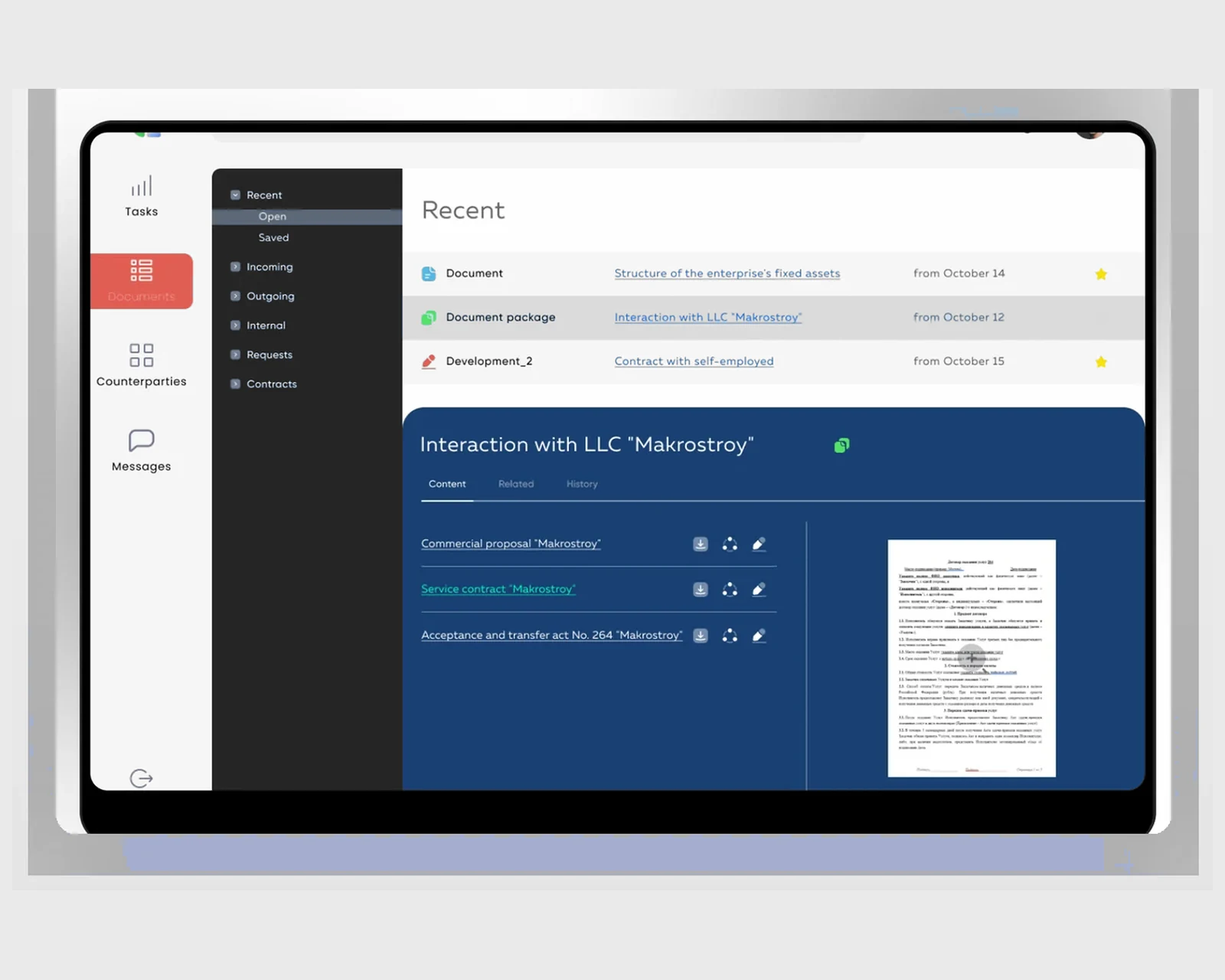
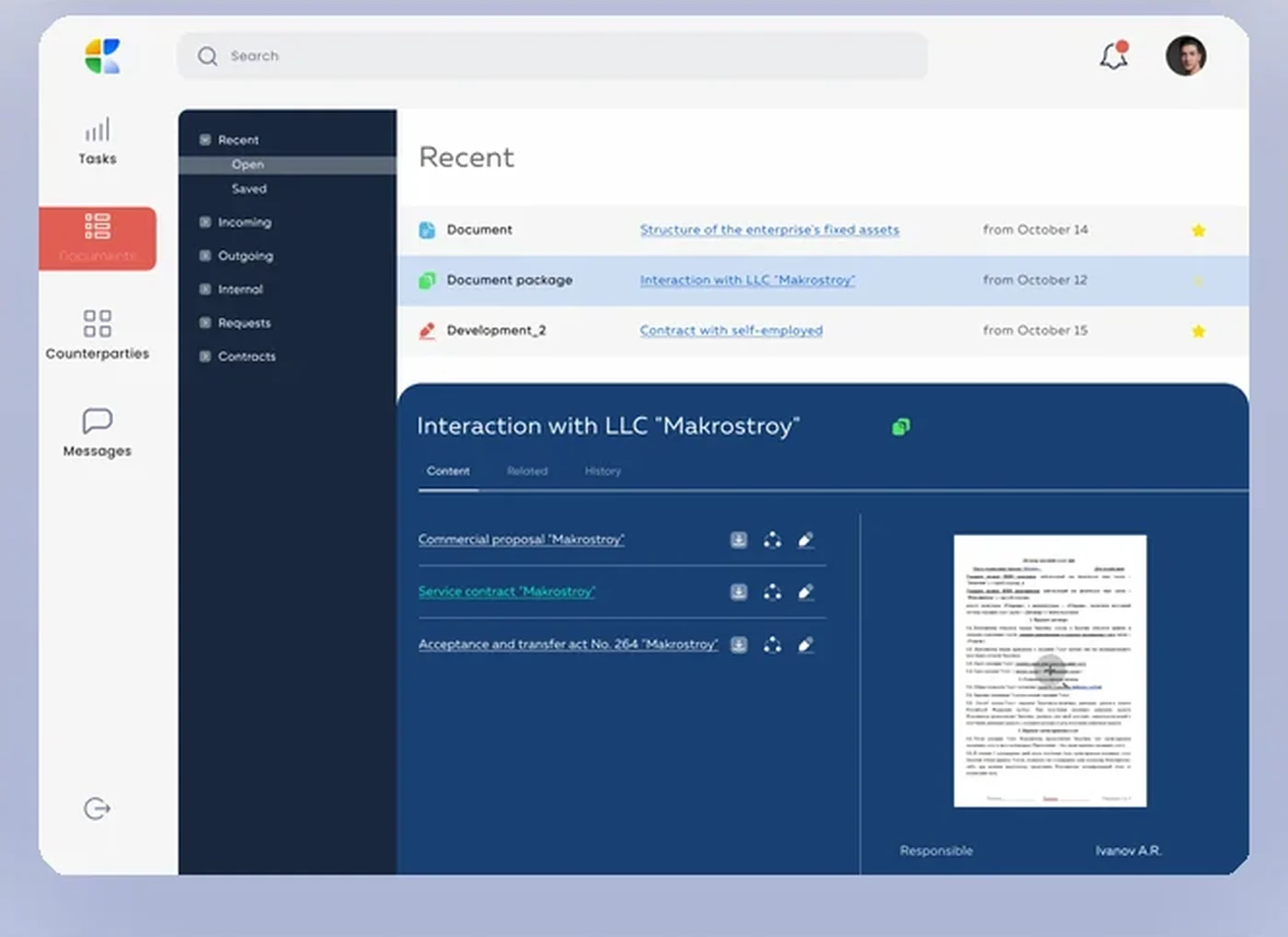
The Documents module is the core of the platform and the surface back-office staff live in. Documents are created and exchanged inside the system rather than over email, organized as incoming, outgoing, internal, requests, and contracts, and grouped into document packages so a related set — a commercial proposal, a service contract, and an acceptance act for the same counterparty — travels together. Each document carries its own content, related items, and a history tab, and signing is optional per document: a user can apply an electronic signature or confirm with login and password, with the chosen method recorded so the trail stays complete.
Approval routing turns a static file into a workflow. Each document type carries an ordered route expressed as a sequence of roles, so a contract moves from author to legal to a department head to the director in the order the business requires, and every step writes an immutable record to the approval history with the actor, action, and timestamp. That history is what makes the platform defensible under a compliance review — the same reason the front end follows the web application development standards we hold every build to. Removing the print-sign-scan loop is the single largest contributor to faster, cleaner approvals.
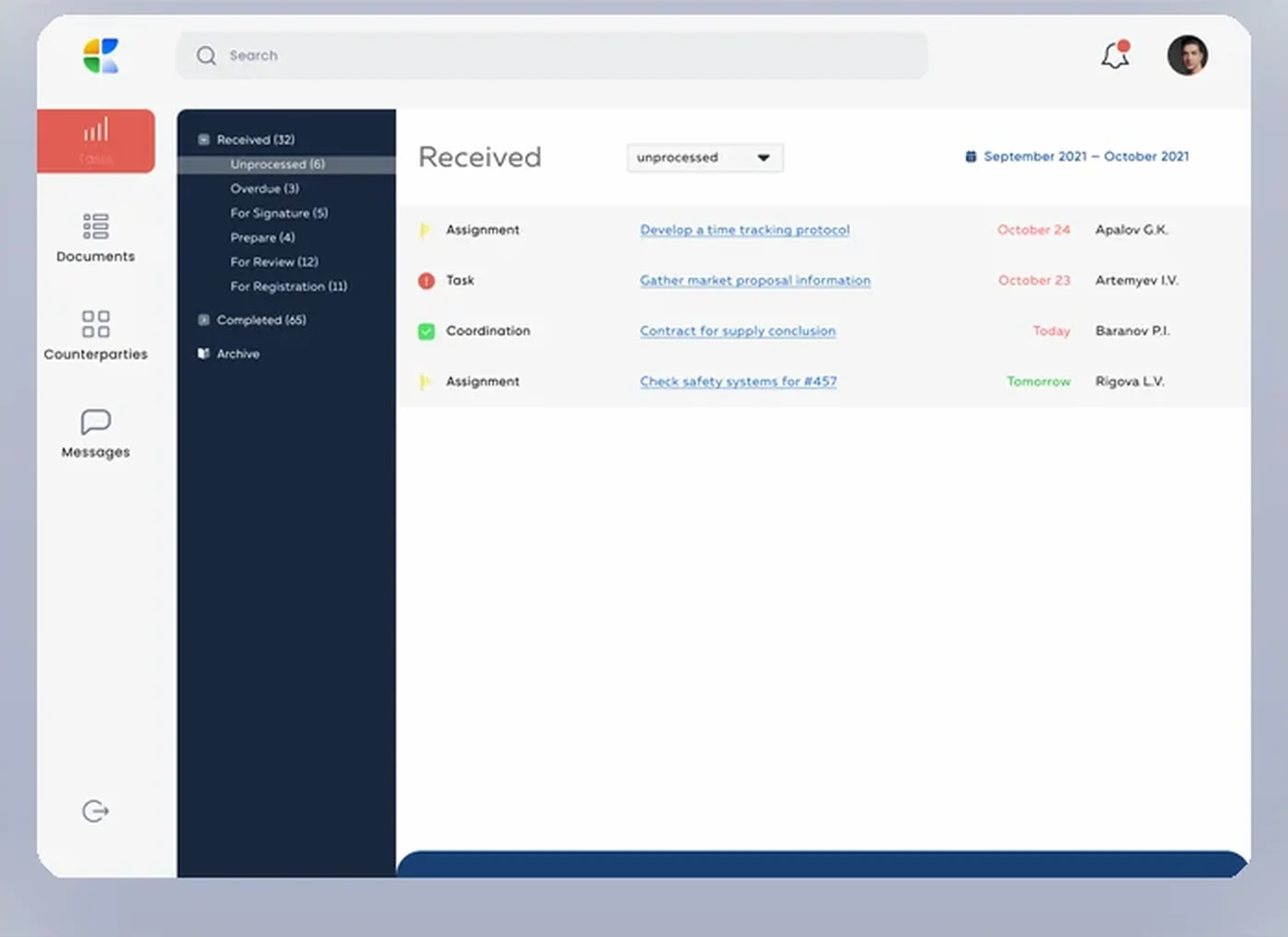
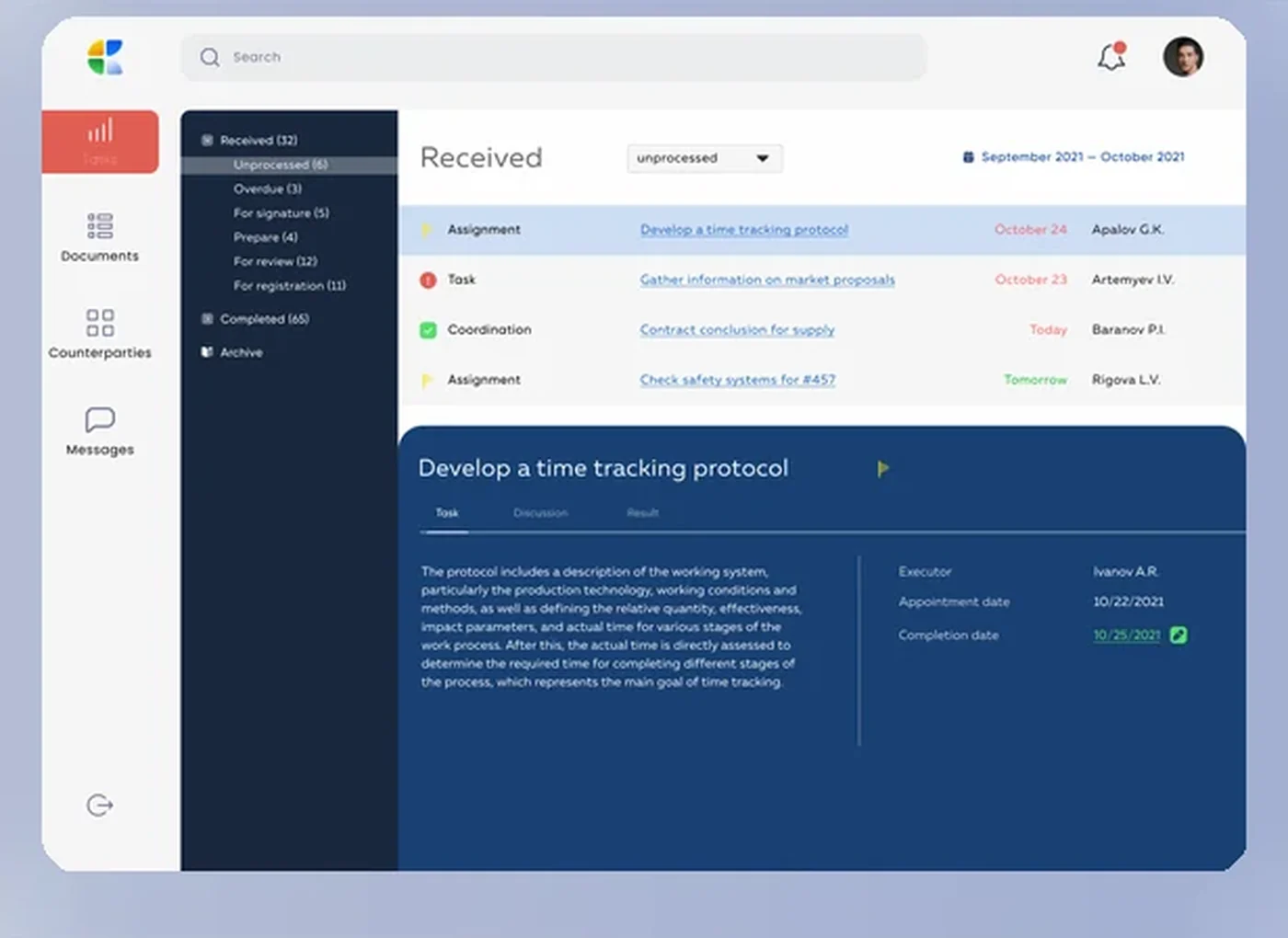
The Tasks module makes the document workflow actionable. Incoming work is split into clear queues — unprocessed, overdue, for signature, for review, for registration — and each item links straight back to the document it concerns, with an executor, an appointment date, and an editable completion date so nothing stalls in an inbox. Assignments, tasks, and coordination items each carry their own status, and a completed view keeps a record of throughput. Counterparties get a first-class home too, so every document exchanged with a given organization is grouped under that organization rather than scattered across folders.
The web client is a React application backed by a Laravel API. The control plane carries the permission model, the approval-routing engine, the document store, and the audit history, and it is engineered on our cloud & DevOps foundation so the API, the search index, and the document storage scale together as the chain adds locations and document volume. Because the client owns its deployment, the entire platform — front end, API, storage — is open and maintainable rather than locked behind a vendor.
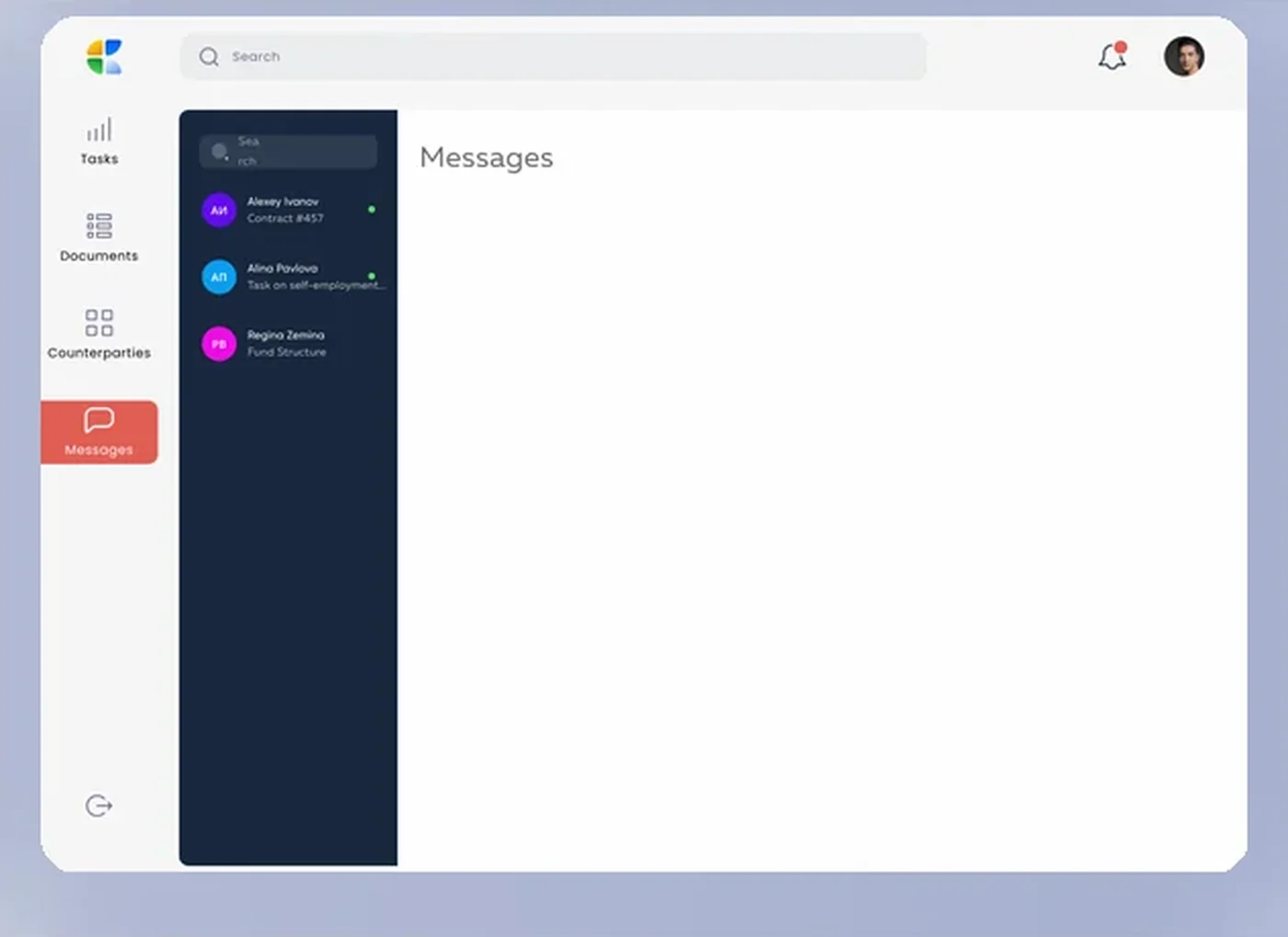
The access model is the backbone that makes the platform trustworthy. Permissions are modeled as roles mapped to document categories and actions rather than per-user toggles, so the director, HR, department heads, accounting, legal, and warehouse managers each see only what their role allows. The defining design choice is self-service: high-level users adjust employee access from the admin UI without a developer in the loop, and archive access is granular, so a closed financial document stays restricted even when its broader category is visible to a team. The Messages module keeps document discussion in context — conversations are tied to a specific contract or task — so decisions are captured alongside the documents they concern rather than lost in email.
Because the client owns its own deployment, data ownership and residency are design choices rather than vendor defaults. Operational data can be pinned to US or EU infrastructure for future data-residency commitments, role-based access keeps every category separated, and the system aligns with GDPR obligations for users in the European Union and CCPA / CPRA obligations for users in California and the broader United States — making a future readiness review a documentation exercise rather than an architectural retrofit.
Compliance posture: GDPR-aligned · ISO 27001 ready · SOC 2 Type II in progress · HIPAA-capable · CCPA-acknowledged.
A five-phase build that took the chain from paper, email, and shared drives to a live web platform with approval routing and a defensible audit trail.
Mapping the seven document categories, six roles, and per-category approval routes, plus the GDPR + CCPA data-ownership posture for the back-office workflow.
React + Laravel control plane skeleton, the role-to-category permission model, the approval-routing engine, and the immutable approval-history contract.
Documents with exchange and e-signatures, Tasks with workflow queues, Counterparties, Messages, and the centralized archive with granular access.
Approval-history validation, e-signature method capture, self-service permission testing, and access-isolation QA across all six roles.
Staff onboarding, role-based access rollout, archive migration, and production launch across US and EU back-office teams.
Beyond the document core, the platform carries a self-service permission subsystem that is where it earns its keep for a fast-moving retail organization. Rather than treating access as a developer task, the subsystem exposes the role-to-category-to-action matrix to high-level users directly, so when a department reorganizes, a new accountant joins, or a financial document needs to be locked down, the change is a few clicks in the admin UI rather than a support ticket and a release. Every permission change is itself recorded, so the audit trail covers not just who touched a document but who could have. The subsystem was built with extensibility in mind — adding a new document category, a new role, or a new approval step is a configuration change against the permission service rather than a code release. It is the layer that lets a single platform keep pace with an organization that changes faster than any vendor roadmap could, and it is what makes self-service access realistic for operations and compliance leaders across the US and EU who have to keep the access map honest week to week.
The system shipped as a single English-language web build serving back-office teams across the United States and the European Union, without a separate codebase per region. It serves users in California, New York, Texas, Florida, and Washington in the US, and users in the Netherlands, Germany, France, Ireland, and Sweden in the EU. Because the client owns its own deployment, data-handling practices are aligned with GDPR for users in the EU and with the US state-privacy patchwork — CCPA / CPRA (California), VCDPA (Virginia), CPA (Colorado), CTDPA (Connecticut), UCPA (Utah), TDPSA (Texas), and Oregon CPA. Role-based access separates every document category, and operational data can be pinned to US or EU infrastructure for future data-residency commitments — so regional compliance reduces to honest disclosure and access discipline rather than per-jurisdiction rework.
The platform is built to roll out across EU and US sites in parallel, with each location's web client provisioned identically and bound to the same permission model and approval routes. The document lifecycle runs the same way in every region, so a multi-site operator gets one consistent picture across geographies. The engineering team behind the build runs a CET workday with East-Coast US overlap (9 AM–1 PM ET) for stand-ups, approval-workflow choreography, and incident response — the window that lets a US operations team and an EU engineering team share four hours of live overlap every day. Data-handling references are documented directly against GDPR obligations and California CCPA obligations.
The active custom software development roadmap for the document platform includes a native mobile companion so managers can review and sign documents away from a desk, a reporting module that turns the approval history into cycle-time and bottleneck analytics, and qualified-e-signature integration for jurisdictions that require it. A cross-entity console with shared counterparty records is planned for groups running several legal entities, with the permission subsystem already structured for multi-tenant layouts. Infrastructure plans include further workflow automation, a continuous integrity harness that reconciles the document store against the audit history, and regional deployment scaffolded into the cloud & DevOps roadmap.
If you are planning a document management system, an electronic document management platform, or any back-office workflow app where approvals, signatures, and a defensible audit trail have to hold up for audiences in the US and EU, we have shipped this stack end-to-end and can compress the build timeline meaningfully. The product overview is available at yusmpgroup.ru (web), and the engineering team behind it sits inside YuSMP Group. We work fixed-price for well-scoped MVPs and on dedicated development teams for ongoing delivery, with a CET workday and a guaranteed East-Coast US overlap (9 AM–1 PM ET) window for stand-ups, demos, and incident response.
A custom EDM MVP covering document creation and exchange, a centralized archive, role-based access, and a single approval route typically costs $70k–$180k. Adding e-signatures, multi-step approval routing, counterparty document tracking, task management, and in-app messaging brings a full back-office platform to $200k–$480k. The dominant cost drivers are the permission model, the approval-routing engine, and the audit trail that records who signed, approved, or edited each document and when.
Off-the-shelf document software assumes a generic folder-and-share model. A retail chain with seven document categories, six distinct roles, and approval routes that differ per category rarely fits that template, and the configuration tax of bending a packaged product to those rules often exceeds a custom build. A custom EDM lets you model the real organization, give high-level users self-service control over permissions, and own the data — which matters for US and EU companies with GDPR and CCPA obligations.
Each document type carries an approval route defined as an ordered list of roles, so a contract moves from author to legal to a department head to the director in the order the business requires. Every step writes an immutable record to the approval history with the actor, action, and timestamp. Signing is optional per document: a user can apply an electronic signature or confirm with login and password, and the record captures which method was used so the audit trail stays complete and defensible.
Access is modeled as roles mapped to document categories and actions rather than per-user toggles, so the director, HR, department heads, accounting, legal, and warehouse managers each see only what their role allows. The key design choice is self-service: high-level users adjust employee access from the admin UI without a developer in the loop. Archive access is granular, so a closed financial document stays restricted even when the broader category is visible to a team.
A focused EDM MVP with document creation and exchange, a centralized archive, role-based access, and one approval route typically takes 12–18 weeks. Adding e-signatures, multi-step approval routing, counterparty tracking, task management, and in-app messaging adds 8–12 weeks. The permission model and the approval-history audit trail are frequently underestimated and should be budgeted at 3–5 weeks of dedicated work, because they touch every other feature in the platform.
Related cases
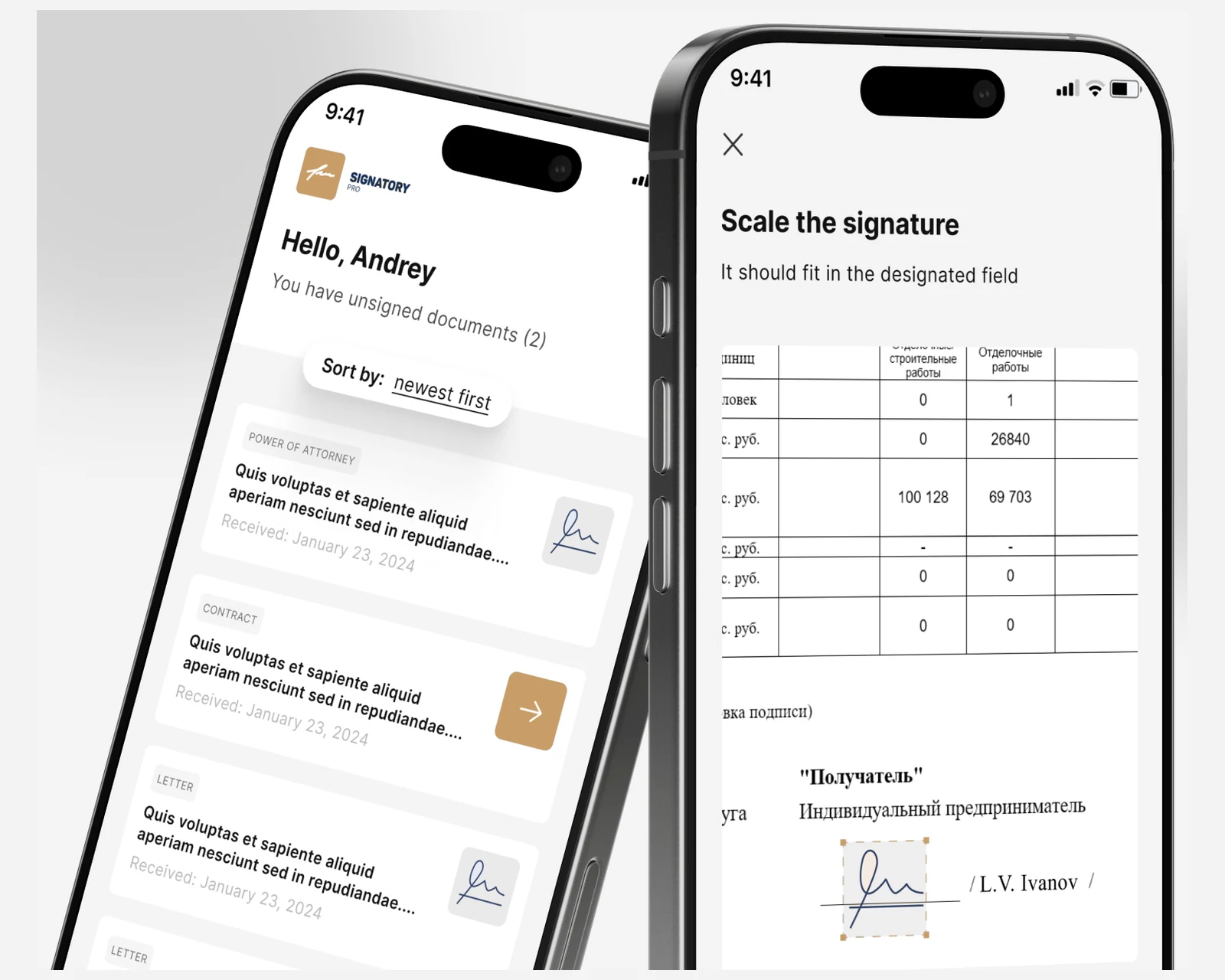
E-signature platform with document workflows and a defensible audit trail for teams across US & EU.
View case →
Document collaboration and management platform for distributed knowledge-work teams across US & EU.
View case →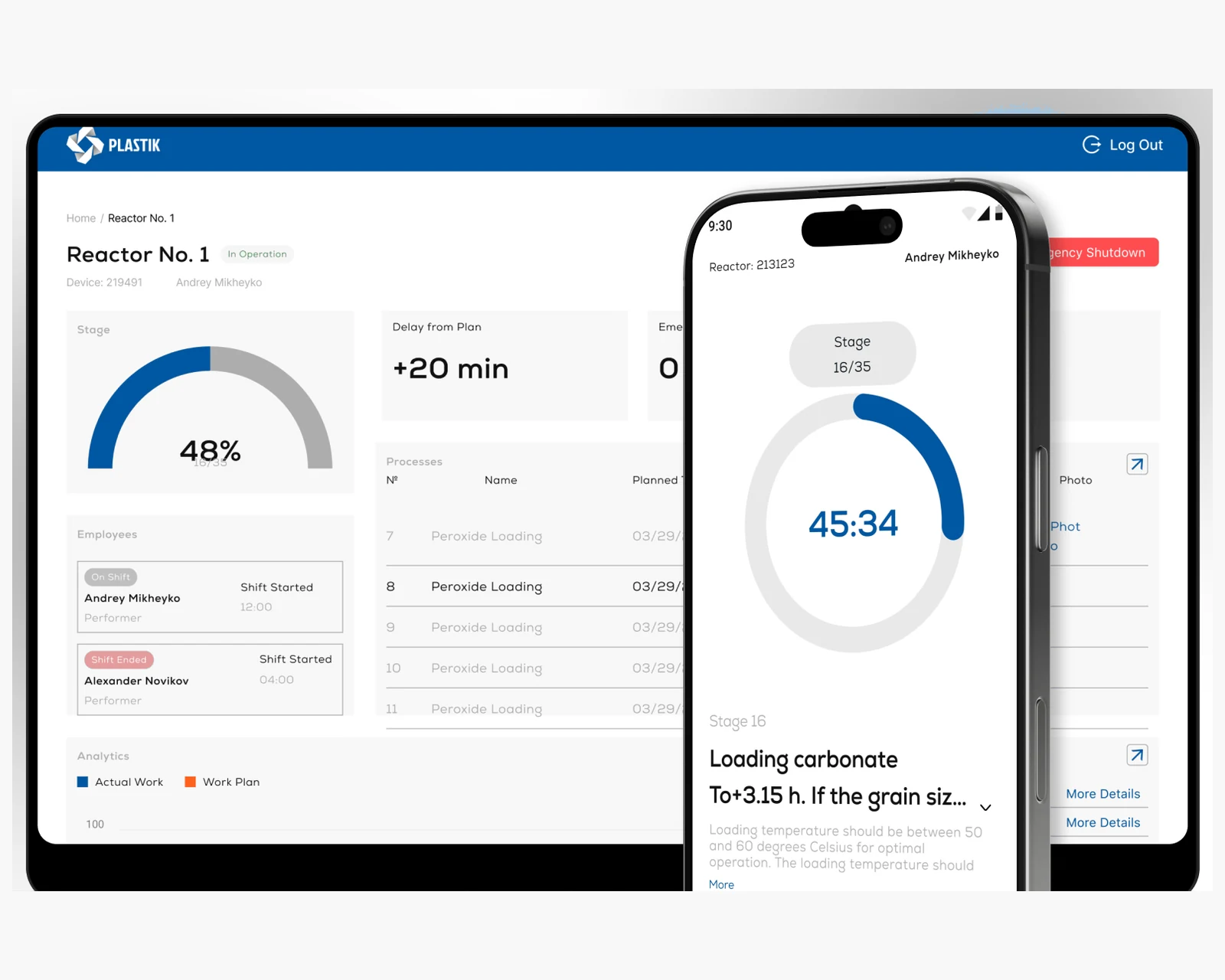
Field-audit app, ops dashboard, and compliance reporting for distributed operations teams across US & EU.
View case →
Custom platforms engineered to your business model, scaling cleanly from MVP to millions of users.
Explore custom software development →
Production-grade React web applications with accessible, maintainable front ends and robust APIs.
Explore web application development →
Containerized infrastructure, CI/CD pipelines, and Terraform-managed deployments across US & EU regions.
Explore cloud & DevOps →Share a few details and a senior consultant will reply within one business day.