Discovery & marketplace model
Two-sided marketplace mapping (mentors vs learners), coach-room information architecture, pricing and payout model, GDPR + CCPA posture, store-billing rules for digital goods.

Case study · EdTech · Coaching
How we shipped a two-sided coaching and mentorship marketplace — native iOS and Android learner apps, a React web broadcast studio, low-latency live webinars with real-time chat, and a mentor-set pricing engine with subscriptions and payouts — built for coaches and learners across the United States and the European Union under GDPR and CCPA expectations from day one.
The client wanted an ecosystem where individual specialists — coaches, mentors, makeup artists, personal-growth trainers, business consultants — could turn their knowledge into a live coaching business, not just a static video library. The core insight was that a modern mentor in the United States and the European Union does not want to be a faceless course on a generic marketplace; they want their own coach room, the ability to run live 1-on-1 and group webinars, and full control over what they charge. Off-the-shelf creator tools failed two acceptance tests immediately: their templated pricing and payout rails could not model a two-sided marketplace where every mentor sets their own prices, and bolting a separate webinar product onto a course catalog left learners juggling three logins and the platform owning none of the data. We built the platform from first principles at YuSMP Group as one unified product — native iOS and Android learner apps, a React web broadcast studio for mentors, a Laravel back end, and a live-streaming layer — engineered with our custom software development practice for the US and EU markets. Unlike a packaged LMS, the system treats the coach-and-learner relationship — not the course file — as the unit it is built around.
A snapshot of what the coaching-platform build delivered across web, iOS, Android, and a Laravel back end in its first production cycle.
The platform decision dominates every other choice in a coaching product. We built a custom two-sided marketplace rather than stitching together Teachable, a webinar tool, and a payments provider because the trade-offs line up cleanly with a mentor-first business. Packaged creator tools assume a single-tenant template — one brand, one pricing model, one payout schedule — while a coaching marketplace needs every mentor to run their own coach room, set their own prices, and host live 1-on-1 and group sessions inside one consistent learner experience. Gluing three SaaS products together leaves the operator renting three roadmaps, paying three rev-shares, and owning none of the relationship data that makes the marketplace defensible.
A custom build on Laravel and React also keeps the live and recorded experiences inside one consent and billing flow, which matters for a platform serving both the United States and the European Union. The same account, entitlement, and payout record drives course playback, a live webinar, and a one-on-one coaching booking — so a learner never re-authenticates and a mentor sees a single revenue ledger. The comparison below summarizes why the custom path won.
| Dimension | Custom platform (this build) | Course SaaS (Teachable / Kajabi) | Webinar tool (Zoom) |
|---|---|---|---|
| Two-sided marketplace | First-class — per-mentor coach rooms | Single-tenant template per creator | No commerce layer |
| Mentor-set pricing | Per-course and per-webinar control | Plan-bound pricing options | Not applicable |
| Live + recorded in one app | Unified — single login and ledger | Recorded-first; live is an add-on | Live-only; no library |
| Native iOS / Android | Purpose-built native apps | Generic branded wrapper | Meeting app, not a store |
| Payout ownership | Operator owns commission & payouts | Vendor controls rev-share | No payouts |
| Data & privacy control | Self-owned — GDPR / CCPA direct | Vendor-held data | Vendor-held data |
| Branding & UX control | Full — custom learner journey | Theme-limited | Fixed meeting UI |
References: Laravel documentation, WebRTC project, Apple StoreKit documentation.
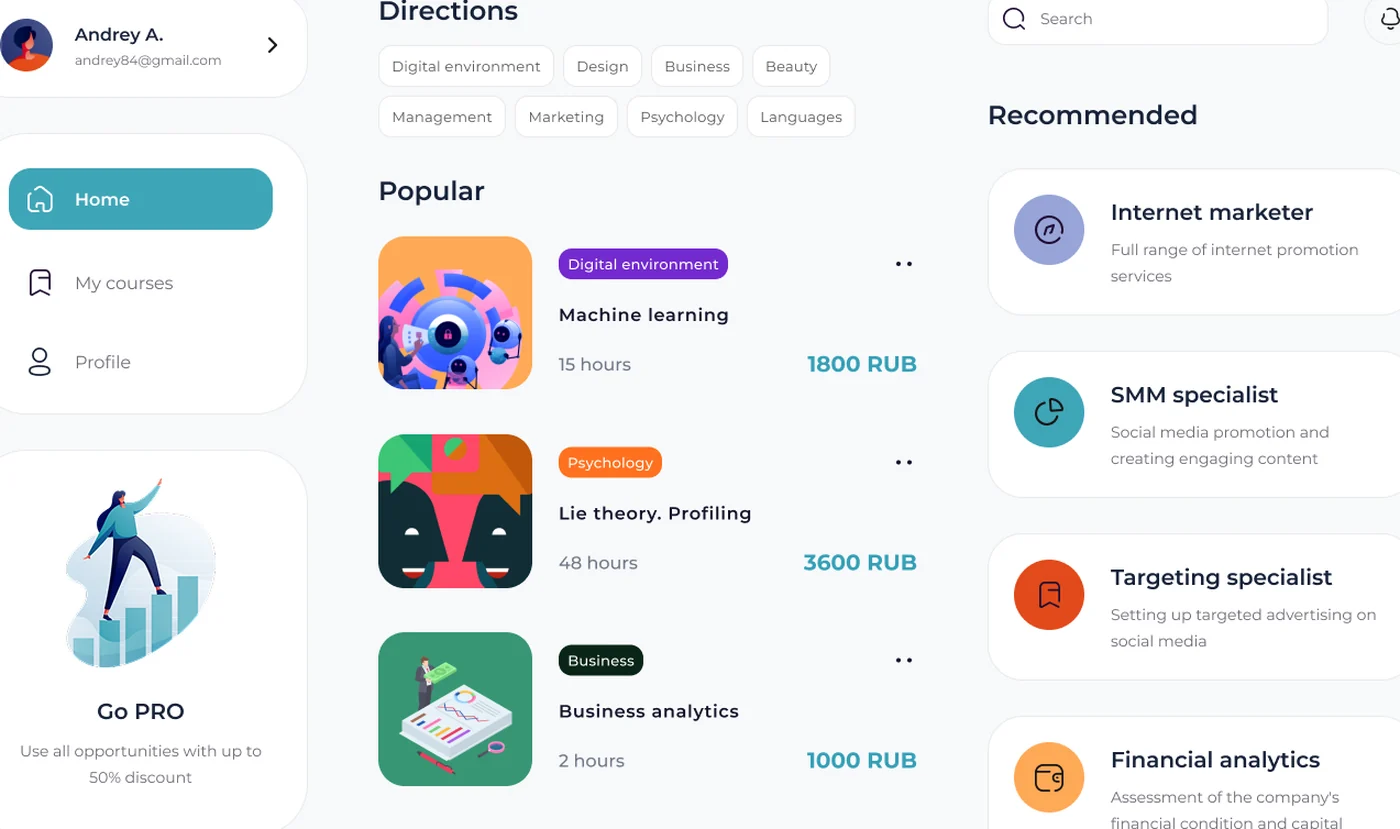
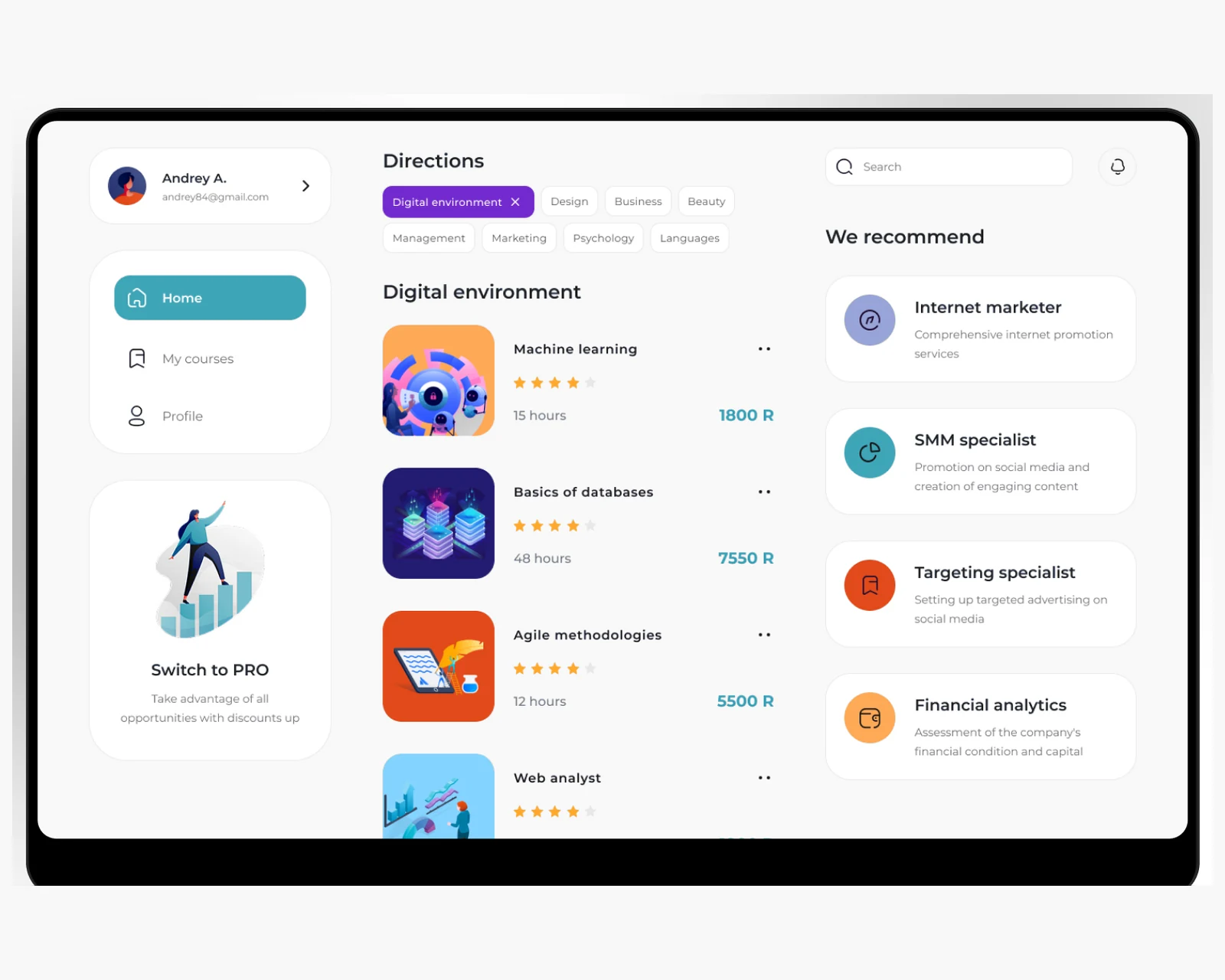
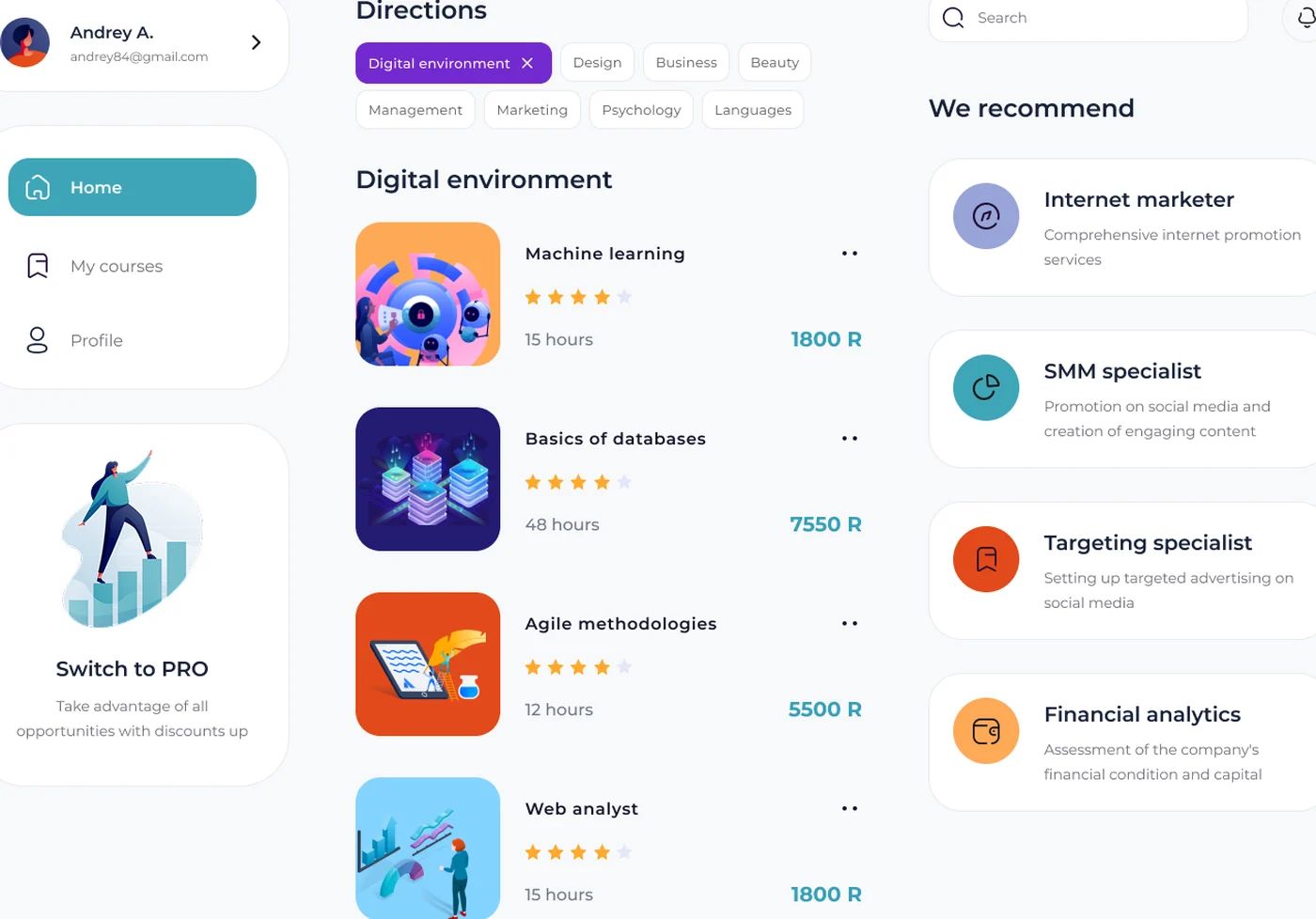
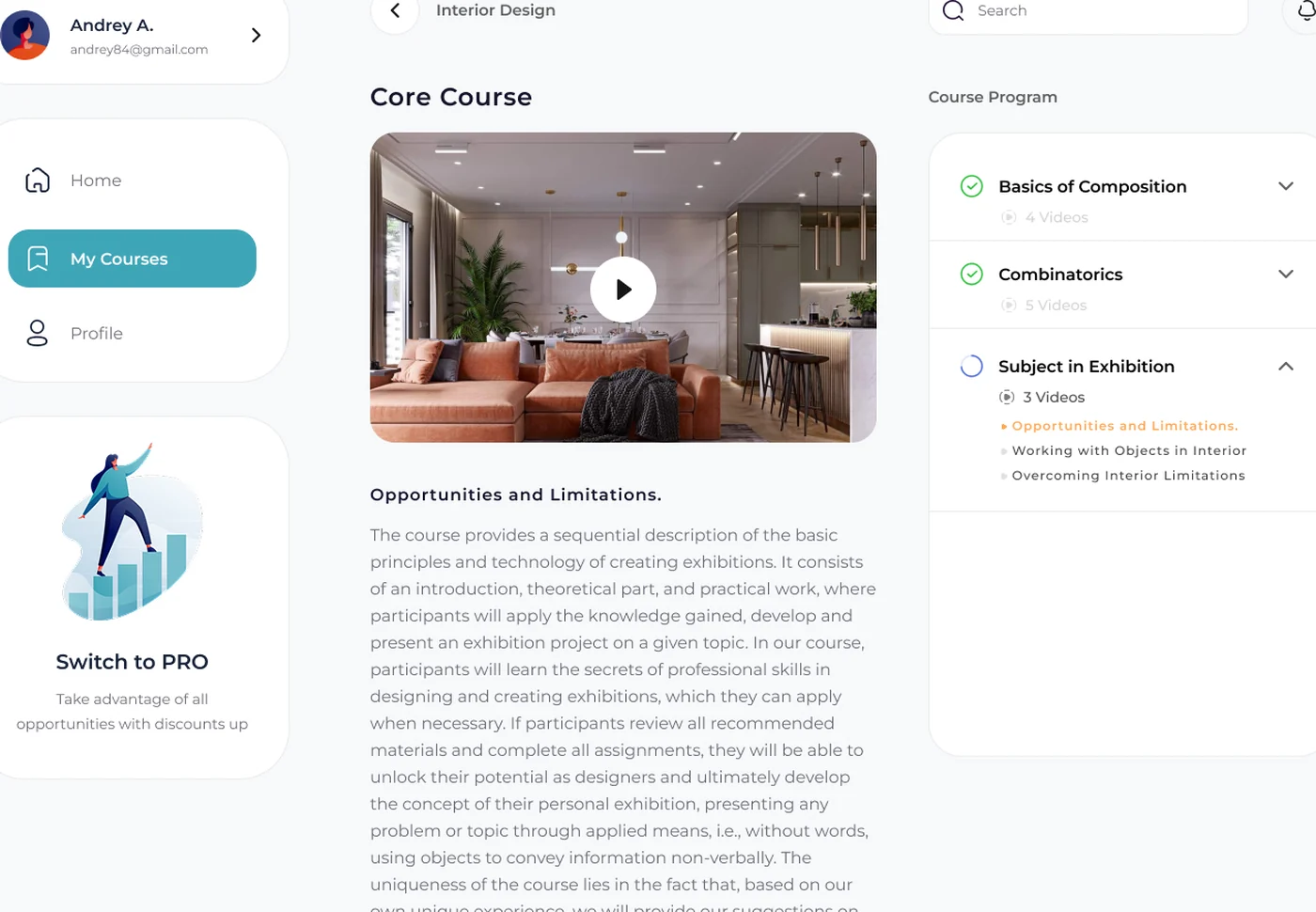
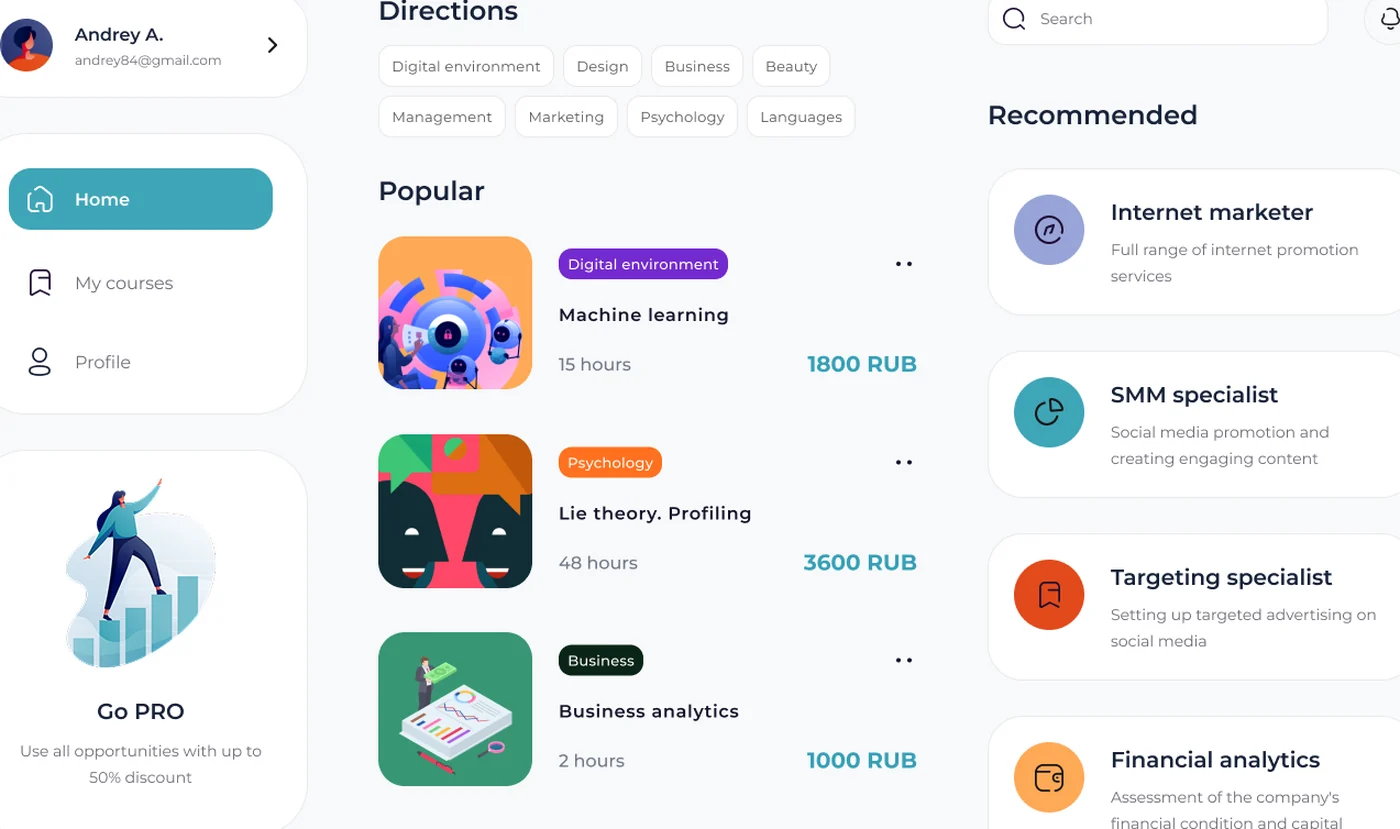
The learner experience is delivered as native iOS and Android apps so the live-session and on-device download paths feel first-class rather than wrapped in a web view. A learner lands on a home surface that organizes coach rooms by direction — design, business, marketing, psychology, languages, and more — with a recommended-mentors rail and a search box. Tapping into a coach room opens that mentor's catalog: recorded core courses with a modular curriculum, plus upcoming live webinars the learner can join. The player handles a coach-led program as a sequence of lessons with progress tracking, so a learner can resume a multi-part course or drop into a single live session without leaving the app.
Under the hood the mobile clients share a single API contract against the Laravel back end, with entitlement checks gating both recorded playback and live-room access. Purchases made on a phone immediately unlock the same content on the web studio and the other platform, because entitlement is keyed server-side rather than per-device. The same engineering team carries iOS and Android in lockstep as part of our iOS and Android engineering practice, which is what keeps the coach-room experience consistent across both stores in the US and EU.
Monetization is the heart of a coaching marketplace, and it had to work for both sides at once. Each mentor sets the price for course access or an individual webinar from their own coach room; learners pay through in-app subscriptions or one-time purchases. On the React web studio the platform charges cards through Stripe, while inside the iOS and Android apps digital-goods sales route through Apple StoreKit and Google Play Billing to stay store-compliant — a non-negotiable for any app selling digital content in the US and EU. Server-side receipt validation confirms each purchase before the entitlement is granted.
Behind the purchase sits a revenue ledger. The platform records gross revenue per transaction, applies its commission, and accrues a payout balance for each coach, with the back office handling reconciliation, refunds, and scheduled payouts. Subscription state — active, lapsed, renewed — resolves cleanly across reinstalls and device swaps because it reads from the same entitlement record the players use. The whole subsystem was built for extensibility: adding a tiered "Go PRO" learner subscription, a promotional discount, or a revenue-share change for a mentor cohort is a configuration change against the billing service, not a code release. This commerce layer is the kind of revenue-critical work we deliver across our web application development engagements.
Live coaching needs sub-second feedback, so we separated the media path from the data path. Video is published through a streaming SFU and delivered over WebRTC for interactive sessions or low-latency HLS for larger audiences, while chat, reactions, and Q&A ride a separate WebSocket channel so a slow video segment never blocks the conversation. The room state is authoritative on the server, late joiners get a replay buffer, and a dropped connection rejoins the same logical room rather than a fresh one. The Laravel-backed admin console gives operators content moderation, mentor and learner management, financial reporting, and payout reconciliation in one place.
On privacy, learner and mentor records, payment metadata, and session history are modeled so a deletion or export request maps to concrete tables rather than a manual hunt. Data-handling practices are aligned with GDPR for users in the European Union and CCPA / CPRA for users in California and the broader United States, with consent captured at sign-up and surfaced in the account settings. The architecture is built so an outside data-protection review is a documentation exercise, not a retrofit.
Compliance posture: GDPR-aligned · ISO 27001 ready · SOC 2 Type II in progress · HIPAA-capable · CCPA-acknowledged.
A five-phase build that took the coaching platform from product specification to production across web, iOS, Android, and a Laravel back end.
Two-sided marketplace mapping (mentors vs learners), coach-room information architecture, pricing and payout model, GDPR + CCPA posture, store-billing rules for digital goods.
Laravel API and entitlement model, streaming SFU and WebRTC / low-latency HLS path, WebSocket chat channel, Stripe / StoreKit / Play Billing payment rails.
React web broadcast studio for mentors; native iOS and Android learner apps with coach rooms, course playback, live-session join, and in-app purchase flows.
Revenue ledger, commission and payout accrual, refunds and reconciliation, admin moderation console, receipt validation, and privacy export / deletion paths.
App Store and Google Play submission across US and EU storefronts, live-stream load testing, mentor onboarding, and production monitoring of sessions and payouts.
The coach room is the organizing idea that separates this platform from a flat course catalog, and it earns its keep as both a discovery surface and a mentor's storefront. Learners browse by direction — design, business, marketing, psychology, management, languages, and beauty — with a filter chip set at the top and a recommended-mentors rail that surfaces specialists like an internet marketer, an SMM specialist, or a financial-analytics coach based on the learner's chosen directions and viewing history. Each room presents the mentor's recorded core courses alongside their upcoming live webinars, so a learner can sample a recorded lesson and then commit to a live session with the same person. The recommendation logic runs server-side against the Laravel back end and is deliberately simple at launch — direction match, rating, and recency — but structured so a future collaborative-filtering or embedding-based ranker can slot in without touching the client apps. Because the room, the pricing, and the payout ledger all key off the same mentor record, a coach who adds a new course or schedules a new webinar sees it appear in their room, in discovery, and in their revenue dashboard in one step — the kind of cohesion that a stitched-together stack of point tools cannot deliver, and a major reason the client chose a custom build for the US and EU rollout.
The coaching platform launched on the web and on Apple App Store and Google Play with storefronts active across the United States and the European Union. The English-language build serves mentors and learners in California, New York, Texas, Florida, and Washington in the US, and in the Netherlands, Germany, France, Ireland, and Sweden in the EU, without a separate codebase per region. Consent flows are region-aware at the client layer: users in the EU and EEA receive a GDPR-style granular consent screen, and users in California receive a CCPA-style "Do Not Sell or Share My Personal Information" disclosure in the same flow. Data-handling practices are aligned with GDPR for European users and with the US state-privacy patchwork — CCPA/CPRA (California), VCDPA (Virginia), CPA (Colorado), CTDPA (Connecticut), UCPA (Utah), TDPSA (Texas), and Oregon CPA. Because learner and payment data is modeled around explicit entitlement and payout records, regional compliance reduces to honest disclosure and clean export/deletion rather than per-jurisdiction data forks.
Payments and payouts were the part of the launch that demanded the most jurisdictional care. Card processing on the web runs through Stripe in both the US and EU, while in-app digital-goods sales route through Apple StoreKit and Google Play Billing to satisfy each store's rules — and the platform's commission and payout logic is currency-aware so a mentor based in the EU and a learner paying in the US reconcile correctly. The English-first build is structured for localization, with copy externalized so additional EU languages can be added without a rebuild. The engineering team behind the build sits across CET and runs a CET workday with East-Coast US overlap (9 AM–1 PM ET) for stand-ups, store-review choreography, and incident response — the timezone that lets a US product team and an EU engineering team share four hours of live overlap every day. The result is one coaching platform that serves the US and EU from a single code base, citing GDPR obligations and California CCPA obligations directly in its privacy policy.
The active custom software development roadmap for the coaching platform includes one-on-one booking with calendar sync for true 1-on-1 mentorship sessions, a tiered "Go PRO" learner subscription, cohort-based group programs with shared assignments, and a smarter recommendation ranker that learns from completion and rebooking signals. A creator-analytics dashboard giving mentors revenue, retention, and engagement views is planned, along with affiliate and referral mechanics to grow both sides of the marketplace. Infrastructure plans include autoscaling the live-streaming tier for large webinars and a continuous-delivery pipeline scaffolded into the cloud & DevOps roadmap so new mentor features ship without downtime across the US and EU.
If you are planning a coaching or mentorship marketplace, a live-webinar product, or any creator-monetization platform where mentors set their own prices and run live sessions for audiences in the US and EU, we have shipped this stack end-to-end and can compress the build timeline meaningfully. The original product write-up is available at yusmpgroup.ru, and the engineering team behind it sits inside YuSMP Group. We work fixed-price for well-scoped MVPs and on dedicated development teams for ongoing delivery, with a CET workday and a guaranteed East-Coast US overlap (9 AM–1 PM ET) window for stand-ups, demos, and incident response.
A coaching-platform MVP covering a React web studio, one native learner app, coach rooms, basic course playback, and a single payment rail typically costs $100k–$240k. Adding the second mobile platform, low-latency live webinars with real-time chat, mentor-set pricing with subscriptions and one-time purchases, payout handling, and an admin moderation console brings a full-featured marketplace to $280k–$620k. The dominant cost drivers are the live-streaming pipeline, the two-sided payments and payout logic, and store-billing compliance for digital goods on iOS and Android.
Packaged creator tools assume a one-size template: their pricing models, payout rails, and branding limits rarely match a two-sided coaching marketplace where individual mentors set their own prices and run live 1-on-1 and group sessions. Stitching Teachable, a webinar tool, and a payments provider together leaves you renting three roadmaps and owning none of the data. A custom platform lets you model the real coach-and-learner relationship, own the payout logic, and meet US and EU obligations under GDPR and CCPA directly.
Live coaching needs sub-second feedback, so we separate the media path from the data path. Video is published through a streaming SFU and delivered over WebRTC for interactive sessions or low-latency HLS for larger audiences, while chat, reactions, and Q&A ride a separate WebSocket channel so a slow video segment never blocks the conversation. Messages are persisted asynchronously, late joiners get a replay buffer, and the room state is authoritative on the server so every participant sees a consistent view.
Each mentor sets the price for course access or individual webinars, and learners pay through in-app subscriptions or one-time purchases. On the web the platform uses a card processor like Stripe; inside the iOS and Android apps, digital-goods sales route through Apple StoreKit and Google Play Billing to stay store-compliant. The platform records gross revenue, applies its commission, and accrues a payout balance per coach, with the admin console handling reconciliation, refunds, and scheduled payouts.
A focused MVP with a React web studio, one native learner app, coach rooms, course playback, and a single payment rail typically takes 14–20 weeks. Adding the second mobile platform, low-latency live webinars with real-time chat, mentor-set pricing with subscriptions and payouts, and an admin moderation console adds 8–12 weeks. The live-streaming hardening and store-billing review for digital goods are frequently underestimated and should be budgeted at 4–6 weeks of dedicated work.
Related cases
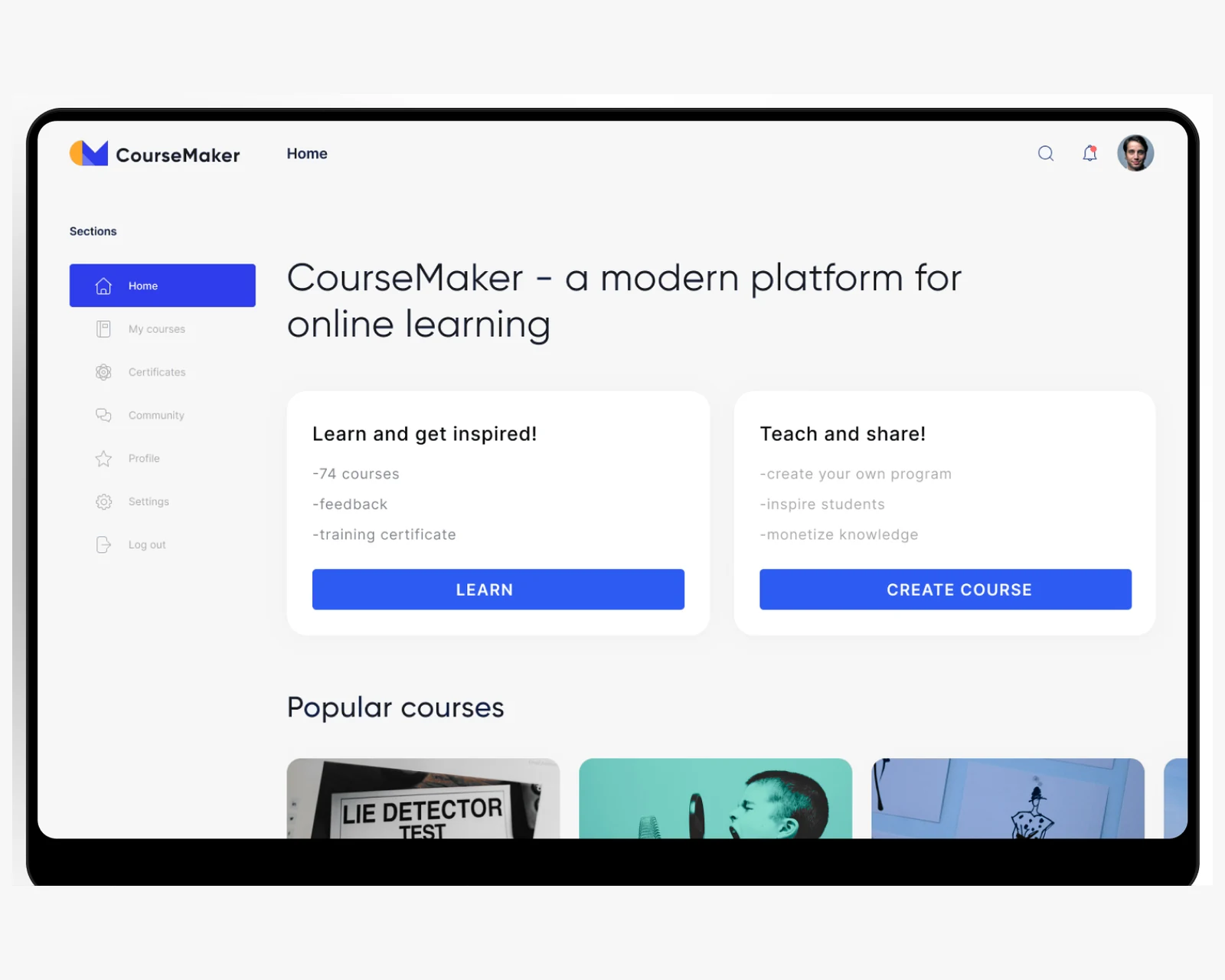
An EdTech platform for building and selling structured online courses — catalog, playback, and creator tooling across US & EU.
View case →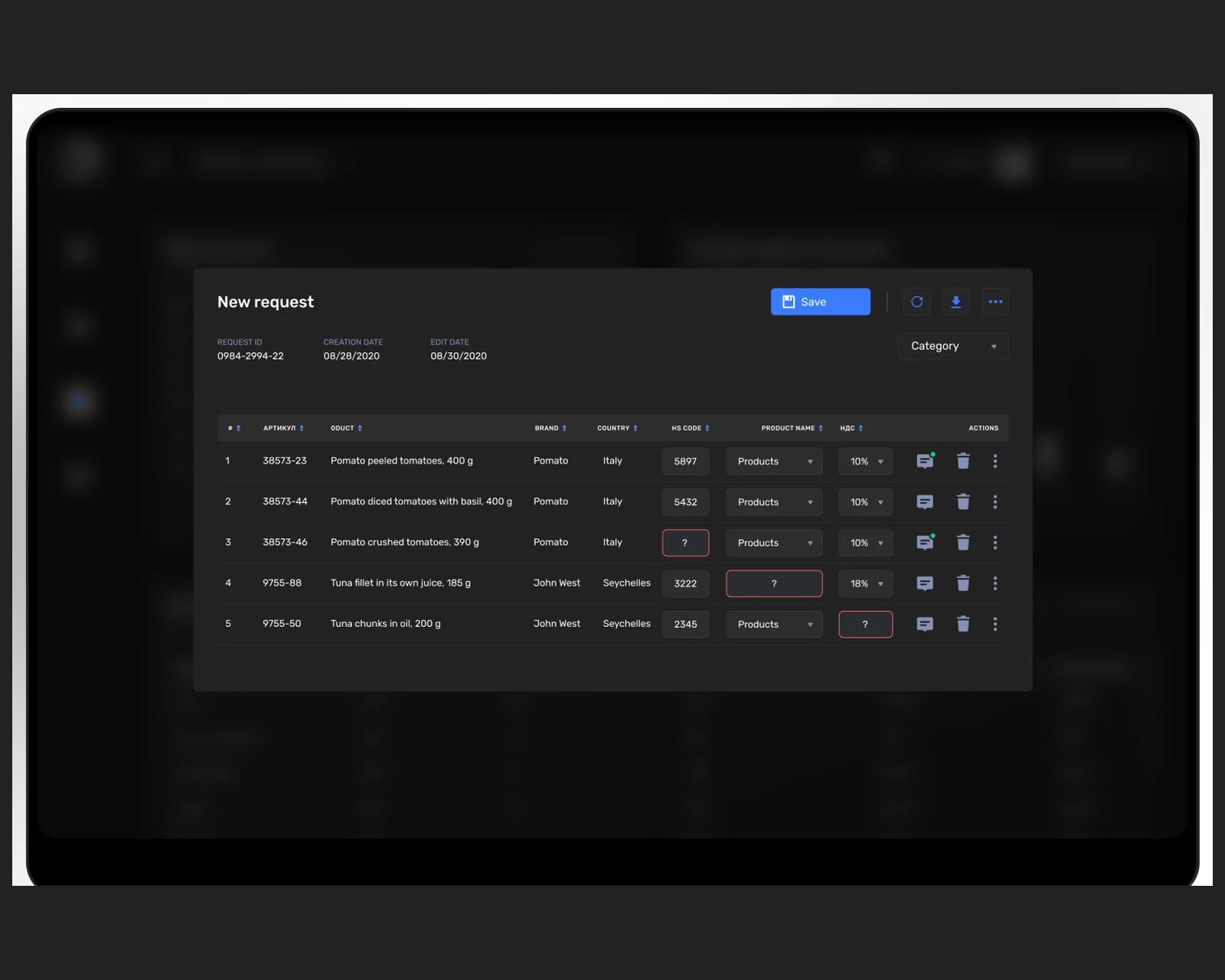
A Laravel + React training and learning portal with structured programs and role-based access for the US & EU.
View case →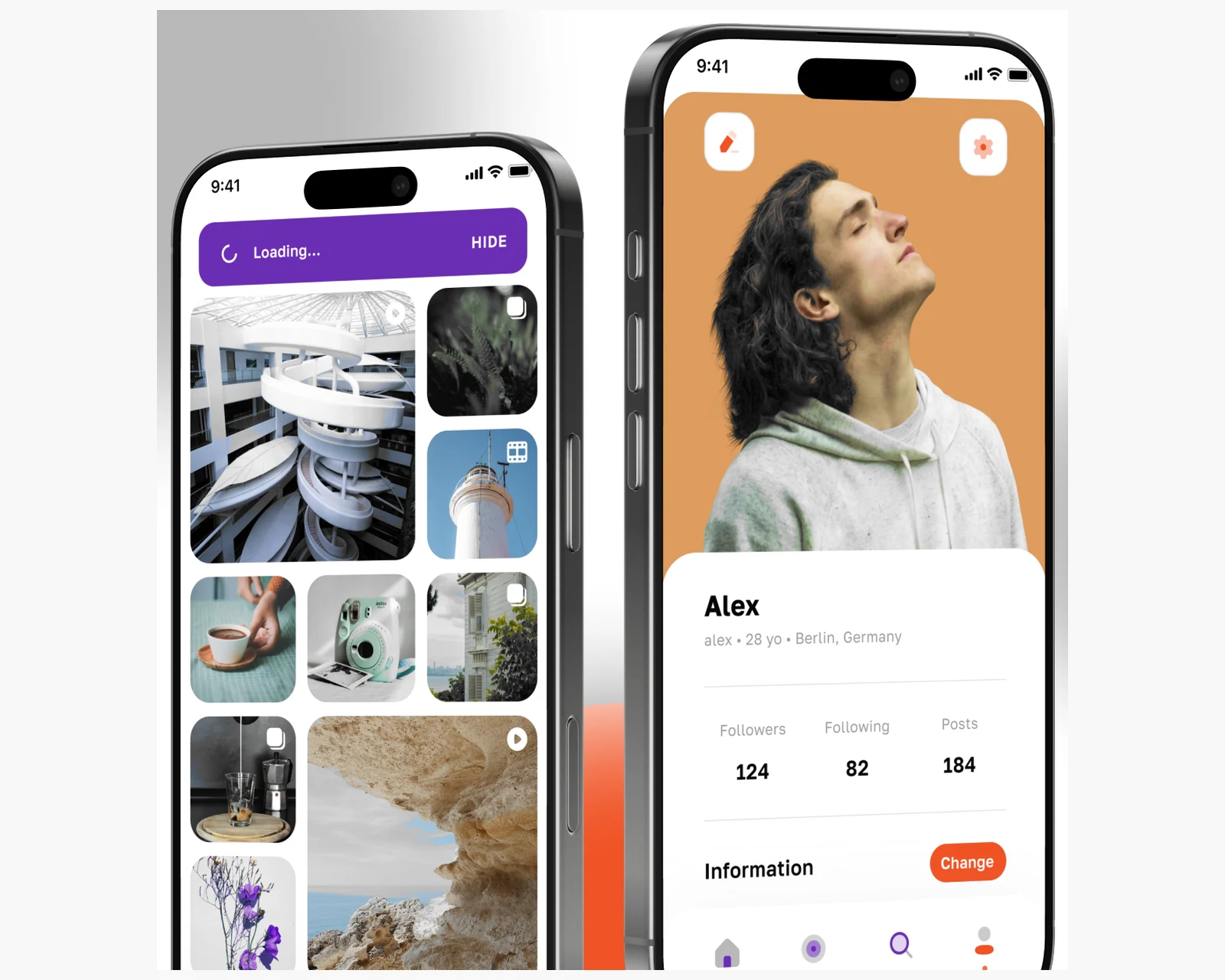
Native iOS + Android social platform with real-time chat, live discovery, and a virtual coin economy across US & EU.
View case →
Production React and Laravel web platforms engineered for real users, billing, and scale.
Learn more →
Native iOS, Android, and cross-platform apps with store-ready release pipelines.
Learn more →
Custom platforms engineered to your business model, scaling cleanly from MVP to millions of users.
Learn more →Share a few details and a senior consultant will reply within one business day.