

Transparent warehouse reporting
Picking, shipping and delivery of goods to points of sale are shown clearly and in real time.
Retail · Web platform
A web app for a large pharmacy chain that automates and syncs warehouses and points of sale, connects data collection terminals and gives top management transparent real-time BI reporting across the chain. Stack: Laravel, React.
In short: what the product is and who we built it for.
The client is a large pharmacy chain that set out to improve its internal business processes. We built a web app that automates work in warehouses and at points of sale, makes reporting transparent and lets the company manage business processes in real time.
The system brought two areas, warehouse accounting and retail stores, together around shared data: stock movement, picking, shipping and delivery to pharmacies became visible and clear, and management received reporting across the entire chain.
The chain ran warehouse operations, points of sale and reporting separately. Data on picking, shipping and delivery of goods was opaque, and management lacked a single real-time view of the whole chain.
The goal was to build a web app that automates warehouse operations, syncs them with points of sale and gives management transparent reporting, all within a tight timeframe.
How we built the product, from architecture to process.
We moved away from the traditional approach to Agile development with incremental delivery: analysis and design were done in large blocks, and the finished requirements and documentation were handed over to development quickly. The process was split into several “puzzle pieces” delivered one by one, so results came sooner and the tight deadlines were met.
Architecturally, the system is split into two areas, warehouse and points of sale, around shared data. The Laravel back end handles accounting and the integrations with terminals and the existing accounting system, while the React web interface gives management dashboards, store and warehouse operations, and real-time BI reporting.
Tools chosen to fit the product’s goals.
To automate a large retail chain with several warehouses and dozens of points of sale, off-the-shelf ERP solutions often require lengthy implementation and adaptation to the specifics of the business. A custom web system let the team implement exactly the business processes needed, including warehouse stock sync, shipment control and management reporting, with no unnecessary modules and no compromises with a vendor.
The Agile approach with incremental delivery of “puzzle pieces” let the client see working parts of the system during development rather than wait for the final release. Adapting an existing platform was considered, but it lost out on flexibility and on the time needed to customize it for the chain’s warehouse logistics.
Key capabilities that solved the business problem.
Picking, shipping and delivery of goods to points of sale are shown clearly and in real time.
Work with data collection devices for scanning goods is automated and connected to the system.
Warehouse accounting is linked with points of sale, so stock and its movement are visible across the chain.
Management metrics are shown in dashboards for top management: sales, margin and trends.
Access to sections and data is restricted by employee role and management level.
Data between the warehouse, points of sale and the accounting system travels over a secure channel.
Key product screens, step by step.
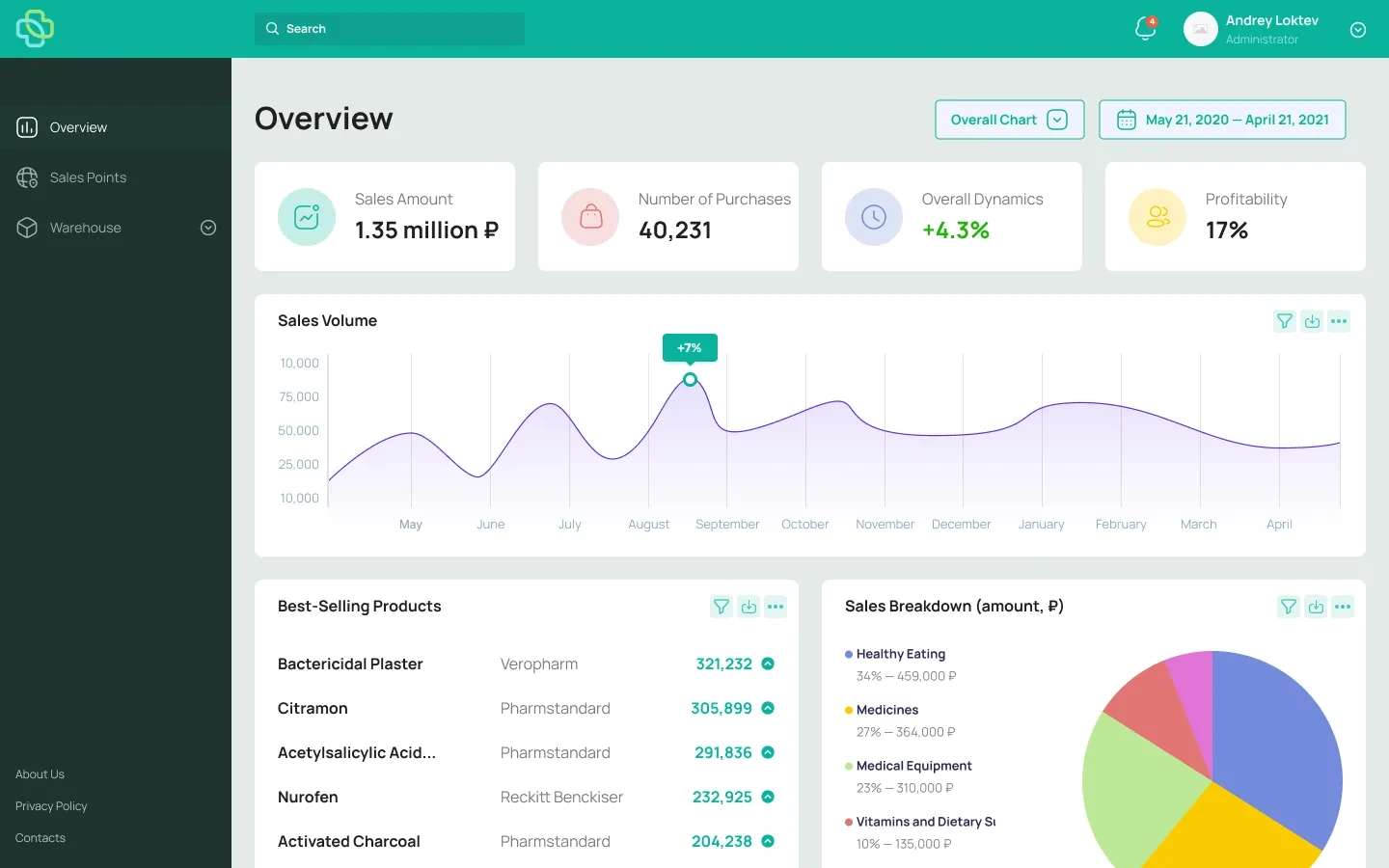
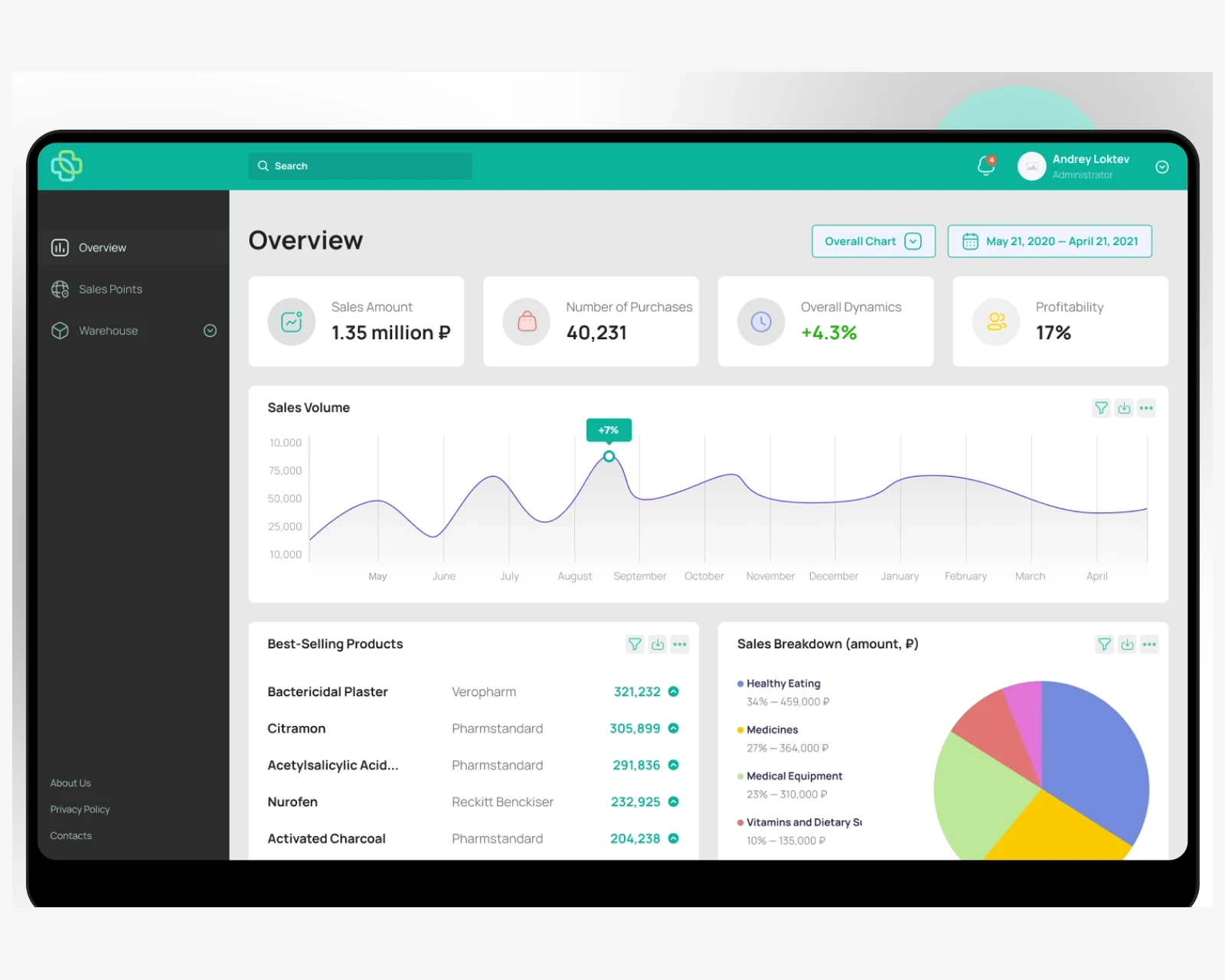
The main screen opens with the Overview section and the chain’s key metrics: total sales, number of purchases, overall trend and margin are shown in cards at the top.
Below are a monthly sales volume chart with growth markers, the top-selling products with manufacturer and amount, and a pie chart of sales by category: healthy food, medicines, medical equipment, vitamins and dietary supplements.
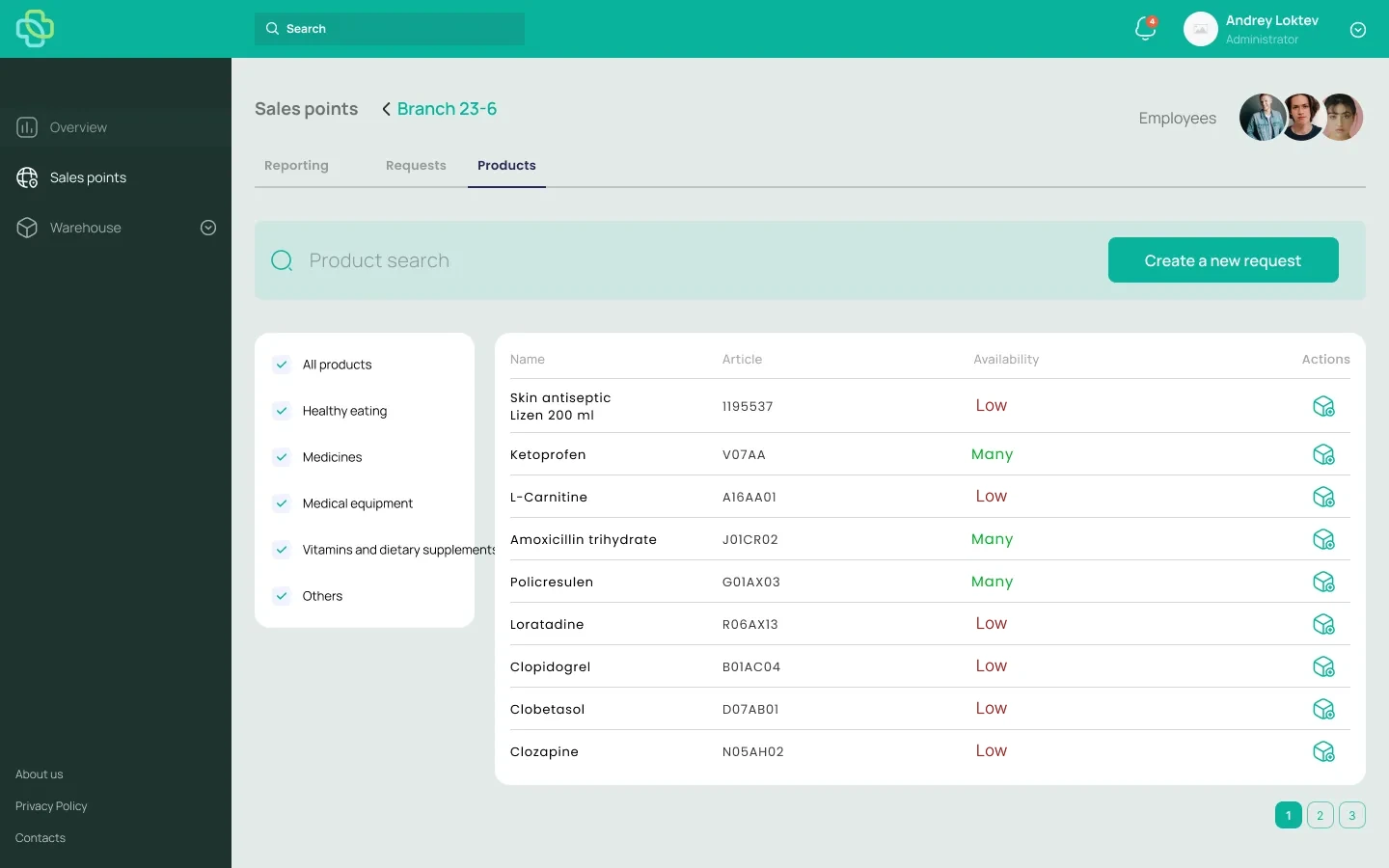
In a branch card (for example, “Branch 23-6”), the Products tab shows staff the product range with name, SKU and availability. The “Plenty” and “Low” statuses are color-coded so shortages are spotted immediately.
On the left is a product category filter, at the top a search and a “Create new request” button. From here the store orders restocking from the warehouse, and the staff assigned to the branch are shown at the top.
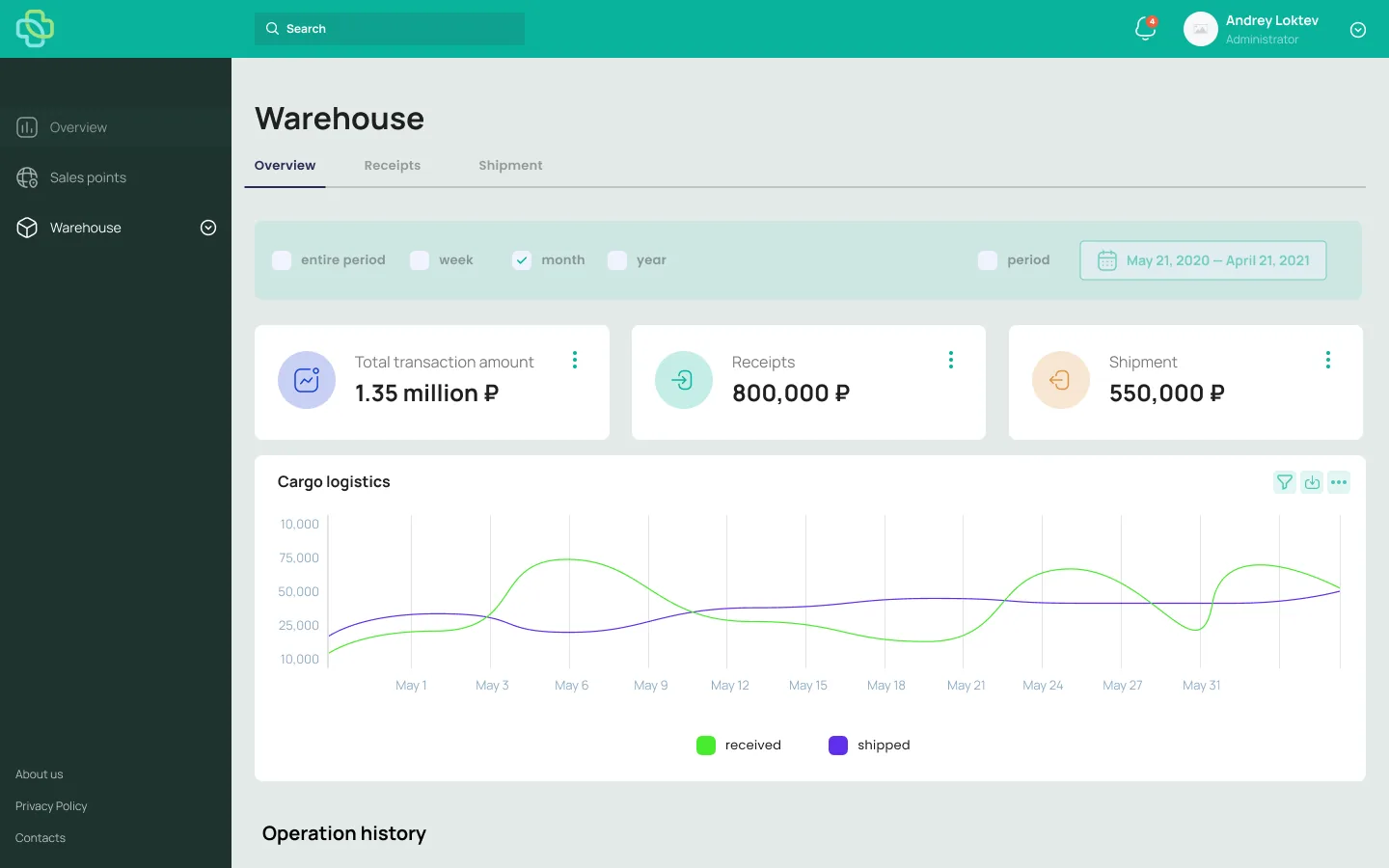
The Warehouse section, with Overview, Inbound and Shipments tabs, shows the total value of transactions, inbound deliveries and shipments for the selected period: week, month, year or a custom range.
The “Cargo logistics” chart compares two curves, received and shipped, by day, with the operation history below. This shows the balance of stock movement between the warehouse and points of sale.
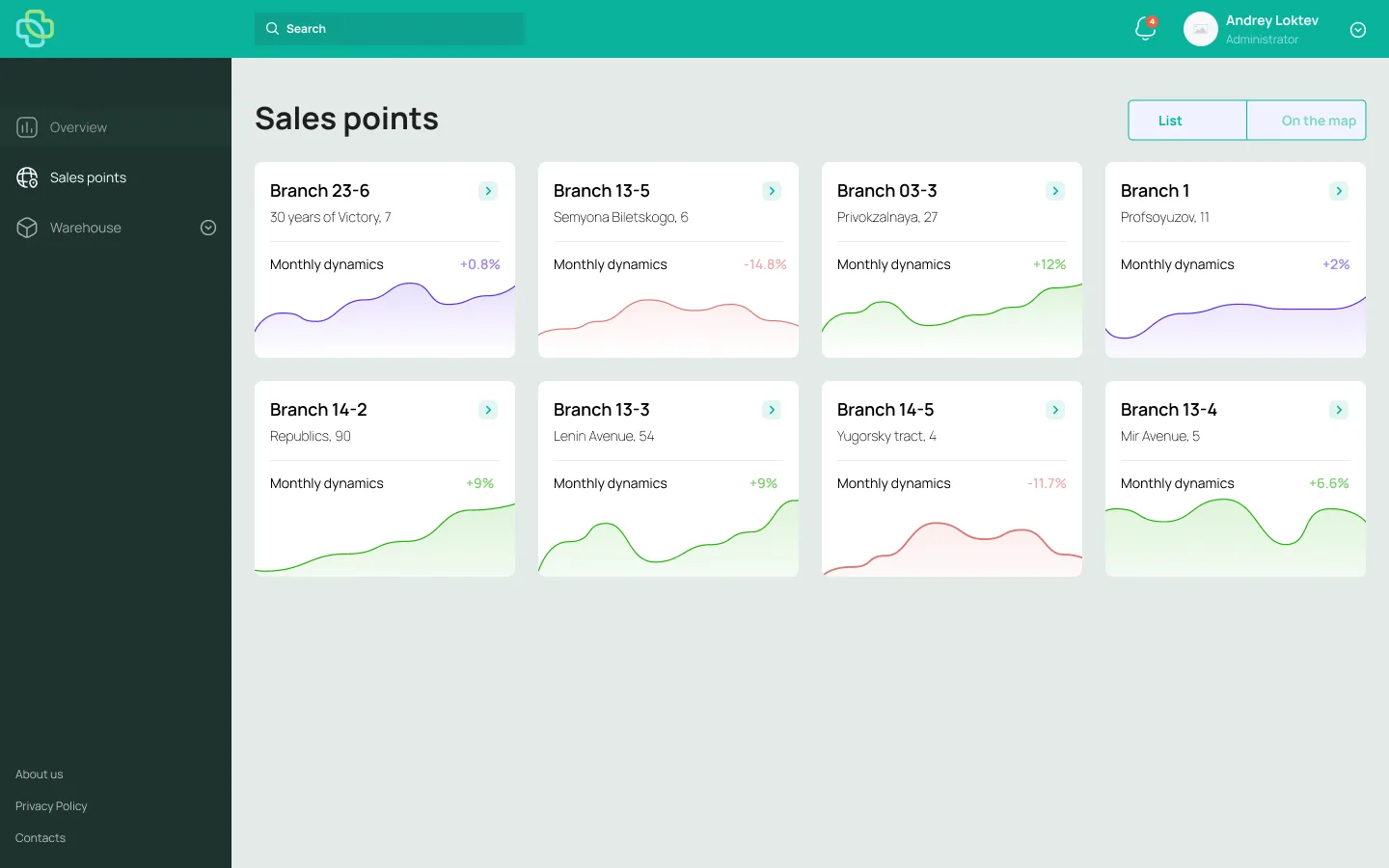
The Points of sale section shows every branch in the chain as a card with its address and monthly sales trend, a mini chart and percentage change, as a list or on a map.
Clicking a branch opens its reporting: a sales volume chart for the period, “Plan completion” and “Compare” toggles and a link to full reporting, so management can analyze each store and compare them with one another.
The system processes employees’ operational data and the chain’s transactional and business data, so information security requirements are addressed at the architecture level.
Access to sections and data is restricted by role, and data between the warehouse, points of sale and the accounting system travels over a secure channel.
Employee and customer data is processed under the requirements of the client’s jurisdiction and stored on locally hosted servers, with role-restricted access.
10 months from the start of development to the successful launch of the system into operation.
2 automation areas in one system: warehouse operations and points of sale.
Agile development in large blocks made it possible to meet the client’s tight deadlines.
Management reporting became transparent, with real-time data on picking, shipping and delivery.
The team continues to support the project after launch.
The typical delivery window for an MVP of this class is 8–14 months (an industry range, not a guarantee).
The cost depends on the number of warehouses and points of sale, reporting requirements and integrations. A system of this class falls within the standard range for custom B2B development; we give an exact estimate after discovery, once the business processes and system boundaries are defined.
With a hard deadline, Agile lets you deliver working parts of the system as they are ready instead of waiting a year for the final release. The client sees progress, can adjust priorities and put the system into operation in stages, reducing risk and getting results sooner.
Data on picking, shipping and delivery of goods is transmitted in real time over a secure API channel. Warehouse stock is updated with every operation, so management sees the current picture without manual reconciliations or delayed reports.
The system restricts access by role, uses a secure data channel and minimizes storage of unnecessary information. Data is processed under the requirements of the client’s jurisdiction, and the specific setup is agreed with the client at the design stage.
The team continues to support the system after launch. The scope depends on the number of users, how often business processes change and SLA requirements. It is usually a monthly or quarterly contract with a fixed pool of hours and incident response by priority.
Companies from retail, medtech, logistics and e-commerce that we helped build digital products.












The full spectrum of development — from native mobile apps to web platforms, AI and cloud. Pick a direction or order a turnkey project.
Native iOS & Android plus cross-platform Flutter and React Native — from MVPs to apps with millions of installs.
Learn moreNative Swift / SwiftUI iOS apps — with Apple Pay, Sign in with Apple, App Store Connect deployment pipelines.
Learn moreNative Kotlin / Jetpack Compose Android apps — Material 3, Google Play release pipelines, Firebase integration.
Learn moreSingle Dart codebase across iOS, Android, web and desktop — with native modules where needed.
Learn moreProduction web apps on React, Next.js, Vue and Node — SaaS dashboards, B2B portals, marketing-conversion stacks.
Learn moreREST, GraphQL and gRPC APIs — designed for partners, mobile clients and internal microservices.
Learn moreBespoke platforms for mid-market and enterprise teams — internal tools, vertical SaaS, mission-critical backends. Discovery to launch in 12–36 weeks.
Learn moreFocused MVPs in 12–20 weeks — one or two integrations, real users on day one, telemetry built-in.
Learn moreEnd-to-end ownership of a digital product — design, build, ship and continuous evolution.
Learn moreTool-using agents that plan, retrieve, act and self-evaluate — in customer service, ops automation, internal copilots.
Learn moreAWS, Azure and GCP architecture, Kubernetes, Terraform/Pulumi, CI/CD and observability — SRE-grade operations for product teams.
Learn moreTechnical SEO, Core Web Vitals, structured data, internal-link architecture — built into your engineering process.
Learn moreRelated cases
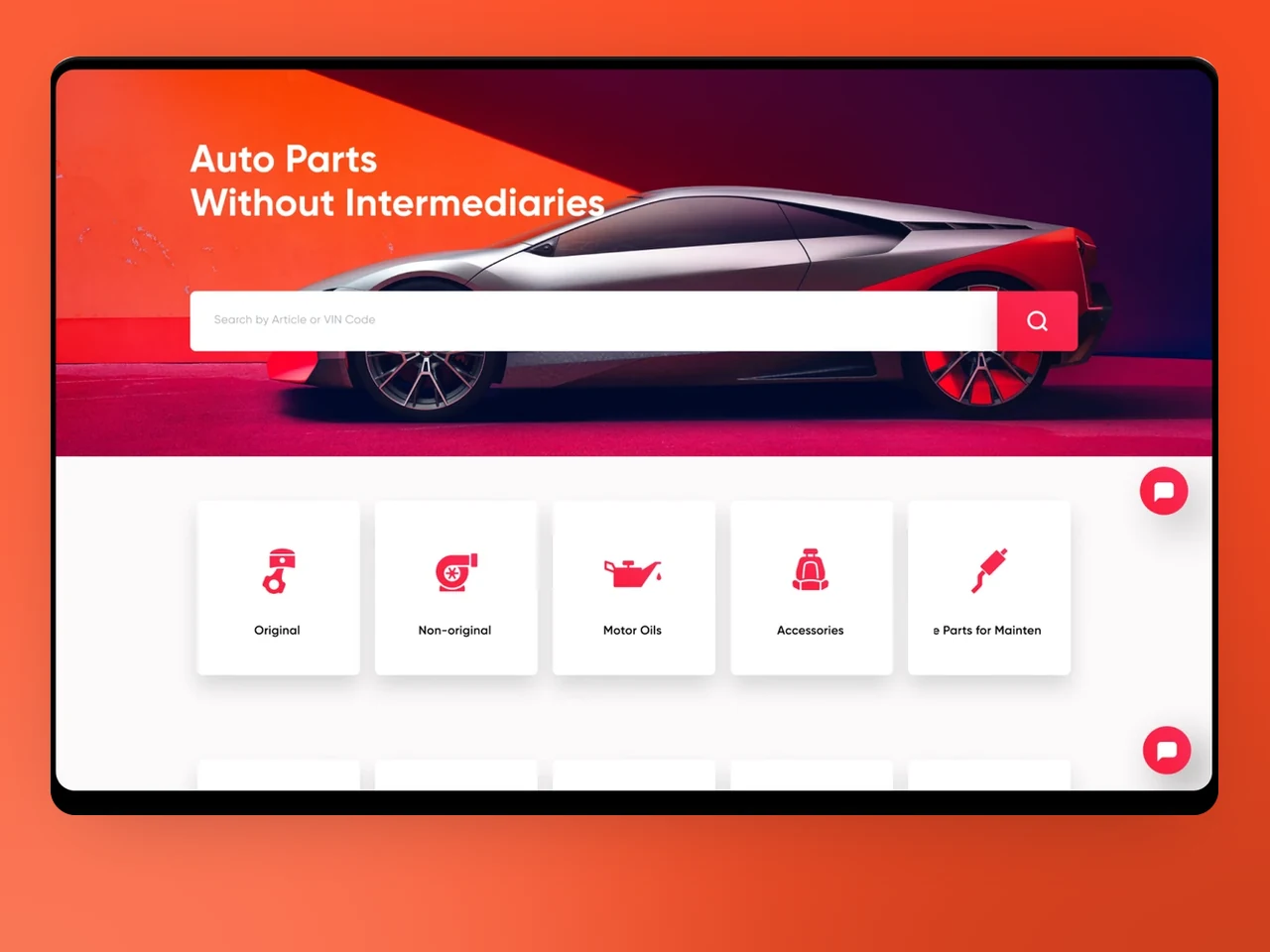
Laravel + React auto-parts storefront with real-time 1C ERP inventory sync — fitment search, card payments, personal account, US & EU launch.
View case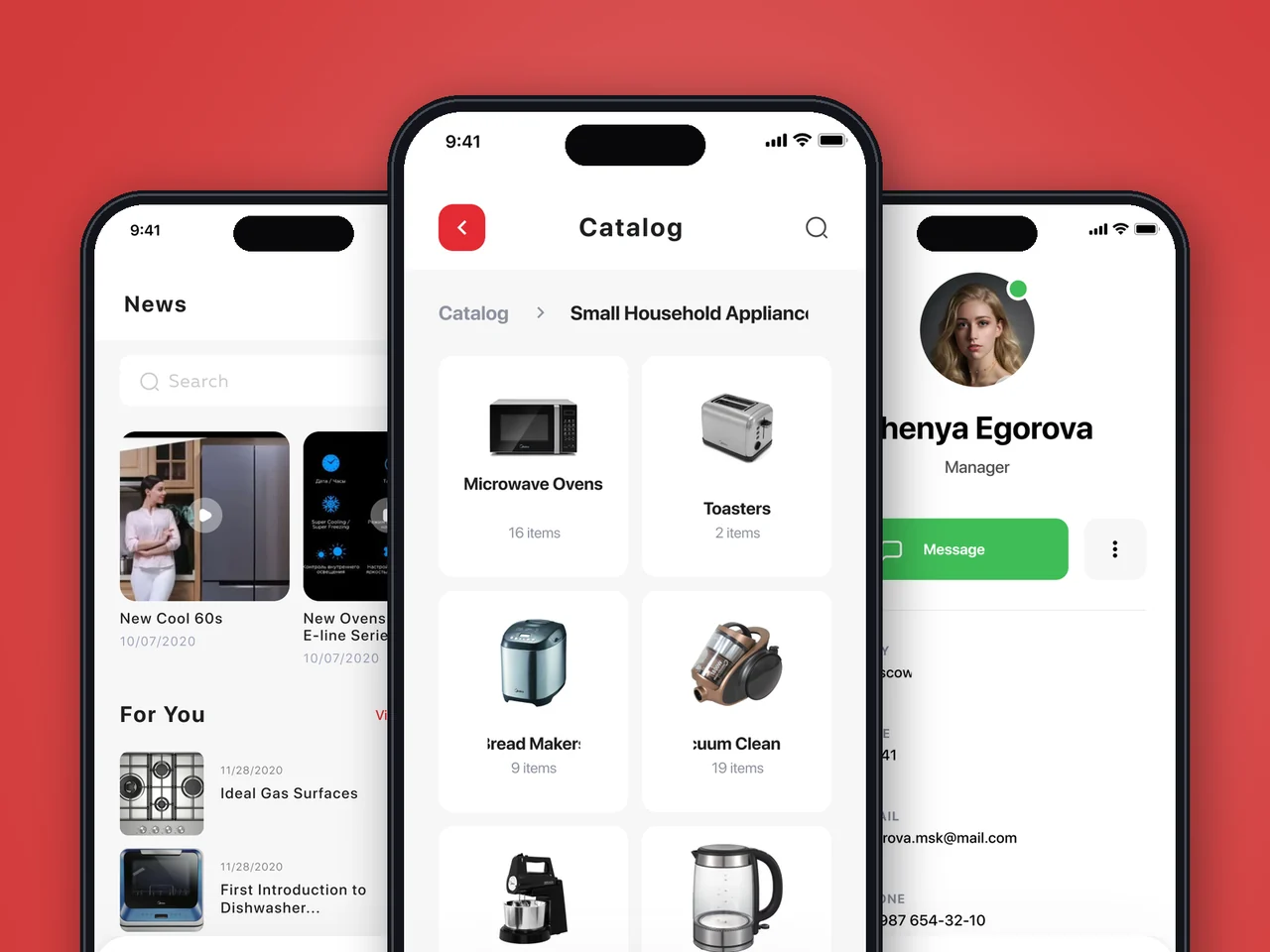
Gamified iOS & Android staff-training and product-catalog app — certificates, points, and ranks for a nationwide appliance chain, US & EU ready.
View case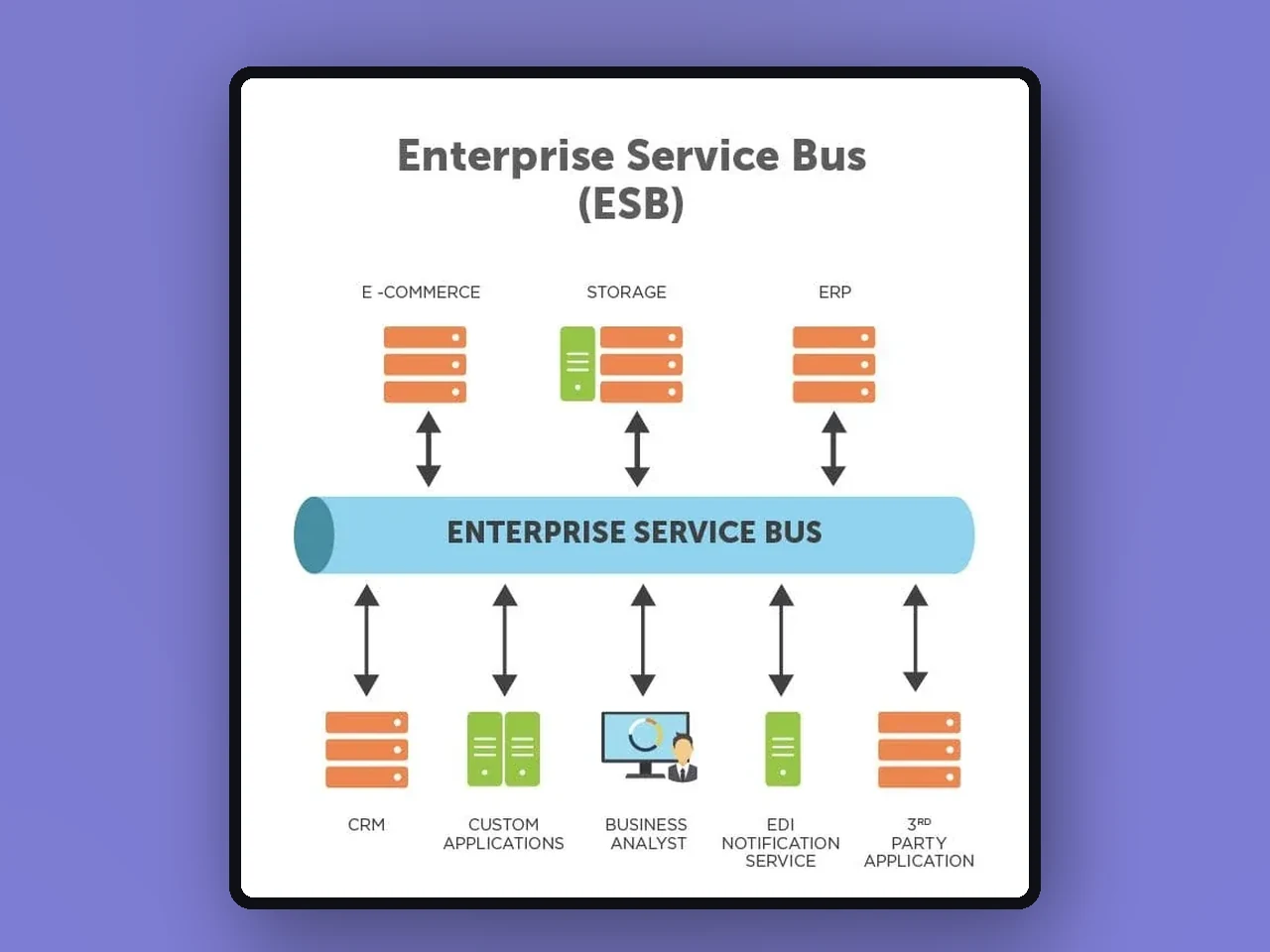
A custom ESB for a large online store: multithreaded sync of heterogeneous databases, load-control admin panel and 10x faster data exchange.
View case20 articles across 5 categories — engineering-led guides on AI, SaaS, MVP, compliance and mobile for US and EU product teams.

Performance-tested comparison of RN (New Architecture) and Flutter (Impeller) across hiring, time-to-market and EU/US compliance.
Read article
Real cost ranges by region (US onshore, Western EU, EU nearshore), team and feature scope. With a worked fintech example.
Read article
Data-driven framework for choosing iOS-first or Android-first in 2026 — US & EU market share, ARPU, review timelines, EU DMA.
Read articleTell us how your warehouses, stores and reporting work today, and we will help you bring them into one transparent system. Let’s discuss how a similar solution could work for your business.
Share a few details and a senior consultant will reply within one business day.
Email: sales@yusmpgroup.com
Phone: +374 44 871 811
Offices: KAMAR Business Center, Vazgen Sargsyan St. 2, Yerevan, Armenia · Remote — East-Coast US overlap (9 AM–1 PM ET)