Real-time order status
Tracking of production stages with statuses from the accounting system
Manufacturing · iOS + Android + web
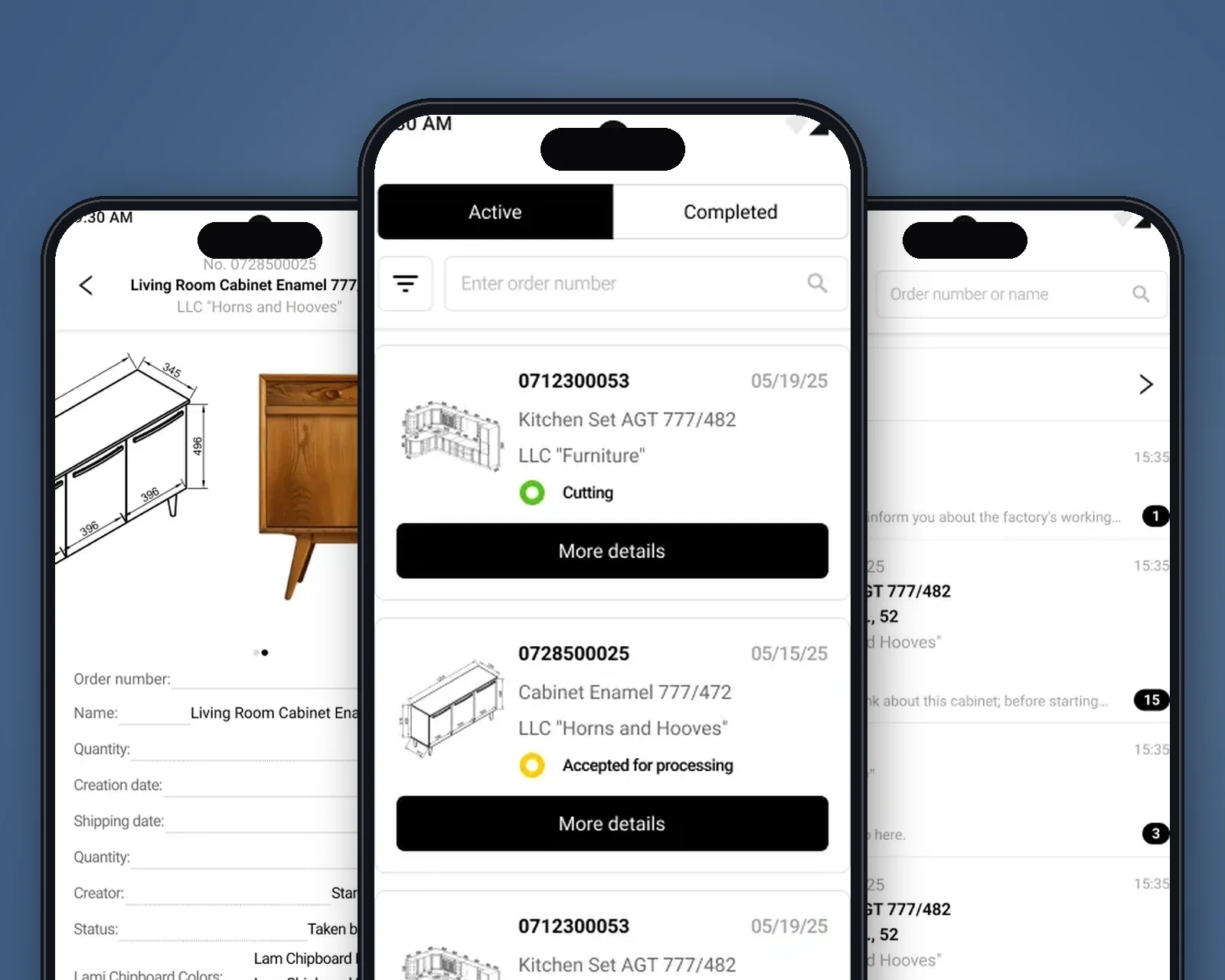
A unified ecosystem that connects iOS and Android apps with a web admin panel. It tracks each order through its lifecycle, from production status to communication with partners and team management, and runs on the client’s own servers. Stack: PHP (Laravel), React, Flutter, two-way 1C integration.
In short: what the product is and who we built it for.
The client is a large nationwide furniture manufacturer with several production sites, its own logistics and a sales department. As order volumes grew, the company faced a heavy operational load: partners and customers kept calling to check the status of their items, and coordination between production, logistics and sales relied on scattered messengers and phone calls.
We built StartApp from scratch as a unified ecosystem of iOS and Android apps and a web admin panel. The product follows each order through its full lifecycle, from being put into work and panel cutting to shipment, and moves communication into an asynchronous, transparent format inside one corporate platform.
The manufacturer needed to make order status transparent without calls to production, set up a direct communication channel with partners and centralize its employee and customer database. The key goal was to reduce the load on the call center by moving communication to an asynchronous format.
A separate requirement was deployment on the client’s own servers (on-premise) with integration into the existing 1C accounting system, access from different devices and closed communication circles for the participants of each order.
How we built the product, from architecture to process.
The iOS and Android clients are built with Flutter: a single codebase speeds up development and keeps both platforms updated in sync under a strict deadline. The web admin panel is built in React, and the back end and API in PHP (Laravel), which holds accounts, roles, orders, messages and the 1C integration logic.
Development took 10 months across three platforms. The core is the two-way 1C integration: order statuses and production parameters (laminated chipboard colors, footage, creation and shipment dates) come from the accounting system, and user actions flow back. Communication moved from scattered messengers into closed order chats with a single history.
Tools chosen to fit the product’s goals.
 Laravel (PHP)Back end, API, roles, 1C integration
 ReactWeb admin panel
 FlutterCross-platform iOS and Android app
For the mobile part the team chose a cross-platform approach with Flutter: a single codebase for iOS and Android cuts development time and support costs, and simultaneous releases on both platforms matter when dozens of partner employees use the app at the same time. The React web panel covers admin scenarios that need a big screen: tables, filters and role management.
On-premise deployment was a business requirement: the system runs on the client’s servers, so order and partner data and all correspondence stay inside the company’s perimeter. It also simplified integration with the 1C system already in use, since the exchange happens within controlled infrastructure without moving sensitive data outside.
Key capabilities that solved the business problem.
Tracking of production stages with statuses from the accounting system
Closed communication circles with partners and a single message history
Drawing, photos, number, dates, laminated chipboard colors and footage on one screen
Management of partners, employees, roles, orders and news
Centralized storage with filters by status, company and dates
Two-way data exchange with the existing accounting system
Key product screens, step by step.
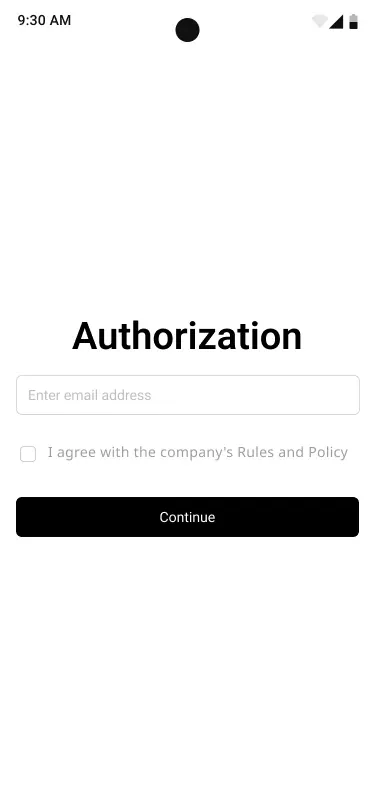
The app opens with a simple sign-in screen: a partner employee enters an email address and accepts the company’s Terms and Policy.
Minimal fields at the entrance mean that someone on the shop floor or in sales reaches their orders in a couple of taps, without complicated registration.
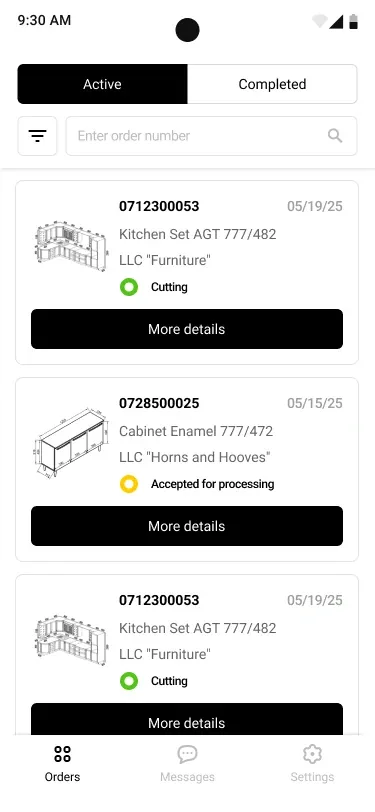
The home screen is a list of orders with Active and Completed tabs and search by number. Each card shows an item thumbnail, order number, date, partner company and a colored status such as “Cutting”, “Accepted for work” and others.
The bottom navigation splits the app into Orders, Messages and Settings, so users always know where they are.
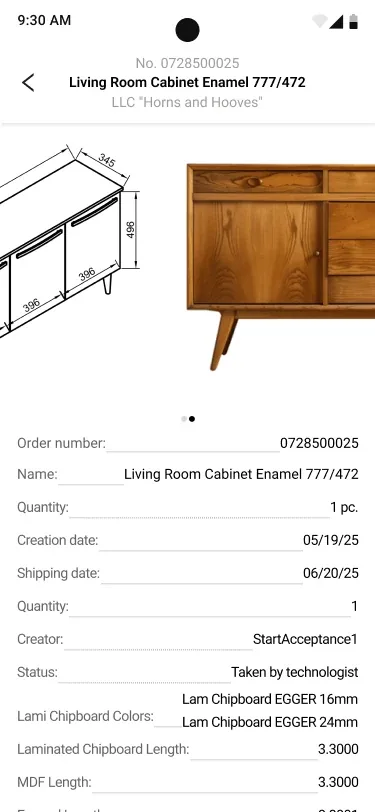
The order screen gathers everything production needs: the drawing and photo of the item, number and name, quantity, creation and shipment dates, creator and current status (“Taken by technologist”).
Below are the production parameters: laminated chipboard colors and chipboard and MDF footage. The data comes from the accounting system, so the card always matches what the back office sees.
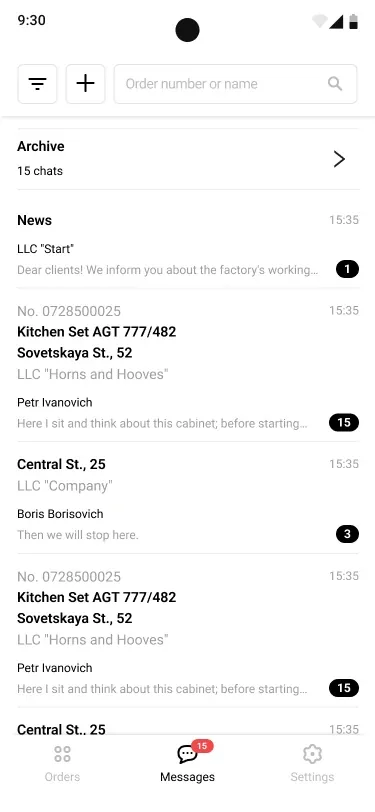
The Messages section is a chat feed: archive, company news and conversations tied to a specific order and delivery address. Each chat shows the last message, time and an unread counter.
Communication no longer spreads across personal messengers: the entire order history is kept in one place and available to the right participants.
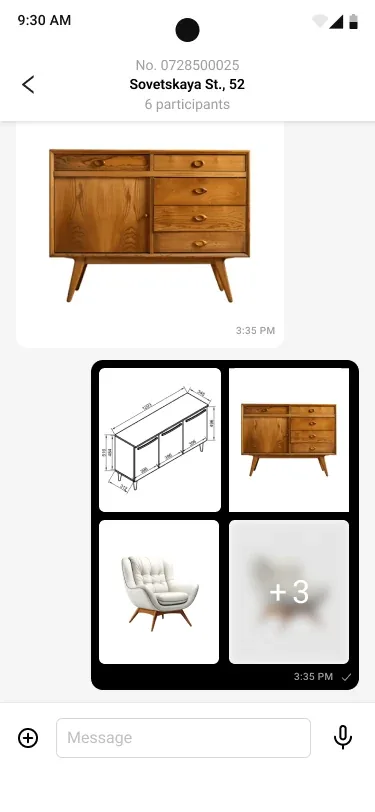
Inside an order chat, participants discuss details and share attachments: item photos, drawings, samples. The gallery collapses extra images into a “+3” tile, and the input field supports text and voice messages.
The chat header shows the order number, address and number of participants, so it is clear who is in the conversation.
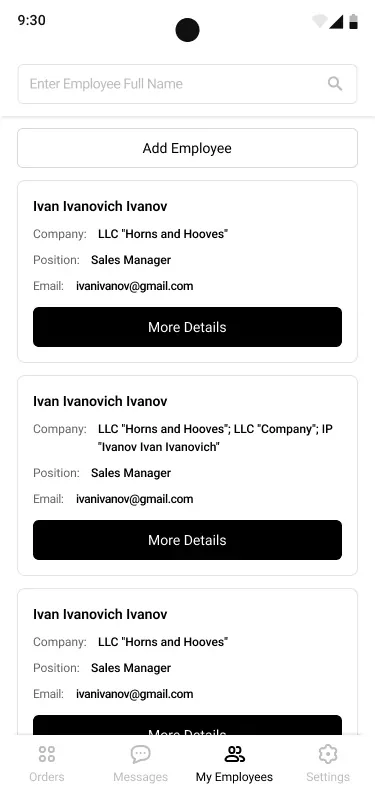
The My employees section helps a partner manage its team: search by full name, adding an employee and cards with company, position and email. One employee can be linked to several legal entities at once.
A centralized database removes confusion about who is responsible for which order and speeds up onboarding new people.
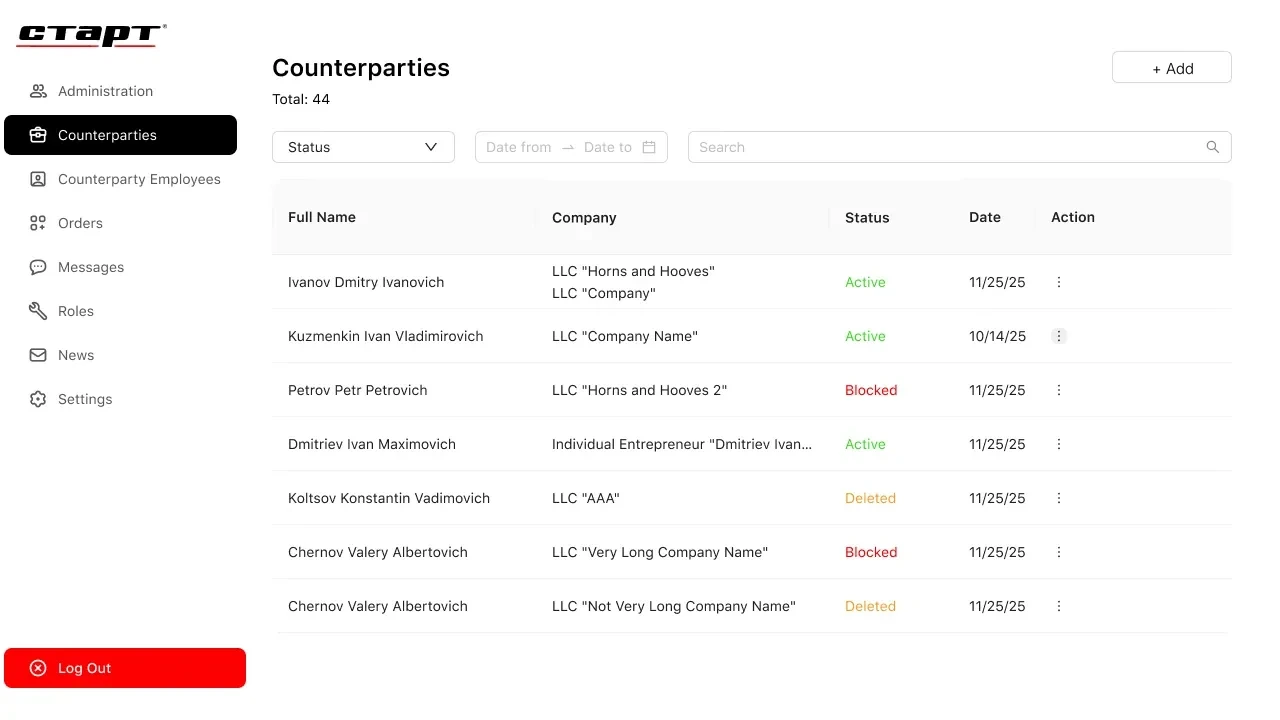
The React admin side gives the back office a big screen for routine work. The Partners section is a table of all companies with filters by status and date and search; the Active, Blocked and Deleted statuses are color-coded.
On the left is navigation across every module of the system: administration, partners, employees, orders, messages, roles and news.
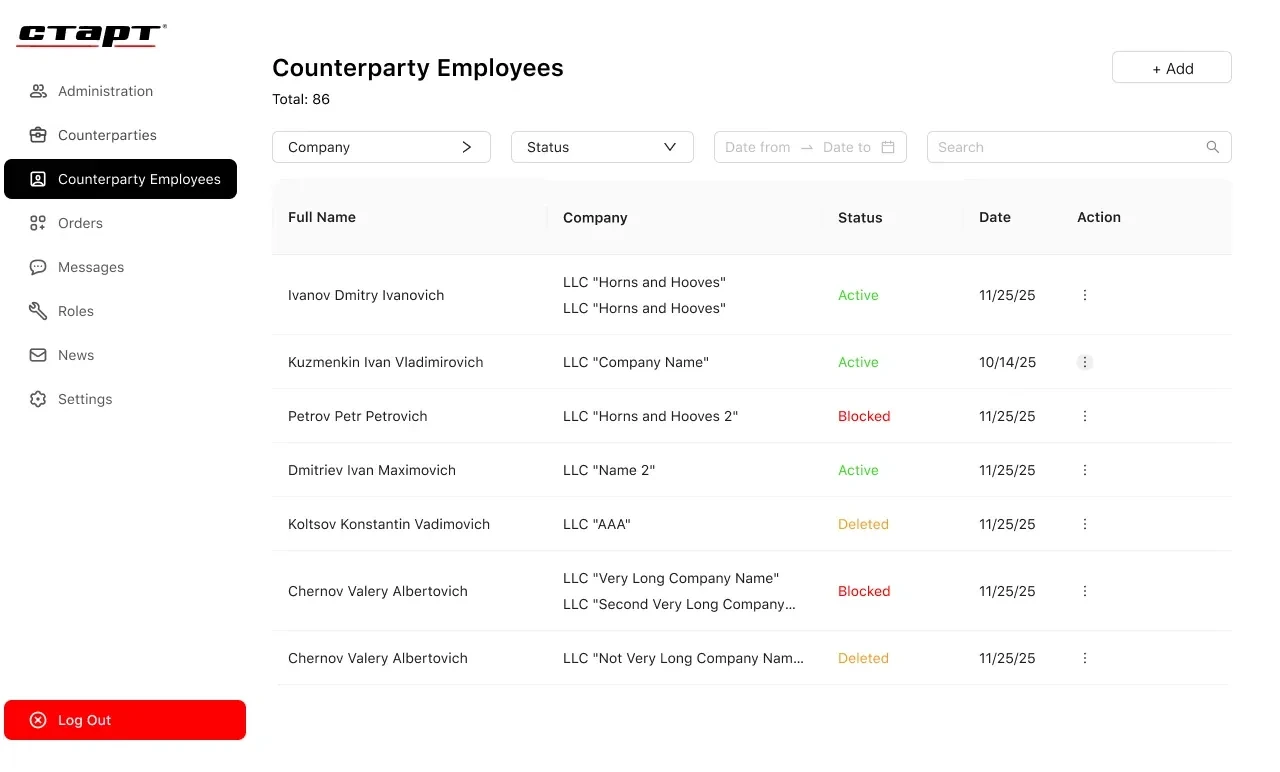
The Partner employees section is a table of people across all companies with filters by company and status. The roles module controls access rights, and the dashboard gathers performance metrics in one place.
The administrator manages the whole ecosystem from a browser, while the mobile apps stay light and focused on orders and communication.
The system is deployed on the client’s own servers: order, partner and employee data and all correspondence stay inside the company’s perimeter and are not sent to external services. The two-way exchange with 1C runs within controlled infrastructure.
Personal data is processed under the requirements of the client’s jurisdiction: sign-in before any data access, access rights managed through the roles module and minimal data storage.
The architecture is built around the Laravel back end, which stores orders, partners, employees, roles and messages, serves the API for the mobile clients and web panel and handles the exchange with 1C. The Flutter apps and React admin panel run on the same API, so data is always consistent across devices.
This foundation leaves room to grow: push notifications on status changes, analytics on production lead times and site workload, an expanded role model and additional integrations can all be added on the existing server base without rewriting the system.
3 platforms in one ecosystem: iOS and Android apps plus a web admin panel.
Transparent real-time order status: statuses come from the accounting system, so there is no need to call production.
Two-way 1C integration: order parameters and statuses sync automatically.
On-premise: the system runs on the client’s servers, and data does not leave the perimeter.
−30% status calls to the call center based on the pilot launch.
Response times to partner requests improved after communication moved from scattered messengers to a single platform.
The cost depends on the number of platforms (mobile apps and/or web panel), the depth of integration with the accounting system (1C, ERP), the role model and deployment requirements. For an ecosystem like StartApp, with Flutter mobile apps, a React admin panel, a Laravel back end and two-way 1C integration, we give an estimate after discovery, once the scenarios and integration scope are defined.
Different roles work differently. Production staff and partners are better served by a mobile app with order status, the item card and chats always at hand. The back office needs a big screen for tables, filters, role management and metrics, which the React web panel covers. Both clients run on the same API, so data stays consistent.
The integration is two-way: order statuses and production parameters (laminated chipboard colors, footage, creation and shipment dates) come from 1C into the app, and user actions flow back. The exchange runs inside the client’s controlled infrastructure, since the system is deployed on-premise.
The system is deployed on the client’s own servers (on-premise): order and partner data and correspondence stay inside the company’s perimeter. Personal data is processed under the requirements of the client’s jurisdiction, with sign-in, role-based access rights and minimal data storage.
StartApp took about 10 months to build across three platforms (iOS, Android, web) with 1C integration. The timeline depends on the number of modules, the complexity of the role model and the depth of integration with the accounting system. We fix exact timelines after discovery.
Companies from retail, medtech, logistics and e-commerce that we helped build digital products.


The full spectrum of development — from native mobile apps to web platforms, AI and cloud. Pick a direction or order a turnkey project.
Native iOS & Android plus cross-platform Flutter and React Native — from MVPs to apps with millions of installs.
Learn moreNative Swift / SwiftUI iOS apps — with Apple Pay, Sign in with Apple, App Store Connect deployment pipelines.
Learn moreNative Kotlin / Jetpack Compose Android apps — Material 3, Google Play release pipelines, Firebase integration.
Learn moreSingle Dart codebase across iOS, Android, web and desktop — with native modules where needed.
Learn moreProduction web apps on React, Next.js, Vue and Node — SaaS dashboards, B2B portals, marketing-conversion stacks.
Learn moreREST, GraphQL and gRPC APIs — designed for partners, mobile clients and internal microservices.
Learn moreBespoke platforms for mid-market and enterprise teams — internal tools, vertical SaaS, mission-critical backends. Discovery to launch in 12–36 weeks.
Learn moreFocused MVPs in 12–20 weeks — one or two integrations, real users on day one, telemetry built-in.
Learn moreEnd-to-end ownership of a digital product — design, build, ship and continuous evolution.
Learn moreTool-using agents that plan, retrieve, act and self-evaluate — in customer service, ops automation, internal copilots.
Learn moreAWS, Azure and GCP architecture, Kubernetes, Terraform/Pulumi, CI/CD and observability — SRE-grade operations for product teams.
Learn moreTechnical SEO, Core Web Vitals, structured data, internal-link architecture — built into your engineering process.
Learn moreRelated cases
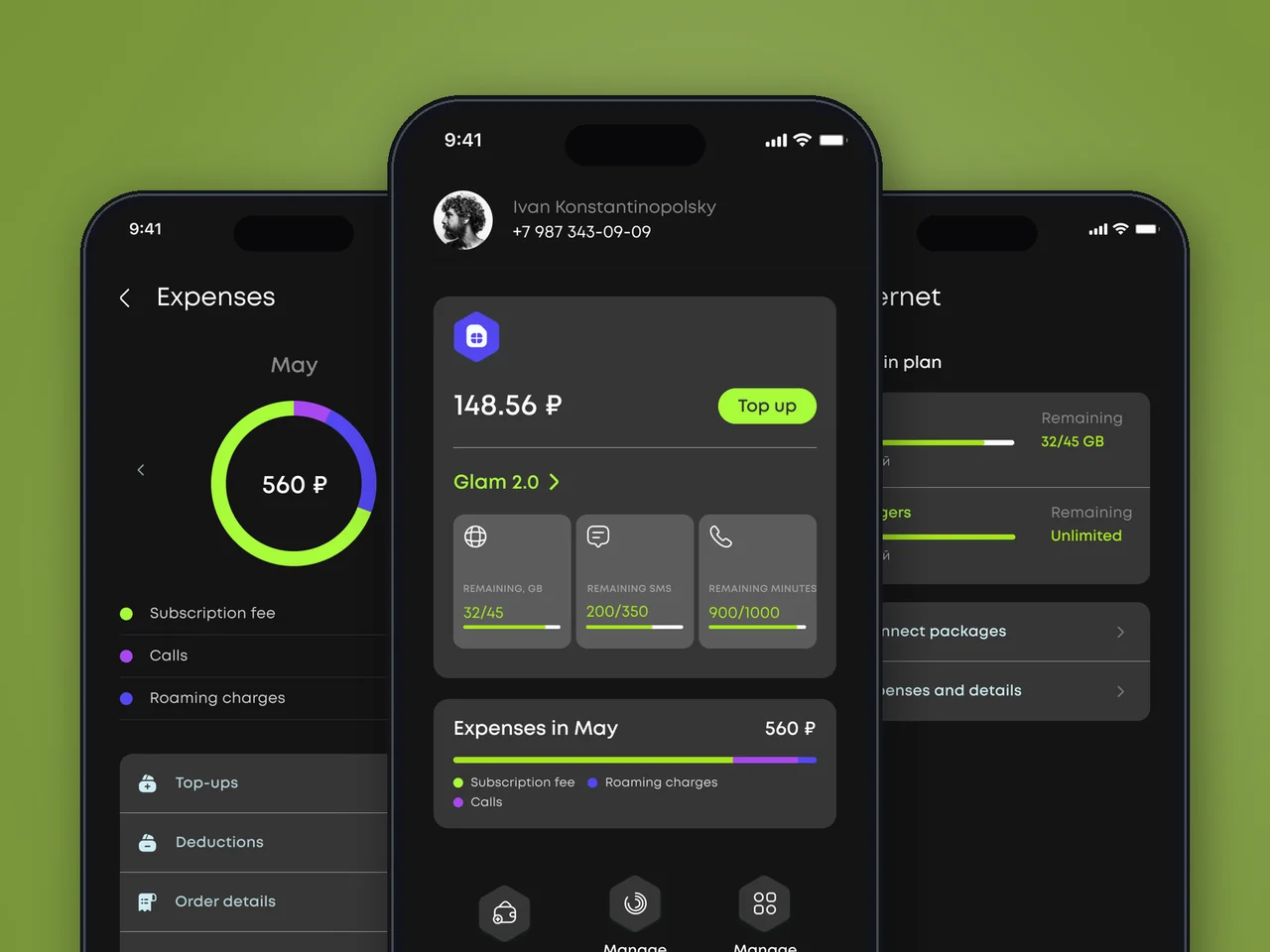
Native iOS + Android self-service for a telecom operator — tariff picker, Apple Pay / Google Pay billing, in-app support chat, US & EU storefronts.
View case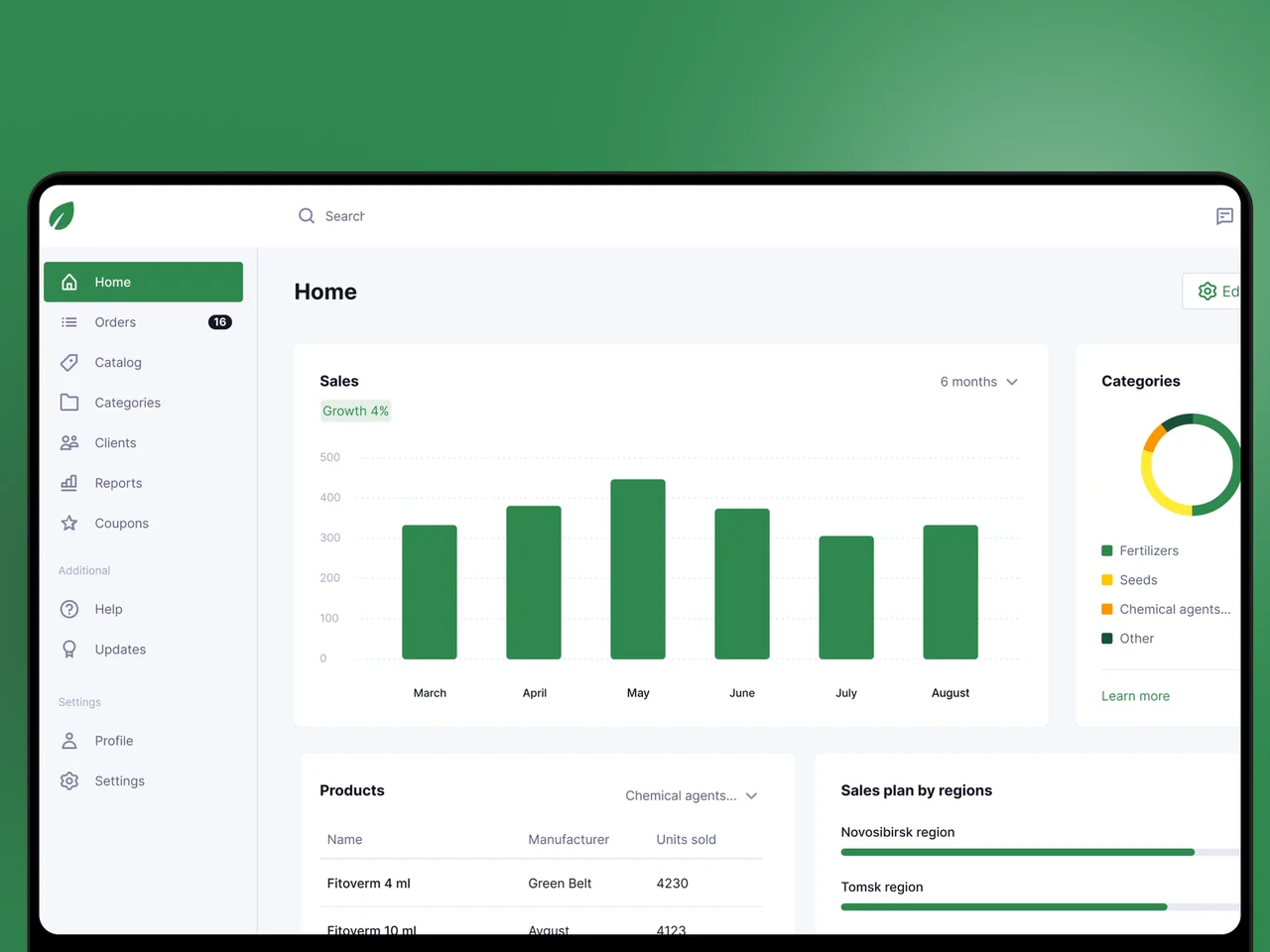
Offline-first iOS & Android field-sales app for an agricultural distributor — structured catalog, deal reporting, plan vs actual.
View case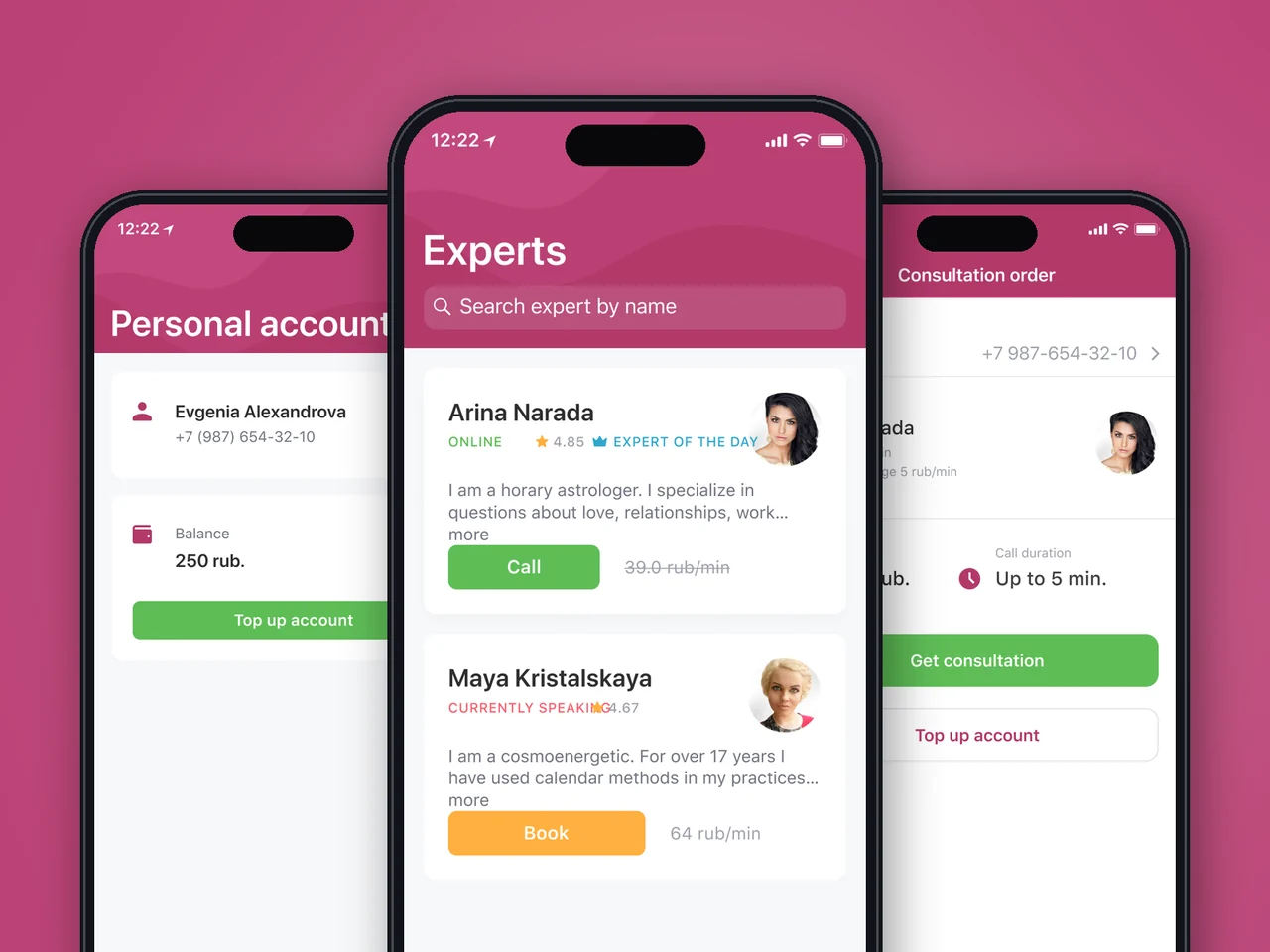
Flutter Android app mirroring a web consultation service: expert catalog, instant callback, per-minute billing and wallet. Released on Google Play in 3 months.
View case20 articles across 5 categories — engineering-led guides on AI, SaaS, MVP, compliance and mobile for US and EU product teams.

Performance-tested comparison of RN (New Architecture) and Flutter (Impeller) across hiring, time-to-market and EU/US compliance.
Read article
Real cost ranges by region (US onshore, Western EU, EU nearshore), team and feature scope. With a worked fintech example.
Read article
Data-driven framework for choosing iOS-first or Android-first in 2026 — US & EU market share, ARPU, review timelines, EU DMA.
Read articleTell us how your production, sales and partners communicate today, and we will help you bring it all into one transparent platform. Let’s discuss how a similar solution could work for your business.
Share a few details and a senior consultant will reply within one business day.
Email: sales@yusmpgroup.com
Phone: +374 44 871 811
Offices: KAMAR Business Center, Vazgen Sargsyan St. 2, Yerevan, Armenia · Remote — East-Coast US overlap (9 AM–1 PM ET)